Cockburn Response
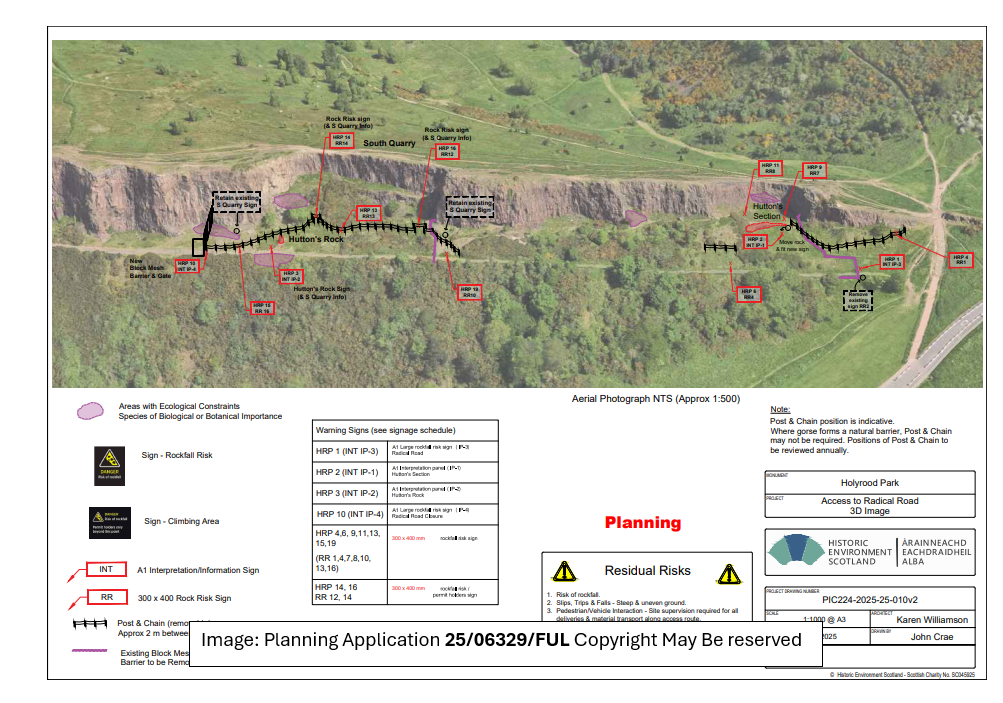
The Cockburn Association welcomes the opportunity to comment on the planning application submitted by Historic Environment Scotland relating to proposed works at the Radical Road in Holyrood Park.
We recognise the complexity of managing risk within a nationally important historic and natural landscape and welcome the clear intention, expressed through this application, to enable a partial reopening of the Radical Road. The proposed installation of safety barriers and fencing, warning signage relating to rockfall risk, vegetation management, and associated measures represents a constructive response following the road’s prolonged closure. Any step that restores public access to this remarkable historic route, while addressing genuine safety concerns, is to be welcomed.
We particularly welcome the timing of this partial reopening, which coincides with the tercentenary of James Hutton’s birth in 2026 and will allow renewed public access to key geological features such as Hutton’s Section and Hutton’s Rock at a time of increased national and international interest in Scotland’s geological heritage.
However, the Association wishes to register concerns regarding Historic Environment Scotland’s proposal to limit public access to only a section of the Radical Road. The full historical, cultural, and experiential significance of the site cannot be appreciated through partial access alone.
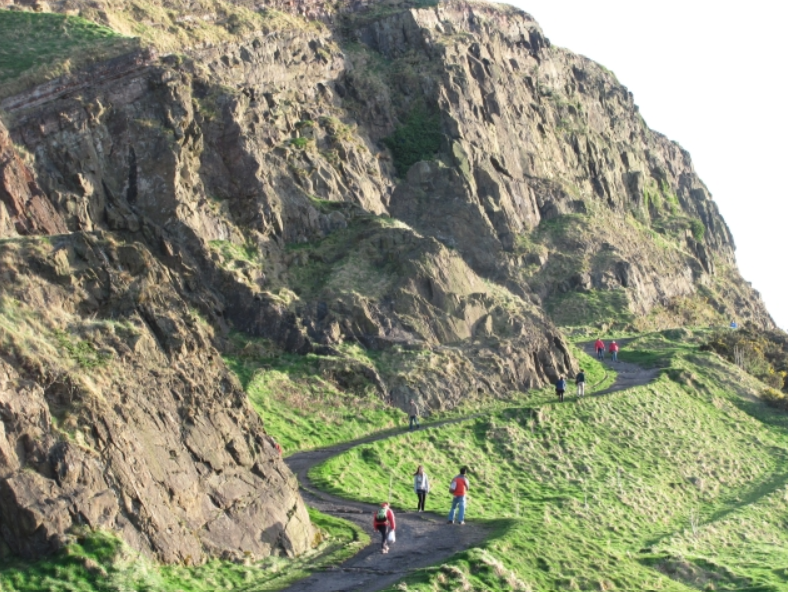
The Radical Road is not simply a viewpoint or a discrete section of path. It is a continuous historic route, deliberately engineered in the early nineteenth century as a democratic promenade shaped by Enlightenment ideals, geological curiosity, and social reform. Its meaning lies in its linearity, continuity, and cumulative experience, as walkers move beneath the Salisbury Crags and engage sequentially with the geology, landscape, and surrounding city. Fragmentation of this route significantly diminishes that understanding.
Partial access also risks weakening the site’s intangible heritage. The Radical Road has long functioned as a place of informal learning, embodied experience, and shared civic use, values that depend on continuity, movement, and repeated public engagement over time. Restricting access to isolated sections erodes these lived and experiential qualities, which are central to the Road’s cultural significance.
We are therefore concerned that measures introduced under the present application, unless explicitly framed as temporary and transitional, risk normalising a permanently curtailed version of the Radical Road. While we acknowledge that partial reopening may represent a pragmatic interim solution, reopening the road along its entire length must remain the clear and stated goal.
Accordingly, the Cockburn Association urges the planning authority to ensure that:
- the partial reopening is explicitly defined as a step towards full reinstatement of the Radical Road, rather than a substitute for it;
- any permissions granted are time-limited, for example to a period of five years, subject to review, and accompanied by a clear commitment to ongoing monitoring and assessment of options for further reopening;
- conditions attached to any consent do not inadvertently legitimise the long-term closure of remaining sections of this historic route;
- the application is considered within the broader context of Holyrood Park as a cultural, geological, and scientifically significant landscape, where public access, understanding, and public benefit are central to its value. This approach would align with National Planning Framework 4, particularly policies supporting public access to the outdoors and the sustainable management of historic assets, as well as City Plan 2030 objectives for inclusive access to Edinburgh’s cultural and natural heritage and the protection and enhancement of greenspaces for public benefit. It would also be consistent with wider Scottish Government policy commitments to wellbeing, outdoor access, and responsible stewardship of nationally significant heritage assets.
Given Edinburgh’s status as a UNESCO World Heritage Site, Holyrood Park’s designation as a Site of Special Scientific Interest, and Scotland’s international reputation for landscape, heritage, and environmental management, it is essential that this internationally important asset is managed with the level of care, resourcing, and long-term planning required to keep it fully accessible wherever safely possible.
The Radical Road remains one of Edinburgh’s most powerful examples of landscape as civic expression. Its full restoration, carefully managed and transparently reviewed, would represent not only a gain for walkers and visitors, but a reaffirmation of Edinburgh’s commitment to shared heritage, public access, and responsible stewardship.
The Cockburn Association therefore supports the proposed partial reopening as an interim measure, but strongly encourages Historic Environment Scotland and the planning authority to treat this application as part of a wider, clearly articulated pathway towards reopening the Radical Road in its entirety.