Who is a city for? Spain, Edinburgh and the price of success
POSTED ON October 9, 2026
Edinburgh’s increased second-home council tax may encourage permanent residential use.
In recent weeks, Spain has been arguing about housing in the streets. Protests have been called in more than 50 cities, and campaigners have camped in Madrid’s Puerta del Sol and Barcelona’s Plaça de Catalunya. When the Spanish parliament voted down two government decrees intended to protect tenants, Pedro Sánchez called a snap election for 29 November. The two largest trade unions, CCOO and UGT, have now agreed to call a 24-hour general strike over housing and wages this autumn, with the date still to be fixed.
The spark was the eviction of Maricarmen Abascal, an 87-year-old who had rented the same Madrid flat for around 70 years. After an investment company bought her building, she faced a rent rise that would have more than tripled what she paid. She was evicted in late September. Such was the outcry that the owners have since agreed to let her go back, sadly she has just passed away. Behind her case lies a housing shortfall that the Bank of Spain estimates to be in the region of 750,000 homes between 2021 and 2025, and a generation that cannot easily leave home. According to Spain’s statistical office, 44.3% of 26- to 34-year-olds were still living with their parents in 2025.
Spain is not Scotland, and Madrid is not Edinburgh. The housing systems, the law and the politics are all different, and we should be wary of easy comparisons. Still, much of what is driving the Spanish protests will be recognisable to anyone who has followed the housing debate here: high and rising costs, too few affordable homes, young people unable to set up on their own, and tourist accommodation competing with homes in the most visited parts of the city. The question underneath is one the Cockburn has been asking for some years. What happens to a successful, attractive city when it becomes steadily harder for ordinary people to live in it?
An emergency, nearly three years on
The City of Edinburgh Council declared a housing emergency in November 2023, and credit is due for what has happened since. In August the Council reported that 1,473 affordable homes had been completed with its partners since its Housing Emergency Action Plan was agreed in 2024.
The scale of the problem has hardly shrunk, though. By the Council’s own count, well over 5,000 homeless households in the city are living in temporary accommodation. In December 2023 the Scottish Housing Regulator found “systemic failure” in homelessness services in both Edinburgh and Glasgow. The Council’s Local Housing Strategy notes that Edinburgh has one of the lowest proportions of social housing in Scotland: 16% of homes are for social rent, against a national average of 22% (2022 Census). As Keith Anderson noted in our November 2025 blog, only 2,051 homes for social rent had been built in Edinburgh over the preceding five years — a level of provision he described as the lowest for many decades. He concluded then that business as usual would not cut it, and we see no reason to change that view.
Homes or holiday lets
The Spanish campaigners have been explicit in linking the housing shortfall to tourism, above all in Barcelona, Madrid and the islands. They argue that homes that once housed residents have been quietly absorbed into the visitor economy. Edinburgh has been having the same argument for more than a decade, and the Cockburn has been part of it throughout.
The evidence here is reasonably clear. A 2018 estimate by Rettie & Co, cited in the Council’s Local Housing Strategy, suggested around one in ten of the city’s private rented homes had been lost to short-term letting. Scottish Government research the following year found 16% of dwellings in parts of the Old Town, New Town and Tollcross being let through Airbnb. Residents spoke of fewer homes, higher prices, noise, and neighbours who simply weren’t there any more.
We set out our concerns in the report of our conference on “the AirBnB phenomenon”, published in 2021. That year we gave our full support to a city-wide Short-Term Let Control Area, which made Edinburgh the first in Scotland in September 2022. Our then Chair, Cliff Hague, wrote of the “hollowing out” of neighbourhoods and argued that converting homes into short-term lets should carry a presumption of refusal. In 2023 we joined community councils and residents’ groups in a joint statement. It said that communities had been “placed under huge pressures by the untrammelled expansion of STLs” and that it was time to ensure Edinburgh “remains a place for people to live.”
None of this was ever hostility to visitors, or to residents letting a room at Festival time. Our concern was always the point at which visitor accommodation stops supplementing a neighbourhood and starts replacing it. Regulation seems to be having some effect. The Housing Strategy records the number of entire homes listed on Airbnb falling from 7,895 in 2020 to 3,694 in 2024, the period in which licensing and the control area came in. Airbnb is only part of the market, and fewer listings do not tell us how many homes have returned to residential use. The forthcoming increase in council tax on second homes adds another measure intended to discourage properties being left outside the permanent housing market. Still, the direction is encouraging.
What conservation is for
Our interest has never been purely in the numbers. Neighbourhoods depend on people who are there in February as well as August. They keep the corner shop going, sit on the community council, and know who to phone when the stair needs repairing. Whether anyone actually lives in a building affects whether anyone notices what is happening to it, and whether or not anyone feels safe on the communal stair.
This is why housing is a conservation question as much as a social one. In 1849 Lord Cockburn, whose name this Association carries, wrote to the Lord Provost on “the best ways of spoiling the beauty of Edinburgh”. “This place,” he warned, “is not exempted from the doom which makes everything spoilable.” Among the chief dangers he named “unfortunate incompatibilities between private and public interests”. Cockburn was worried about houses crammed onto the slopes between the Castle and Holyrood, not holiday lets. Still, a flat that earns more as visitor accommodation than as a home raises a comparable tension between private returns and the public interest.
The Old Town has faced pressure on its homes before. When Patrick and Anna Geddes settled in James Court in 1886, the Old Town was overcrowded and badly neglected. Patrick Geddes’s approach combined careful repair of existing buildings with selective clearance to let in light and air, rather than wholesale demolition. The pressures today run almost the other way, but the principle holds: a historic centre is conserved by keeping it fit to live in, not by emptying it. An immaculately conserved Old Town that nobody can afford to live in would be a very peculiar kind of conservation.
More homes, and the right ones
The Spanish debate has become polarised between those who want stronger protection for tenants and those who argue that only more building will help. Edinburgh needs both. We need many more homes, especially homes for social rent. But it also matters where they go, who can afford them, and whether they become real neighbourhoods with schools, shops, green space and transport, rather than isolated blocks of a single tenure. And the homes we already have deserve the same attention. That means empty properties and vacant upper floors brought back into use, and a firm line on converting homes into visitor accommodation.
In practical terms, we would like to see three things. First, the Council should treat the planning permission now required within the control area as a real safeguard, with a clear presumption against turning homes into short-term lets. Second, it should put social rent firmly at the centre of the next phase of the Action Plan. Third, it should treat the reuse of existing buildings as part of the housing answer, not a heritage sideshow.
Edinburgh is not Madrid. But Spain shows how a slow squeeze on ordinary residents can, quite suddenly, become a political crisis. Edinburgh’s attractions are real, and so are the jobs, culture and investment that come with them. But a city that is wonderful to visit and impossible to live in has lost something no visitor economy can replace. The measure of our housing, planning and tourism policies is whether the people who keep this city going can still afford to call it home.
Sources
Spain
- Euronews, “Spain faces housing protests in more than 50 cities after parliament rejects tenant protections” (3 October 2026): https://www.euronews.com/2026/10/03/spain-faces-housing-protests-in-more-than-50-cities-after-parliament-rejects-tenant-protec
- Euronews, “Spain’s housing crisis: Key issues come into focus after 87-year-old evicted from home” (28 September 2026): https://www.euronews.com/2026/09/28/spains-housing-crisis-key-points-after-protests-over-maricarmen
- PBS NewsHour, “What to know about Spain’s housing protests sparked by an 87-year-old woman’s eviction” (5 October 2026): https://www.pbs.org/newshour/amp/world/what-to-know-about-spains-housing-protests-sparked-by-an-87-year-old-womans-eviction
- JURIST, “Thousands protest Spain lawmakers’ rejection of protective measures amid worsening housing crisis” (October 2026): https://www.jurist.org/news/2026/10/thousands-protest-spain-lawmakers-rejection-of-protective-measures-amid-worsening-housing-crisis/
- TIME, “Spain’s Leader Is Betting His Government on the Housing Crisis” (5 October 2026): https://time.com/article/2026/10/05/spain-snap-elections-sanchez-housing-crisis/
- idealista/news, “CCOO y UGT acuerdan convocar una huelga general de 24 horas este otoño por la vivienda y salarios dignos” (6 October 2026): https://www.idealista.com/news/inmobiliario/vivienda/2026/10/06/917578-ccoo-y-ugt-acuerdan-convocar-una-huelga-general-de-24-horas-este-otono-por-la
Edinburgh
- City of Edinburgh Council, “Positive progress to tackle housing emergency” (26 August 2026): https://www.edinburgh.gov.uk/news/article/14473/positive-progress-to-tackle-housing-emergency
- City of Edinburgh Council, “Housing, Homelessness and Fair Work Convener reflects on World Homeless Day” (10 October 2025): https://www.edinburgh.gov.uk/news/article/14304/housing-homelessness-and-fair-work-convener-reflects-on-world-homeless-day
- City of Edinburgh Council, Local Housing Strategy 2025–2030 (June 2025): https://www.edinburgh.gov.uk/downloads/file/37781/local-housing-strategy-2025-2030
- Inside Housing, “Regulator intervenes over Glasgow and Edinburgh’s ‘systemic failure’ on homelessness services” (December 2023): https://www.insidehousing.co.uk/news/regulator-intervenes-over-glasgow-and-edinburghs-systemic-failure-on-homelessness-services-84512
The Cockburn Association
- Keith Anderson, “Edinburgh’s Housing Emergency – 2 years on, so what next?” (5 November 2025): https://www.cockburnassociation.org.uk/news/edinburghs-housing-emergency-2-years-on-so-what-next/
- The AirBnB phenomenon – Edinburgh, conference report (2021): https://www.cockburnassociation.org.uk/wp-content/uploads/2021/06/AirBnB-Conference-Report.pdf
- “Edinburgh Short-Term Let Control Area Consultation”, response (2 November 2021): https://www.cockburnassociation.org.uk/planning-consultation-responses/edinburgh-short-term-let-control-area-consultation/
- Cliff Hague, “How should Edinburgh respond to the latest surge in Short-Term Let applications?” (13 May 2022): https://www.cockburnassociation.org.uk/news/how-should-edinburgh-respond-to-the-latest-surge-in-short-term-let-applications/
- “Communities support new Short-term Let regulations”, joint statement (30 August 2023): https://www.cockburnassociation.org.uk/news/communities-support-new-short-term-let-regulations/
Historical
- Henry Cockburn, A Letter to the Lord Provost on the Best Ways of Spoiling the Beauty of Edinburgh (Edinburgh, 1849). Royal College of Physicians of Edinburgh copy, Internet Archive: https://archive.org/details/b28042323
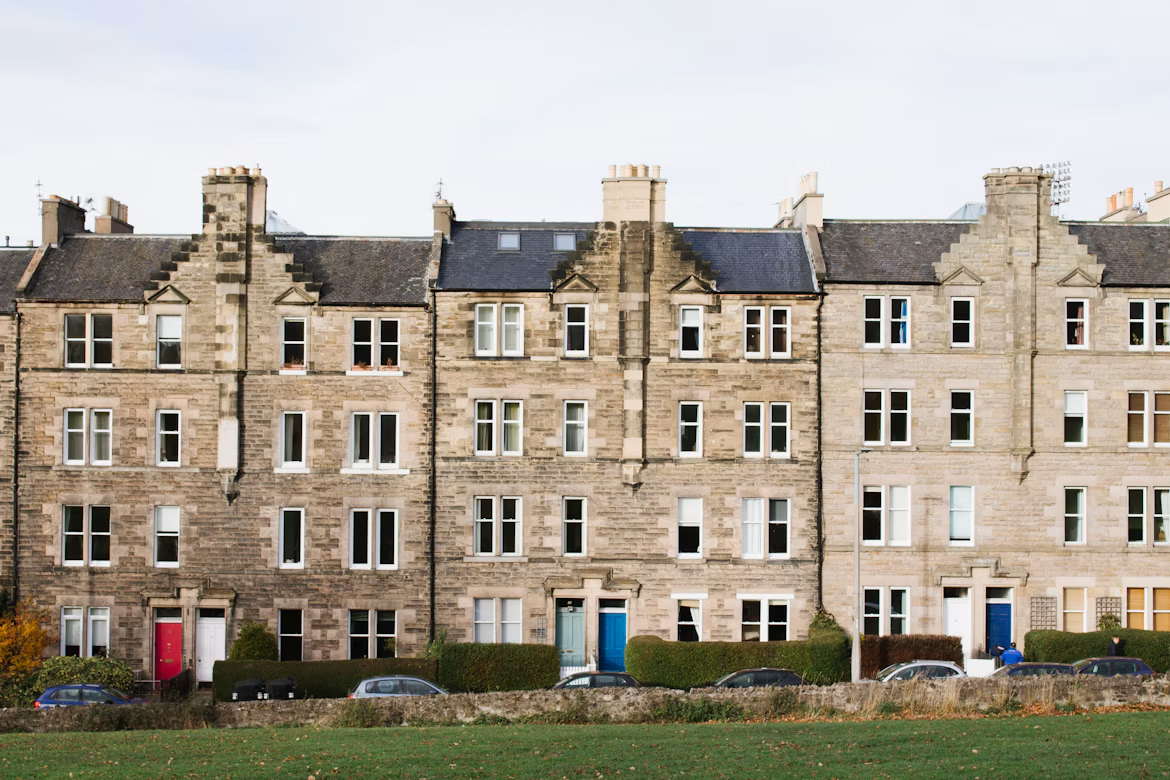
Image: Upsplash by Kirsten Drew (@k_drew)