Edinburgh’s Next Chapter, shaped by civic voices
POSTED ON June 12, 2026 BY James Garry
Edinburgh’s next chapter, shaped by civic voices and shared ambition
Edinburgh has never been a city that stands still. Nor should it be.
The city we inherit today is the product of ten centuries of change: some enlightened, some contested, some still bearing consequences we continue to live with. From the making of the New Town to the arrival of the railways, from the protection of the Old Town to the expansion of leisure in Leith, Edinburgh has long had to ask itself how growth, beauty, utility, community, and civic life can be held in proper balance.
That question is not a matter of nostalgia. It is one of stewardship and vision. How do we plan for a growing, changing capital while keeping faith with the qualities that make Edinburgh distinctive, liveable and loved? Lord Cockburn asked about Edinburgh in 1949, now 2049 it is nearly upon us.
It was in that spirit that the Edinburgh Civic Forum met on 2nd of June 2026. This great initiative was spearheaded in 1990 by the Association – a far-sighted and progressive move on behalf of the city. There is nothing else quite like it in Scotland. The Forum brings together civic, community and amenity organisations to consider how Edinburgh’s many voices might contribute constructively to some of the most important conversations now shaping the city’s future. The continuing support of senior City Council staff cannot be overstated.
City Plan 2040: More Than a Planning Exercise
City Plan 2040, Edinburgh’s next local development plan, is one of the principal ways in which the city will decide how and where change should happen.
The forthcoming ‘Call for Ideas’ stage is especially important. It comes early enough in the process for communities, organisations, landowners, businesses and residents to put forward ideas before detailed policies and site allocations materialise. In other words, it is the moment to shape the city’s agenda.
Forum members explored priorities for Edinburgh’s future from housing and transport to public space, heritage, climate resilience and how to create the strong communities that make neighbourhoods work. None of these questions can sensibly be treated in isolation. Together, they shape the ordinary experience of living in the city.
A clear theme emerged: Edinburgh must find a better balance between growth and liveability. Growth is not, in itself, the problem – growth without a clear vision, is. The test for City Plan 2040 will be whether it enables the homes, services, infrastructure and economic activity the city needs while strengthening, rather than eroding, the character and wellbeing of its neighbourhoods. A plan based on world-leading ambition, but rooted in its locality.
The Edinburgh Civic Forum Steering Group will shape a response for consideration by the Forum in September 2026. That testimony should not seek to flatten the diversity of civic opinion into a single line. Rather, its value will lie in identifying the shared principles that Edinburgh’s citizens can stand behind: ensuring Scotland’s capital is a place where heritage is created, protected, and enjoyed by all, and where all its citizens have a sense of pride and belonging.
The National Conversation Begins at Street Level
The Forum also discussed a submission to the National Conversation, a UK-wide initiative launched in May 2026 inviting people to share what they value about community life and about what would improve the streets we work, learn and live on.
Inspired by the need for greater civic dialogue and social cohesion, the Independent Commission on Community and Cohesion chaired by Sajid Javid and John Cruddas, and supported by the Jo Cox Foundation, aims to shape future UK Government priorities to build strong and resilient communities. In the light of the unedifying scenes witnessed on streets across the UK this week, it feels particularly timely.
Although UK-wide in scope, the questions are designed to draw out national and local distinctiveness. What makes a place feel like home? What connects people to their neighbours? How do we live well together in a period of social, technological and environmental change?
The Cockburn Association has long argued that healthy civic life depends on informed community-led discussion, a willingness to listen, and the confidence to speak for the long-term public interest. The National Conversation is therefore an opportunity to demonstrate democratically and empirically that the health of a city is measured not only by investment figures or development pipelines, but by belonging, trust and resilient communities.
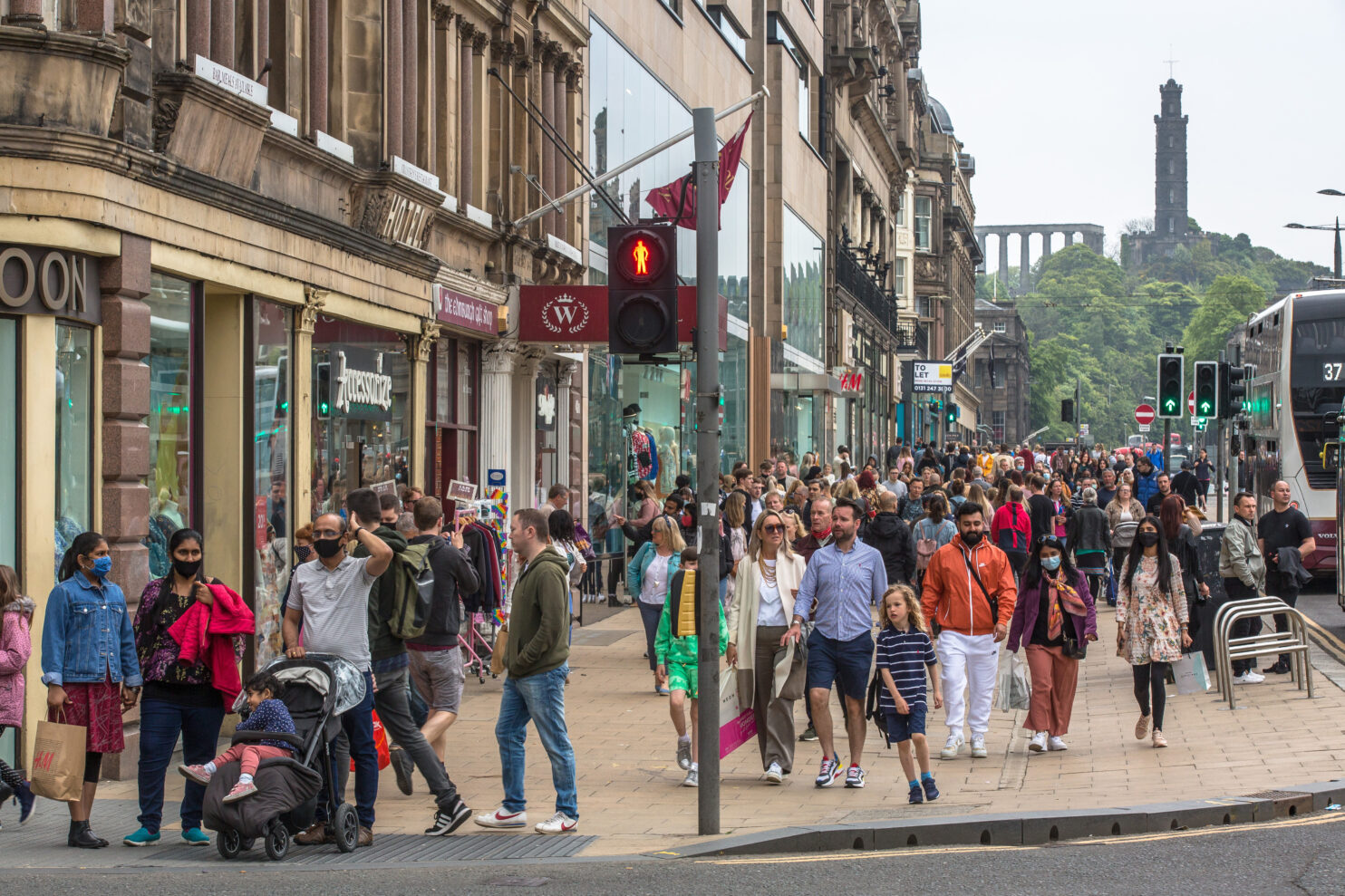
Princes Street, the Waverley Valley and the Civic Heart of the City
These wider questions are particularly vivid in the continuing debate about Edinburgh’s city centre.
The Cockburn Association and the Edinburgh Civic Forum Steering Group were invited to take part in a workshop on 8 June 2026 on the future of Princes Street and the Waverley Valley: the great east-west frontage of the New Town and the dramatic landscape below it, around Waverley Station, between the Old Town, the New Town and Calton Hill.
Princes Street is too often discussed as though it were simply a retail problem. It is much more than that. It is a street, a view, a threshold, a transport artery, a gathering place and one of the great urban set-pieces of Europe. The Waverley Valley, framed by the Castle, the Old Town, the New Town and Calton Hill, is one of the city’s, and the country’s, defining landscapes.
As retail patterns, tourism, commuting, public transport and cultural life continue to change, the future of this part of the city requires imagination and discipline: a clear understanding of what makes it special, and what social outcome-driven change could achieve.
Decisions here will say much about the city’s wider civic priorities and ambition: how it balances heritage and growth, movement and gathering, tourism and everyday use, economic renewal and the dignity of public space.
That is precisely why civic participation matters. The future of Princes Street and the Waverley Valley is therefore a test of whether Scotland’s capital can treat its most prominent public places as shared civic assets, worthy of ambition and care.
Why the Civic Forum Matters
One of Edinburgh’s great strengths is that so many people care about it. That care is always expressed with passion, often underpinned by the expertise that comes with local knowledge. While the emotion may sometimes be expressed through frustration, the positive thread which we can all share, is the desire to demand the highest quality of development, design and maintenance that our city and its citizens, visitors and businesses expect and deserve.
The Edinburgh Civic Forum provides a place where that care can be coordinated constructively. It brings together organisations from across the city to share experience, understand emerging policy, identify common concerns and contribute to the planning and civic processes that shape Edinburgh’s future.
It is not necessary for every member organisation to agree on every detail. Indeed, a healthy civic forum should make room for difference and debate. But it can help Edinburgh speak more clearly on the principles that matter: places should work for people; development should be judged by quality as well as quantity; communities should be involved early and meaningfully; and the city’s heritage should be understood as a living resource, not a decorative constraint.
As City Plan 2040 moves forward, as the National Conversation invites reflection on belonging and community life, and as major questions continue to be asked about the city centre, Edinburgh needs exactly this kind of civic seriousness.
The future of Edinburgh will not be secured by one plan, one workshop or one consultation response. It will be shaped through many decisions, large and small, over many years. Some will concern skyline and setting; others the quality of a pavement, the survival of a local service, the design of a new housing site, the planting of trees, the reuse of a building, or the simple ability of residents to feel that their place still belongs to them.
There is a practical invitation here too. Those who care about Edinburgh should use the opportunities ahead — City Plan 2040, Local Place Plans, the National Conversation and the work of the Edinburgh Civic Forum among them — to put forward ideas, test assumptions and help define what a good future for the city should look like.
For nearly 150 years, the Cockburn Association has argued that Edinburgh’s beauty, history and liveability are not luxuries. They are public goods. They require vigilance, imagination and participation. The present moment asks the same of us again: to take part, to think long term, and to help ensure that Edinburgh’s next chapter is worthy of the city we have inherited.
Get Involved:
City Plan 2040: https://www.edinburgh.gov.uk/local-development-plan-guidance-1/city-plan-2040
Princes Street and Waverley Valley: https://www.edinburgh.gov.uk/city-mobility-plan-1/princes-street-waverley-valley-strategy
The National Conversation: https://www.thenationalconversation.org.uk
Edinburgh Civic Forum: https://www.cockburnassociation.org.uk/engage/civic-forum
Image: Princes Street – G.Gainey