
Discussion: What is the impact of climate change on our local heritage?
Thursday, February 22 · 10:30am - 12:30pm GMT
Join us (online or in person) to learn about the threats climate change presents

Join us (online or in person) to learn about the threats climate change presents
Call for owners and tenants across City of Edinburgh to share opinions

The Caledonian Brewery was the capital’s last major operational brewery
The Caledonian Brewery was the capital’s last major operational brewery
We can see no justification for the level of internal alteration and demolition from a historic policy or statutory focus.
We can see no justification for the level of internal alteration and demolition from a historic policy or statutory focus.
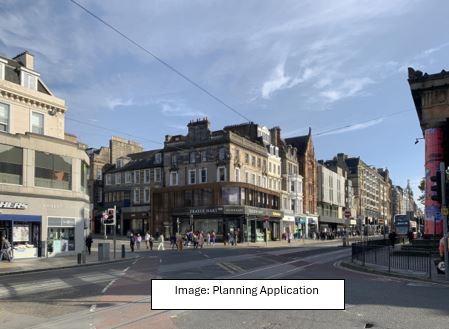
The Cockburn Association has considered this application and wishes to lodge the following comments. Overall, we would wish to formally object to these proposals on the grounds on impact to the historic fabric of listed buildings, the implications that this has for the integrity and authenticity of the World Heritage Site (and its compatibility with its Outstanding Universal Value) and the potential for wider disruption due to access and servicing requirements of this type of development.
Whilst the Cockburn welcomes proposals that bring the upper floors of buildings within the First New Town into active use, this must be consistent with the impact on the historic fabric of the buildings. The Heritage Statement is helpful in setting out the changes that have taken place on this site over time, but there is no escaping that this site comprises a substantial amount of first-generation New Town architecture, which is becoming rarer as further developments are undertaken. The most significant alterations have taken place on ground and first floor levels where commercial uses have been found. Substantial original fabric in the upper floors remains, and it is our view that the policy objective of development here should be retain as much of this as possible.
We can see no justification for the level of internal alteration and demolition from a historic policy or statutory focus. The proposals are inconsistent with the legal obligations of s.14 and s59 of the Planning (Listed Buildings & Conservation Areas)(Scotland) Act in that the scheme does not preserve features of architectural interest or merit. These, added to the external alterations to the historic fabric result in a scheme that is damaging to the listd buildings in question.
As such, we advise that the proposals are inconsistent with Local Development Plan policies ENV1 (impact to the integrity of the World Heritage Site) and ENV 4 Listed Buildings – Alterations and Extensions, where is it clear that no unnecessary alterations will be permitted. Similarly, the scheme is inconsistent with NPF4.
In addition, we have concerns about the operation of this use in this location. Transitory accommodation like this has a considerably higher degree of movement in terms of guests accessing the accommodation via taxis, etc as well as higher levels of service vehicles such as laundry and change over activities as well as possible catering, etc. The junction at Hanover Street and Princes Street is very congested, and this side of Hanover Street will form part of the Meadows to George Street cycleway. Pavement or curbside parking for drop-off or servicing requirements could have a substantial impact on the free movement of pedestrians and wider vehicle movements. This needs to be fully assessed before any further consideration is given.
As such, the Cockburn objects to this application. We can see some merit in the proposed use but not the current proposals, where considerable amendments will be required.-
The onus on the applicant to prove that this is an acceptable proposal in this location.
The onus on the applicant to prove that this is an acceptable proposal in this location.

Having reviewed this application we have concerns that it may be inconsistent with Policy Hous 7 (uses affecting residential amenity) in an area of known tourist pressure and negative impacts on the established long-term residential community.
If the council is minded to grant this application, we recommend only a temporary consent is granted with conditions requiring the monitoring of noise, smells, etc.
The onus on the applicant to prove that this is an acceptable proposal in this location.
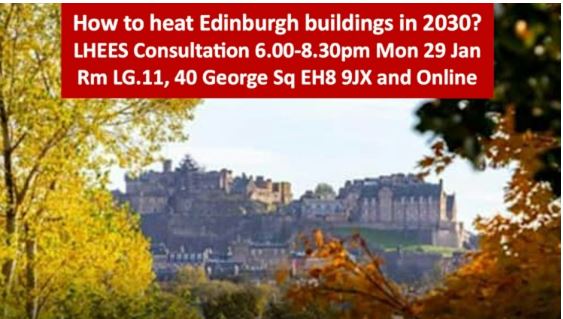
Learn about City of Edinburgh plans for cutting emissions and safely keeping buildings warm
We consider that the proposed use as student accommodation is acceptable in this location
We consider that the proposed use as student accommodation is acceptable in this location

The Cockburn Association supports this application.
We consider that the proposed use as student accommodation is acceptable in this location and that the design, height, and scale of the proposal is suitable. We are not concerned that the former base of the Scottish Law Commission will be demolished, although we would have preferred if the sculptural elements on the front façade had been retained and incorporated into the new proposal. Although we understand that the Scottish Law Commission wishes to retain and remove this armorial sculpture.
The increased height and scale of the proposal, as compared to the existing disused office block, will reinforce the streetscape of Causewayside. The inclusion of new streetside greenspace is an attractive addition, if well maintained.
The existing sterile parking area to the rear of the current office building is to be replaced with a well-designed courtyard garden with seating and cycle storage. This is landscaped to permit light to rooms on the lower ground floor although careful assessment of the natural light availability for these rooms is required. The building is pulled back from existing properties and, when considered in conjunction with the courtyard garden and green roofs of the student block, there should be a general improvement to the amenity enjoyed by neighbours.
We note that the proposal is for a high-density mix of cluster rooms and studios. In general, we prefer student accommodation which consists of cluster flats and avoids single aspect accommodation since this is easier to convert to non-student, full-time residential accommodation at a later date, if desired.
Are you interested in a career in heritage? Then this event is for you!

Accelerating decarbonisation across the land and building lifecycle

Hear about the work done towards rescuing this important William Adam house

