The New Town of Edinburgh and Other Stories

Monday 9th December 2024

Simon Laird explores the evolution of Edinburgh New Town, brainchild of Lord Provost George Drummond. Why was it built? How did it evolve during design and construction? And how has it accommodated 250 years of change? During his six terms as Lord Provost, Drummond was responsible for other developments in and around the Old Town, including points of interest close …

Book Here

The Glasgow Cenotaph

Thursday 21st November 2024

In its centenary year, Niall Murphy, Director of Glasgow City Heritage Trust, will discuss Sir John James Burnet’s design for the Glasgow Cenotaph and how it sits within the context of the other war memorials he produced for the likes of the Imperial War Graves Commission. 7.30pm at St Andrews West Church & Renfield Centre, 260 Bath Street, Glasgow  Note: …

Book Here

The Making of a Ducal Landscape

Monday 11th November 2024

In this joint lecture with Scotland’s Garden and Landscape Heritage, Dr David Munro, a geographical consultant for the Duke of Buccleuch at Drumlanrig Castle, draws on historic estate plans and fieldwork to examine a ducal landscape that includes one of Scotland’s largest castles. He also uncovers a wider estate landscape rich in historical features that provide opportunities for heritage conservation …

Book Here

Streamlining the Streets

Thursday 24th October 2024

A surprising amount of construction took place in Renfrewshire during the 1930s. Fiona Sinclair, architect and historian, will illustrate the wealth of buildings from the inter-war period in Renfrewshire and highlight the achievements of some remarkable architects.   7.30pm at St Andrews West Church & Renfield Centre, 260 Bath Street, Glasgow. Note: Lecture will also be live-streamed via Zoom Tickets …

Book Here

Echoes of Faith: Protecting Religious Built Heritage in Secular Scotland

Monday 14th October 2024

Scotland’s Churches Trust has been protecting and preserving the nation’s sacred buildings since 1978. Its current director, Dr DJ Johnston-Smith, discusses some of the innovative ways the Trust has championed Scotland’s religious built heritage over the past five decades, and how it is responding to the ongoing mass closure of Scottish churches and the emerging need to safeguard the country’s …

Book Here

Lighting Up Leith: Recent excavations into Leith’s Industrial Past

POSTED ON August 16, 2024 BY Cullen T. Cockburn

Recent archaeological excavations by AOC Archaeology Group, thanks to developer-funded work, along Baltic Street and Halmyre Street have unearthed the structural remains of the district’s vibrant industrial and maritime past.

Recent archaeological excavations by AOC Archaeology Group, thanks to developer-funded work, along Baltic Street and Halmyre Street have unearthed the structural remains of the district’s vibrant industrial and maritime past.

Support the Cockburn

Donate
Join Us

The Importance of Planning Policy

POSTED ON June 25, 2024 BY Barbara Cummins

The Cockburn is a strong advocate for the Scottish Planning System and of the need to have coherent, relevant and up-to-date policies in place.  We also need to have the system adequately resourced by professional, committed staff with the right skills and aptitude to serve this fine city.  Good decisions need good policies implemented by skilled staff with good advice and support from the community. It is that simple.

The Cockburn is a strong advocate for the Scottish Planning System and of the need to have coherent, relevant and up-to-date policies in place.  We also need to have the system adequately resourced by professional, committed staff with the right skills and aptitude to serve this fine city.  Good decisions need good policies implemented by skilled staff with good advice and support from the community. It is that simple.

Support the Cockburn

Donate
Join Us

Former Royal High School proposals win Cockburn support

Posted on: May 17, 2024

The Association supports proposals to refurbish and repurpose the former Royal High School into a National Centre for Music.

The Association supports proposals to refurbish and repurpose the former Royal High School into a National Centre for Music.

Cockburn Response

The Association has examined the planning and listed building consent applications by the Royal High School Preservation Trust for the repurposing and refurbishment of the former Royal High School.  We have recollected our substantial history of engagement with this iconic structure, acknowledged as the one of the finest Greek Revival building in the world, more than justifying its Category A-listing.  We have also benefited from a detailed site visit with the applicant and architects, when we were able to assess the internal changes as well as external.

The Association supports the proposals to form new premises for the National Centre for Music including music rehearsal and performance spaces, licensed cafe /restaurant and bar facilities, offices, internal and external alterations, landscaping, public realm including provision of external multi-use space for temporary events/festival uses.

We agree with the assessment of Historic Environment Scotland that the proposals would return the main building closer to its original solitary setting on the site.  The loss of most of the later buildings will enable the Hamilton building to have greater visual clarity in its landscape setting with Calton Hill.  We particular welcome the new landscape structure which provides new pleasure grounds and event spaces around the main building.  This will have a both a positive impact on the setting of this A-listed building as well as enhancing the character of this part of the Conservation Area.

The reduction in scope of the proposals from both the failed hotel schemes and the abandoned Music School scheme results in much “lighter touch” internal changes.  We are particularly supportive of the use of existing lower spaces rather than previous ideas which involved significant (and expensive) alterations.   Additionally, we accept the interventions to facilitate barrier free access – such as the new openings proposed for the east and west pavilions.

Finally, the opening up and access to the previously hidden belvedere/clock tower at the south-east corner is a welcome outcome.

For the sake of clarity, we note the changes in level proposed at the Western pavilion end, but feel that these are proportionate in order to facilitate the wider and more flexible use of proposed new facilities.  Bringing otherwise hidden areas of landscape around the building into active use is also supportable.

In summary, we welcome these proposals, believing that they result in a suitable reuse but in a manner which reinforces the essential heritage value of the site, rather than detracting from it.


Comments on World Heritage Management Plan 2024-2034

Posted on: April 15, 2024

There is a clear need for the final version of the Management Plan and Action Plan to have Key Performance Indicators and specific areas of action with expected outcomes and outputs.

There is a clear need for the final version of the Management Plan and Action Plan to have Key Performance Indicators and specific areas of action with expected outcomes and outputs.

Cockburn Response

The draft Management Plan now covers a period of 10 years versus the previous plan’s 5-year lifespan. We assume that this is to align with City Plan 2030 although there is no specific explanation for this change. It would be helpful if this were explained. A ten-year plan period could mean that there is little scope to respond to changes in policy or circumstance. However, the introduction of a two-year Action Plans is a pragmatic response to allow these concerns to be managed.

The draft Plan appears to be a roll-over of the existing plan. Given the issues and challenges that we set out in our full reponse, we question if this is entirely the right approach.

The Association agrees with and supports the aims of the draft Plan as set out in para. 2.2.  We also support the five themes set out in the Action Plan, being awareness and appreciation; climate emergency; conservation and maintenance; control & guidance; and a sustainable visitor experience.

In accepting the structure of a 10-year main Plan with a 2-year Action Plan, we would expect the latter to have SMART targets embedded in it. We would expect a final version of the Plan and Action Plan to have Key Performance Indicators and specific areas of action with expected outcomes and outputs.

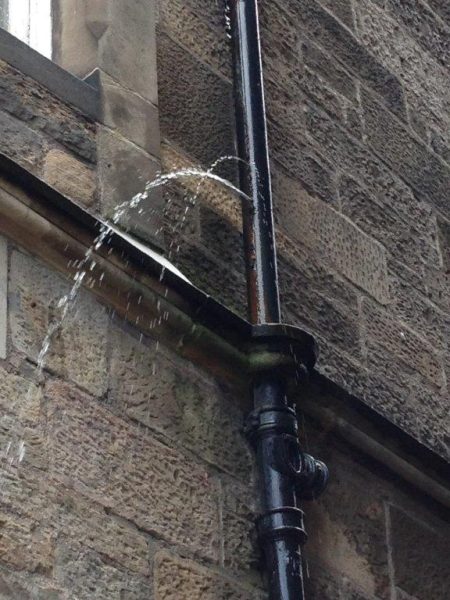
Failed rainwater goods in the WHS.

The Management Plan must drive a data-driven approach to policy formulation and action-setting. This is currently missing in the draft Plans. We appreciate that a State of Conservation Report has been prepared, but its data must be used to inform the plan, influence its approach, and drive activities (with measurable targets).

Short-term Lets, Control Areas and planning consents

POSTED ON December 15, 2023

On 1 December 2023, Lord Braid issued his Opinion on a judicial review on the approach taken by the City of Edinburgh Council’s interpretation of the Short-Term Let Control Area and its impact on STL properties prior its designation. His decision that it cannot be retrospectively applied may be disappointing for communities affected by STLs but consent for a Change of Use remains a live issue.

On 1 December 2023, Lord Braid issued his Opinion on a judicial review on the approach taken by the City of Edinburgh Council’s interpretation of the Short-Term Let Control Area and its impact on STL properties prior its designation. His decision that it cannot be retrospectively applied may be disappointing for communities affected by STLs but consent for a Change of Use remains a live issue.

Support the Cockburn

Donate
Join Us