What Are We Making Room For? Public Art and the Pause in Princes Street Gardens
POSTED ON August 21, 2026 BY James Garry
Public art should tell Edinburgh’s stories across the whole city
Earlier this month, on 13 August, the Culture and Communities Committee approved a temporary halt on new permanent statues, monuments and artworks in Princes Street Gardens. The reasoning is practical rather than dramatic: the gardens already hold twenty-one statues and memorials, two more are in the pipeline, and Edinburgh World Heritage, several councillors and festival organisers had all arrived at roughly the same question. At what point does a garden built to give the city breathing room become another surface to be filled?
Nobody on the committee was arguing for an end to public art. What’s been agreed is a pause: time to think about siting, cumulative effect and purpose before the next proposal lands, rather than approving works one planning application at a time and noticing only afterwards that the gardens have quietly filled up. The memorial to Muriel Spark and a sculpture commemorating those affected by the Infected Blood Scandal, both already under way, are unaffected.
Public art earns its keep in a city in ways that are easy to underrate. A well-placed statue becomes a landmark and a meeting point, “under Wellington”, “at the Fountain”, in a way a street name never quite manages. But that’s exactly why location matters. A garden with a few well-chosen focal points reads clearly; keep adding permanent works over decades with no single hand guiding the whole, and pieces start to compete for attention as open ground gets progressively less open.
Lord Cockburn never wrote about statues directly. His 1849 Letter to the Lord Provost on the Best Ways of Spoiling the Beauty of Edinburgh was concerned with railways, building heights and the felling of trees. But the underlying logic still applies: Edinburgh’s character rested, he argued, on “our curious, and matchless position, our strange irregularity of surface… our distant prospects”, and his warning was that the city could be spoiled not by one catastrophic decision, but through the accumulation of individually defensible ones. This Association’s own history bears that out — we campaigned to keep the statues of George IV, William Pitt and Dr Chalmers when the George Street tramway scheme threatened to remove them. The principle then is the principle now: decisions about where memory sits should take account of the whole city, not be settled piecemeal.
The whole city is the canvas
There’s a bigger question behind the present debate. Why should Princes Street Gardens, or the historic centre generally, so often be the place we look to for new public art? Edinburgh’s neighbourhoods have histories and identities of their own, and public art can help reveal them — creating landmarks that matter to the people who live nearby rather than only to visitors.
Edinburgh already does this well in places. The Colinton Tunnel has been transformed from redundant railway infrastructure into a community artwork, Chris Rutterford’s mural drawing on Robert Louis Stevenson’s From a Railway Carriage. In Leith, the Leith History Mural has told a different kind of civic history since the 1980s — work, protest and community life rather than kings and generals. At Balgreen, a pedestrian tunnel once known mainly for graffiti has become a wildlife mural, developed with ideas from children at Balgreen Primary School and funded by community donations. And in Craigmillar, the surviving fragment known as Gulliver’s Foot recalls the giant play sculpture built by the Craigmillar Festival Society in the 1970s.
These are very different works — permanent and temporary, monumental and playful — and that variety matters. It reminds us that public art doesn’t have to mean a bronze figure on a stone plinth, and that civic recognition doesn’t require a prestigious city-centre address. The Council’s work to map existing public art and explore future locations deserves attention on those terms. The question shouldn’t simply be “where in the centre can this go?” It should be “where in Edinburgh could this work mean most?”
Whose stories do we tell?
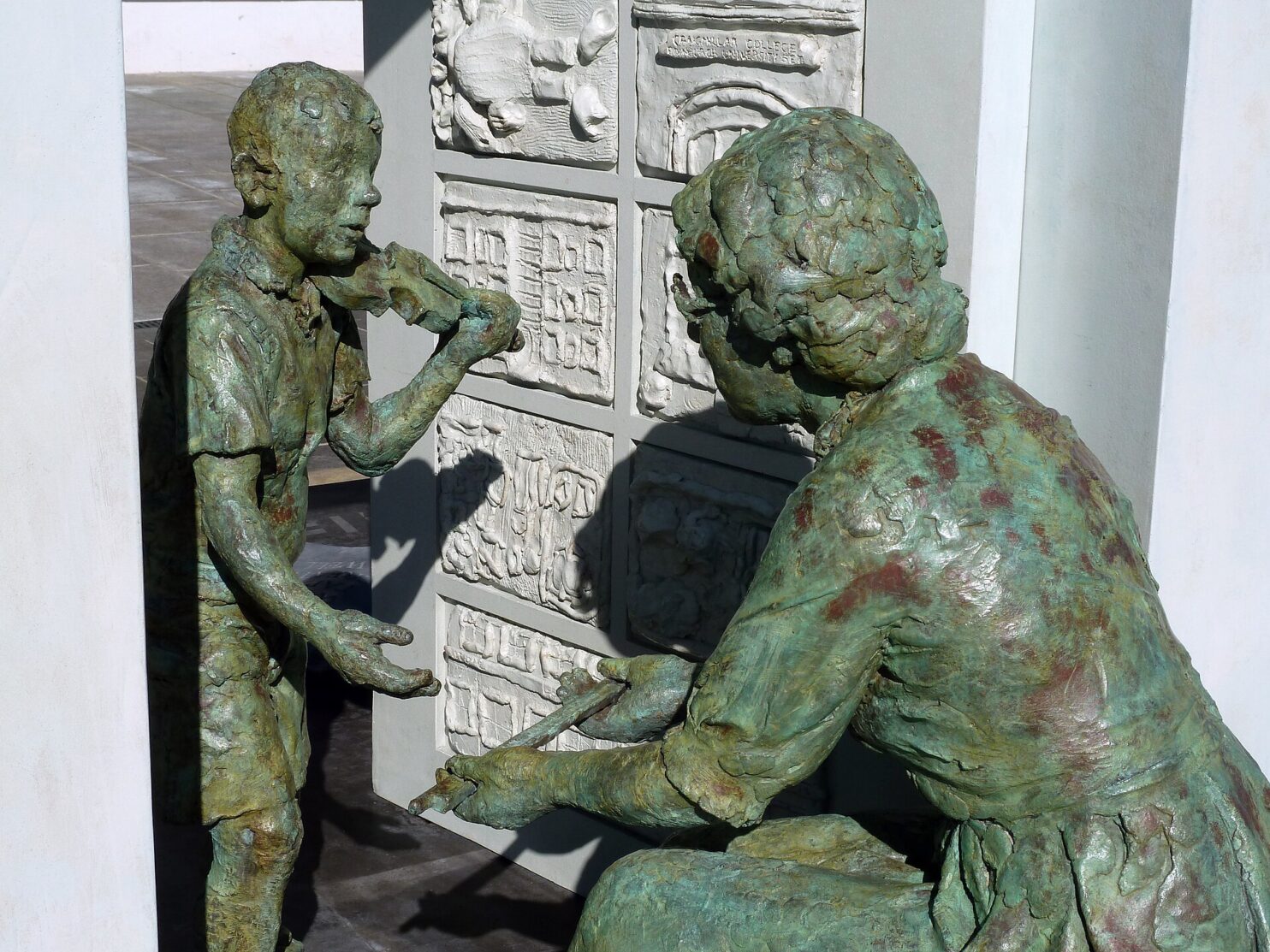
Geography is only part of the issue. Much of the city’s traditional monumental landscape was created when the range of people considered worthy of permanent commemoration was remarkably narrow — women in particular are conspicuously under-represented. That shouldn’t turn into a competition for plinths; it’s a reason to think more imaginatively. Craigmillar already offers one answer of its own: a 2014 statue outside Craigmillar Library depicts Helen Crummy, founder of the Craigmillar Festival Society, handing a violin bow to her son — the small act of advocacy that led, eventually, to Gulliver. It’s a woman commemorated for organising her community rather than for birth or marriage, on her own patch rather than in the city centre.
A mural can tell a collective story a single figure cannot. A plaque can recover somebody nearly erased from the record. And sometimes a statue remains exactly the right answer: the proposed memorial to Muriel Spark, whose presence in the city’s public realm has until recently been surprisingly slight, is a case in point. The question there was never whether she deserved recognition, but how and where Edinburgh should tell that story.
The new Edinburgh Public Art Panel, with its remit covering commissioning, placement and representation as well as individual artworks, is well placed to carry that thinking forward. And the timing is useful: the Council’s City Plan 2040 Call for Ideas is inviting exactly these kinds of questions about what Edinburgh’s neighbourhoods should become, alongside the wider National Conversation about the city’s future.
The gardens don’t need to become frozen against all future change, and the answer to a moratorium on new statues in one part of Edinburgh is not “when can we start again here”. It’s to look at the rest of the city — from Colinton to Craigmillar, and beyond — where some of Edinburgh’s most interesting public art already happens away from the ceremonial centre, and ask what more of it could mean.
Further reading
- Edinburgh Council approves temporary ban on statues — The Edinburgh Reporter, reporting on the Culture and Communities Committee decision and the discussion surrounding the moratorium.
- The Edinburgh Public Art Panel — City of Edinburgh Council, setting out the Panel’s role in commissioning, placement, community engagement, inclusivity and representation.
- City Plan 2040: planning for Edinburgh’s future development — City of Edinburgh Council’s current Call for Ideas consultation on Edinburgh’s next Local Development Plan.
- A Letter to the Lord Provost on the Best Ways of Spoiling the Beauty of Edinburgh — Henry Cockburn’s 1849 pamphlet, digitised by the Wellcome Collection.
- Biography of Henry Cockburn — the Cockburn Association’s account of Lord Cockburn’s life and legacy.
Image:
Statue in memory of Helen Crummy, Niddrie Mains Road, Edinburgh. Photo: Margaret Ferguson Burns, CC BY-SA 3.0, via Wikimedia Commons