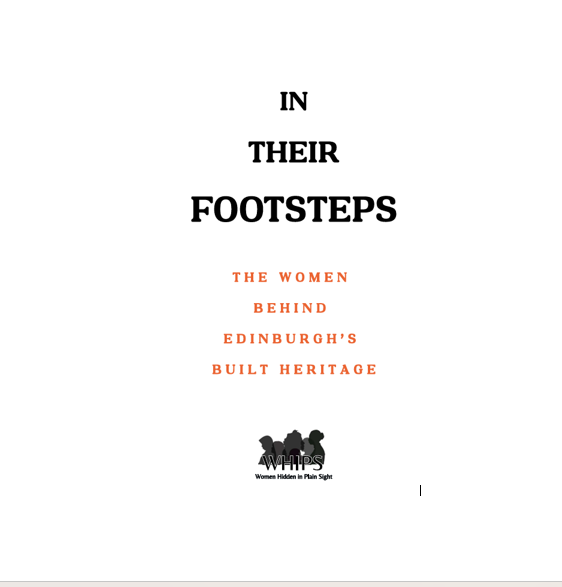
In Their Footsteps: Reflections from Women’s History Month
POSTED ON April 3, 2026 BY Anna Dowling-Clarke
Hidden women’s histories reshape how we see Edinburgh’s past
As Women’s History Month draws to a close, I want to reflect on the three guided walks I delivered in partnership with The Cockburn Association, and on what I observed when these stories were shared with those who attended.
Over three consecutive Sundays in March, I led around 45 people in total through Edinburgh’s Old Town on the guided walk, In Their Footsteps: The Women Behind Edinburgh’s Built Heritage. Each group included people of different ages, backgrounds, and relationships to the city, and yet something consistent emerged across all three walks. Again and again, it became clear that these stories resonate.
At the beginning of each walk, I asked people to hold a single word in their minds as we moved through the city: choice. The argument I made at the start of the tour, and one I explored in my first blog post for The Cockburn Association, is that heritage is not passive but is rather an active, ongoing series of decisions about what to preserve and what to demolish, whose name to put on the wall and whose to leave off. Often, those choices accumulate over decades and centuries until they feel so natural and settled that we stop recognising them as choices at all and we call it history.
What struck me, walk after walk, was how participants responded to this framing, and how personally they took it.
Several people remarked how surprising it was to realise how many women’s stories are hidden in plain sight, stories they had not encountered before despite having lived in the city for many years, and for some, their entire lives. The sites that drew most attention were The Magdalen Chapel and Trinity Apse, which many participants were either unaware of or had never connected to the women who built them. What felt particularly striking was not only the relative obscurity of these sites, but the ways in which they have been treated over time. It is worth remembering that without the sustained work of organisations like The Cockburn Association, many of these buildings would not be standing at all, and others would look very different to how they look today. Either way, the stories they contain would be even harder to recover.
And then, of course, there is the legacy of the women themselves, whose contributions have faded despite being a fundamental part of Edinburgh’s fabric. That sense of loss felt especially sharp when specific details emerged, such as the tombstone of Jonet Rhynd, the woman who completed the original structure of The Magdalen Chapel, now hidden beneath a carpet and in need of restoration.
Others spoke about how differently they now saw familiar places. Streets they had walked through countless times began to feel layered, inhabited in new ways. One participant described the tour as having shifted their focus, allowing them to see the city not simply as a collection of buildings but as a network of lives, many of which have gone unrecognised. This is precisely what I had hoped for. As I said at the close of each walk, these are not obscure stories to be confined to the margins. A fifteenth-century queen who commissioned a collegiate church in her own name. A woman who fought to save a Georgian square and typed the invitations to her own campaign meetings. A woman who built the last Roman Catholic church to be built in Edinburgh before the Reformation. These women were always here. What changes is whether we choose to include them in the main historical narrative.
There was also a quality of curiosity in these conversations that I found encouraging. People asked probing questions: How do we know these stories? Why have they been overlooked for so long? What else might be missing? In my first post, I argued that history is shaped by what survives, what is written down and what is considered worth preserving in the first place. Hearing those same questions asked aloud by participants suggested that once people are given the framework, the instinct to look beyond the main narrative follows naturally.
Some of the most meaningful moments came quietly at the end of each walk. Several participants spoke to me afterwards about feeling a stronger connection to Edinburgh because their understanding of it had deepened. I said at the outset of each walk that I hoped people would leave with what I called a habit of attention, a willingness to pause in any historic space and ask: who else was here? Whose story has not been favoured? And why not? Hearing participants reflect that something in them had genuinely shifted was more than I had anticipated and it reinforced my conviction that this kind of work matters.
Of course, a guided walk can only reach so many people. Time, distance and accessibility all shape who is able to take part in a shared, in-person experience, and it mattered to me and to The Cockburn Association from the beginning that the stories explored in In Their Footsteps could exist beyond the tour itself.
That is where the brochure comes in. Designed as more than a simple summary, the brochure is an invitation to explore these histories in your own way and at your own pace. It introduces each of the five sites and the women connected to them, while directing you to the WHIPS website where you can find more detailed accounts and, if you prefer, listen to audio recordings of each stop. Without the structure of a shared itinerary, you can pause, revisit and linger, and perhaps develop your own habit of attention along the way.
Women’s History Month may be drawing to a close, but the work of recognising and sharing these histories does not end with it. Lord Cockburn once wrote about what Edinburgh might look like in 2049; I want to borrow that impulse. Over the next decades, I hope that the stories we explored on these walks, and the hundreds of others still waiting to be found, become part of the main fabric of how we understand this city. Not as footnotes or special interest topics, but as part of the mainstream historical record.
Guest Author: Anna Dowling-Clarke
Brochure: