Granton Lighthouse Building

Posted on: January 6, 2026

Support adaptive reuse of Granton lighthouse with conservation, interpretation, safeguards.

Support adaptive reuse of Granton lighthouse with conservation, interpretation, safeguards.

Cockburn Response

The Cockburn Association welcomes the opportunity to comment on the proposals for the former Northern Lighthouse Board depot at Granton. This is a building of rare historic character whose distinctive industrial form has long served as a familiar marker along West Harbour Road. Much of its history, from the Stevenson engineers’ involvement to the experimental work undertaken by the Northern Lighthouse Board, remains legible in the surviving fabric. For this reason we agree with the accompanying heritage assessment that the structure is of greater significance than its present Category C listing suggests, and we welcome the care that has gone into tracing its evolution. We consider it essential that this rich and layered history is made legible to future users and visitors through well-considered, permanent onsite interpretation embedded within the project from the outset.


In principle, we support the aim of bringing the building back into productive use. Its long period of underinvestment has left it vulnerable; the current proposals offer the best chance in many years of securing its future while opening it up to the neighbourhood. The partnership with Out of the Blue has clear potential. Creative workspaces, rehearsal studios, and a publicly accessible café and exhibition area seem well judged for a building of this sort and for a district whose new population is growing quickly. The prospect of some public access to the lantern, handled carefully, would give the lighthouse a renewed civic role without compromising its fabric, particularly if accompanied by interpretation that explains its technological, social and maritime significance.


The approach to conservation and repair appears generally sound. We are pleased to see a commitment to repair rather than replace, including reinstating lost slate roofs, refurbishing the lantern, and retaining the cast-iron columns and other early fittings that give the interiors their distinctive atmosphere. We do, however, believe that more weight should be placed on securing appropriate conservation techniques through planning conditions. The building has previously suffered from hard cement pointing and other intrusive interventions, and there is a risk that poorly specified work could do further harm. A clear method statement, approved in advance by the Council’s conservation team, would help ensure that the repairs genuinely enhance the building’s long-term health.


The proposal to introduce a new shopfront to West Harbour Road and to remove the unsightly palisade fencing at the entrance is a welcome improvement. At present, the approach to the site is forbidding. The new arrangement should provide a more legible and inviting threshold, although we would encourage careful scrutiny of the detailed design. The laser-cut metalwork and contemporary reveal have some merit as modern insertions, but unless handled with restraint they could sit somewhat awkwardly alongside the robust industrial character of the original building. It is important that the new elements feel subordinate and that any signage or illumination is modest. The lantern, if lit at night, should be treated gently to avoid glare across the wider harbour landscape.


The public realm within the courtyard also deserves close attention. The drawings suggest that it will remain a working yard accommodating movement to the property to the south. At the same time, it is presented as part of a developing network of public routes between future residential blocks. There is nothing necessarily contradictory in this, but the arrangement must be very clear. Pedestrians should not feel as though they are entering a service yard by mistake, and those working on the site should not face avoidable conflicts with delivery vehicles or visitors. A coherent and clearly marked shared-surface strategy would help, ideally supported by subtle interpretive cues that reinforce the site’s historic identity rather than treating the space as purely transitional.


We welcome the commitment to improve access within the building, especially a new lift to the upper floor. We recognise that the historic layout makes full step-free access impossible, but simple interpretive measures for those unable to climb to the lantern would allow more people to appreciate the building’s story and significance. The quality of internal wayfinding will also matter, particularly where several uses overlap and the building has more than one entrance. Ensuring that the main route is obvious, accessible and interpretively coherent should be a priority.


The environmental strategy is one of the strongest aspects of the submission. Retrofitting historic structures of this age and type is seldom straightforward, yet the choice to retain the existing fabric, introduce breathable insulation, and avoid unnecessary replacement is very welcome. The adoption of air source heat pumps and discreet solar panels is sensible and reflects the wider ambitions for a low-carbon Granton Waterfront. We would simply encourage the Council to satisfy itself that overheating risk in the upper spaces, particularly those with enlarged rooflights, has been properly tested, and that maintenance arrangements for the PV panels and gutters can be carried out safely without compromising the building fabric.


Noise is likely to be the most sensitive operational issue, given the continuation of music rehearsal and recording uses and the proximity of emerging residential development. We note the applicant’s intention to undertake a fuller assessment and would expect the Council to require this before works begin. Conditions governing plant noise, studio breakout, and hours of late-evening activity would be advisable. The café element will bring welcome animation but should be managed so that deliveries, waste collection and any evening events do not cause avoidable nuisance.


One area of continuing concern is the exclusion of the storekeeper’s cottage from the present application. While we understand that the boundary line may be pragmatic, the cottage and the main complex clearly read as a single historic ensemble. We regret that the current proposals do not extend to the cottage, as fragmenting their treatment risks a future mismatch in tone, quality or conservation approach. It would be helpful if the Council sought clear assurance that any subsequent proposals for the cottage will be developed in parallel, follow the same conservation-led principles, and contribute positively to the understanding and integrity of the site as a whole.


Taken as a whole, the proposals represent a thoughtful attempt to secure the long-term future of a highly distinctive historic building. They offer a realistic balance between conservation, public benefit and environmental responsibility, and they appear capable of giving the lighthouse a renewed place within the life of the growing Granton community. Subject to conditions ensuring appropriate conservation techniques, careful detailing of new elements, firm noise controls, a clear and well-integrated onsite interpretation strategy, and a properly coordinated approach to the wider site, we would support the granting of consent.


Russell Road PBSA

Posted on: November 26, 2025

Over dominant student block threatens townscape, protected views and housing balance

Over dominant student block threatens townscape, protected views and housing balance

Cockburn Response

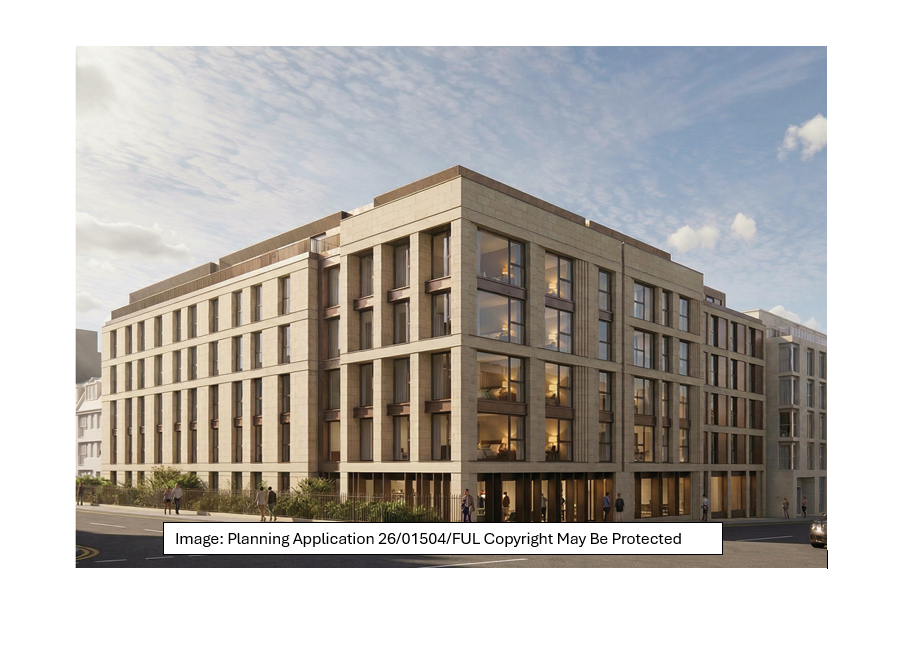
The Cockburn Association has reviewed the proposal for the demolition of existing buildings and the development of purpose-built student accommodation at 36 Russell Road. While we appreciate the intention to bring the site back into productive use, we cannot support the application in its current form.

At seven storeys and approximately 25 metres in height, the proposed building would be overly dominant within its setting and out of keeping with the surrounding townscape. Its form, massing, and roofline have not been convincingly justified and would risk appearing intrusive when viewed from neighbouring streets and from key protected views looking into the city centre. Before any scheme progresses, a more robust visual impact assessment is required to demonstrate that the proposal will not compromise Edinburgh’s valued skyline or wider landscape setting.

We are also concerned that this application will, in effect, set the parameters for how the rest of the adjacent site comes forward. In the absence of an agreed masterplan, piecemeal development risks undermining the potential for a coherent, well-designed neighbourhood. A site-wide masterplanning approach would provide clearer guidance on height, density, movement, public realm, and the mix of uses appropriate for this location, ensuring better long-term outcomes.

The site sits within easy walking distance of active travel routes, rail connections, and frequent bus services. Its highly accessible location makes it well suited for mixed-tenure, affordable or lower-cost housing that would support long-term residents and contribute to a more balanced and sustainable community. The exclusive focus on student accommodation fails to take advantage of this opportunity.

We further note that Edinburgh continues to face significant pressure from an expanding pipeline of student accommodation. A detailed, citywide assessment of supply, demand, distribution, and emerging trends is still required to guide decision-making. Until such evidence is available, approving additional large-scale, single-use student blocks risks exacerbating existing imbalances in local housing markets.

Although most rooms in the proposal are designed as cluster flats, the scheme as a whole offers little in the way of wider community benefit, usable amenity space, or meaningful integration with its surroundings. Given its scale, density, and narrow land use, we remain unconvinced that the proposal represents the best use of this strategically located site.

For these reasons, the Cockburn Association objects to the proposal as submitted.

Change of use from hotel to serviced apartments

Posted on: November 25, 2025

Objection to replacing approved housing with serviced apartments in New Town

Objection to replacing approved housing with serviced apartments in New Town

Cockburn Response

The Cockburn Association objects to the proposed change of use of 14–15 Claremont Crescent from hotel to seven serviced apartments. This application represents a clear retreat from the principle of restoring permanent residential use to this listed New Town terrace, a principle that underpinned the Council’s recent approval for residential conversion and which aligns with wider strategic objectives to sustain living communities within the historic city centre.

Claremont Crescent forms part of a sensitive, predominantly residential environment whose character depends not only on architectural form but on stable, long-term occupation. The replacement of consented residential flats with commercially managed serviced apartments introduces a transient model of occupation that is fundamentally different in nature, intensity, and impact. Experience elsewhere in the New Town demonstrates that such uses erode residential amenity through regular guest turnover, increased servicing activity, vehicle movements, waste handling, and the gradual loss of neighbourly continuity. These impacts are not mitigated simply because the former use was a hotel; the direction of travel approved by the Council was explicitly toward permanent housing, not a reshaped version of commercial accommodation.

Although the applicant states that no additional physical alterations are proposed, the change in operational use has the potential to affect the way the building is used, managed and maintained, with implications for the long-term care of its listed fabric and the character of the terrace. Serviced apartments often introduce cumulative pressures, including increased wear, signage, access systems and servicing infrastructure, which can undermine both heritage value and residential amenity if not rigorously controlled.

This proposal conflicts with the spirit and intent of NPF4, particularly Policy 16 (Quality Homes), and with City Plan 2030 policies seeking to protect residential environments from inappropriate commercial encroachment. Allowing this change would also set an unhelpful precedent, signalling that recently approved residential conversions can be reversed for short-stay commercial purposes, weakening the Council’s efforts to rebalance the city centre toward permanent habitation.

For these reasons, the Cockburn Association considers the proposal unacceptable in principle and detrimental to the long-term sustainability and character of the New Town. We therefore object to the application and urge the Planning Authority to refuse consent. Should the Council nonetheless be minded to consider approval, we strongly insist that stringent conditions be imposed to prevent unmanaged short-term use and to safeguard residential amenity and the historic fabric of the building.

Royal Terrace

Posted on: November 14, 2025

Harmful to A-listed Royal Terrace’s setting and neighbouring residential amenity

Harmful to A-listed Royal Terrace’s setting and neighbouring residential amenity

Cockburn Response

The Cockburn Association objects to this application. It has been brought to our attention by a local resident, and we share significant concerns about the impact of the proposal on both the heritage value of Royal Terrace and the amenity of neighbouring properties.

Royal Terrace is one of Edinburgh’s most architecturally important streets and forms a defining part of the Georgian New Town and the UNESCO World Heritage Site. Its Category A listing reflects its exceptional national significance. Any intervention within its curtilage, or which may affect its setting, must therefore be subject to the highest level of scrutiny. The elevated position of the site means that the proposed development would be highly visible and risks introducing an intrusive presence into a deliberately formal and coherent historic streetscape.

We are particularly concerned about the commercial nature of the proposal and the potential for increased activity, noise, and overlooking. These issues raise clear risks to residential amenity for properties along Royal Terrace and within the wider area, especially given the prominent siting and proximity of the proposed works to long-established homes. The potential for disturbance is considerable.

In our view, the works would have a material impact on the setting of the Category A-listed terrace. As such, a separate application for Listed Building Consent (LBC) is likely to be required under Section 8 of the Planning (Listed Buildings and Conservation Areas) (Scotland) Act 1997. We urge the planning authority to confirm this requirement and to request a full heritage impact assessment before progressing the application.

On policy grounds, the proposal appears contrary to several key provisions of the Edinburgh City Plan 2030. In particular, Hou 8 (Listed Buildings and Their Settings), which requires developments to preserve and, where possible, enhance the character and setting of listed buildings; and Des 2 (Alterations and Extensions), which calls for high-quality, context-appropriate design that does not harm the established character of its surroundings. The concerns about noise, disturbance, and overlooking also raise issues under Hou 9 (Protecting Residential Amenity). These matters align closely with NPF4 Policy 7 (Historic Environment), which places strong emphasis on safeguarding nationally significant heritage assets and their settings.

In summary, the Cockburn Association objects to this application on the grounds that it would harm the setting of a Category A-listed terrace, introduce unacceptable impacts on residential amenity, and does not comply with the relevant policies in City Plan 2030 or NPF4. We recommend refusal unless the applicant can demonstrate, through a substantially revised and fully justified proposal, that no detriment would arise to the historic environment or neighbouring amenity.

Atholl Crescent

Posted on: October 31, 2025

Protect Atholl Crescent’s heritage; reject intensive transient pods, favour residential.

Protect Atholl Crescent’s heritage; reject intensive transient pods, favour residential.

Cockburn Response

The Cockburn Association wishes to begin by acknowledging the constructive engagement provided by the applicant. We are grateful for the opportunity to visit both the Atholl Crescent buildings and a completed example of the developer’s work on Victoria Street. These visits helped clarify the design intent and allowed useful discussion around the challenges of adapting historic fabric.


We also recognise the wider policy context and the need to broaden the city’s accommodation offer, particularly in terms of affordability and accessibility. Edinburgh benefits when visitor provision is diverse, inclusive, and sensitively integrated into the life of the city. Ensuring that people of varying incomes and mobility needs can stay in central Edinburgh is a legitimate aim, and one we do not dismiss.


However, following detailed review of the proposals, we must object. The buildings at Atholl Crescent are of the highest architectural and historical significance, forming part of a distinguished early nineteenth-century terrace within the New Town Conservation Area and the UNESCO World Heritage Site. While we acknowledge that some modern alterations have taken place internally, the terrace retains important elements of its original plan form, spatial hierarchy. The proposed intensive subdivision of principal spaces, installation of pod-style units and new services throughout, and associated physical interventions would, in our view, result in substantial and irreversible harm to the special architectural and historic interest of these Category A listed structures. This would be inconsistent with the requirements of the Historic Environment Policy for Scotland, which places great weight on protecting and enhancing cultural significance.


We are equally concerned about the high-density transient use proposed. Atholl Crescent and Atholl crescent Lane retain a residential character. The scale of occupation, turnover of guests, servicing needs, and late-night activity associated with this model of accommodation would introduce significant intensification into a location planned and built as a quiet domestic street. We do not believe that a pod-style hotel aligns with the character, amenity, or lived environment of this part of the New Town. In our view, this conflicts with policies in City Plan 2030 which require development to safeguard residential amenity and maintain balanced, sustainable communities.


A crucial material factor in this case is the existence of extant consent for a lower-density residential scheme. That consent demonstrates that a viable, heritage-appropriate future for these buildings already exists, one that restores their domestic character, supports a living community, and avoids the physical and operational pressures of intensive transient use. Our concern is therefore not an abstract wish to retain every former office building as housing, but the real-world comparison between two clearly identified paths: a settled residential restoration aligned with the historic form and community fabric of the Crescent, or a significantly more intensive visitor use with greater operational impacts and less obvious benefit to the character and wellbeing of the surrounding neighbourhood.


In this context, the key public-interest question remains unanswered: why should a far more intensive transient scheme be considered preferable to a viable consented residential use that would better sustain the New Town’s historic function as a lived-in community? We have not seen compelling evidence that such a shift would enhance the Outstanding Universal Value of the World Heritage Site or contribute positively to the long-term stewardship of these buildings.


We also note the absence of clear long-term heritage management and maintenance proposals, which are essential for buildings of such national importance.


For these reasons, we respectfully request that the applications be refused. We would be pleased to see revised proposals that protect the architectural integrity of the interiors, avoid over-intensification, and support the Crescent’s continued role as part of a living residential quarter. The Cockburn remains willing to work constructively with the applicant to explore a conservation-led scheme that secures the buildings’ future and maintains the character and community balance of this important part of the New Town.


Western Harbour

Posted on: October 29, 2025

Call for contextual, sustainable, and community-focused redesign of Western Harbour

Call for contextual, sustainable, and community-focused redesign of Western Harbour

Cockburn Response

The Cockburn Association acknowledges the urgent need for new homes in Edinburgh and supports, in principle, the residential redevelopment of this long-vacant brownfield site within the Western Harbour area. However, having reviewed the current submission, we remain unable to offer support at this stage. The proposal, as it stands, does not demonstrate the design ambition, contextual awareness, or public-realm quality required for such a prominent waterfront location.

The architecture and overall layout continue to appear overly generic, with monolithic massing and limited articulation across the elevations. The design does not respond convincingly to its immediate context or to the distinctive maritime character of the area. We question the continuing tendency to reference the industrial or warehouse styles of Leith when this part of the harbour lies geographically and visually closer to Newhaven, with its more traditional maritime vernacular. The current design language feels misplaced in a residential context and risks producing a development that is neither rooted in its surroundings nor reflective of the waterfront’s authentic identity.

The original Robert Adam masterplan for Western Harbour, upon which this site and the adjoining parcels (A2–C) were based, at least attempted to respect a more traditional maritime design history, employing varied densities, rooflines, and visual interest to create a legible sense of place. This proposal abandons much of that ambition. As Site A1 will inevitably set the tone and design precedent for subsequent phases at the northern tip of the harbour, it is essential that this stage is handled with far greater care and imagination.

Equally concerning is the absence of reference to the derelict Lighthouse building, one of the few remaining physical reminders of the area’s nautical heritage. This application represents an ideal opportunity to explore its restoration and repurposing for community use, thereby delivering tangible public benefit while preserving a key element of the site’s maritime legacy. Its omission is a significant missed opportunity, particularly given the building’s prominence and deteriorating condition.

The handling of landscape and ecology remains weak. The proposal lacks a convincing ecological or landscape framework that demonstrates how the existing ponds, woodland, and wetland habitats will be retained and enhanced. These natural features are valuable assets that contribute to biodiversity and climate resilience, and their protection should be central to the development concept. Similarly, the public-realm strategy remains underdeveloped and fails to show how the site will provide meaningful connections to the waterfront, high-quality open space, and safe routes for pedestrians and cyclists.

We also note with concern that the application does not include an Affordable Housing Statement, which remains a required component for a complete submission. While the plans reference a 35% affordable housing quota, this must be supported by clear evidence that at least 70% of that quota will be delivered as social housing by a registered provider. In the context of Edinburgh’s ongoing housing crisis, such provision is essential. The statement should also explain the rationale behind the differing proportions of one-, two-, and three-bedroom units across tenures and confirm compliance with the requirement for 20% of homes to be built to wheelchair-accessible standards. The absence of this information limits proper public and policy scrutiny.

Given the site’s scale, visibility, and strategic importance, the quality benchmark for design and delivery should be considerably higher. A development of this magnitude should aspire to create a coherent, distinctive, and sustainable neighbourhood that reflects its setting on the Forth and contributes positively to Edinburgh’s evolving waterfront identity. Without stronger design ambition, a clearer ecological framework, and a transparent affordable-housing strategy, there is a real risk that this project will fall short of its potential.

We therefore recommend that the planning authority require substantial revisions to the scheme before approval is considered. These should include a refined design approach grounded in the site’s maritime context; the preparation of a robust landscape and ecology plan that retains and enhances existing natural assets; a detailed Affordable Housing Statement addressing social-let provision and accessibility standards; and consideration of the restoration and community reuse of the Lighthouse building as a heritage and placemaking asset.

In summary, while the Cockburn Association supports the principle of new housing at Western Harbour, we believe that this proposal, in its current form, lacks the architectural distinctiveness, contextual sensitivity, and social commitment required to deliver a development of enduring value. We urge the applicant and the planning authority to work collaboratively to produce a scheme that realises the true potential of this important waterfront site,  one that honours its maritime legacy, meets the city’s social-housing needs, and contributes meaningfully to a sustainable and distinctive Edinburgh waterfront.


Gillespie Crescent

Posted on: October 23, 2025

Cockburn objects: overdevelopment, heritage harm, community imbalance, and unsustainable demolition

Cockburn objects: overdevelopment, heritage harm, community imbalance, and unsustainable demolition

Cockburn Response

The Cockburn Association welcomes the opportunity to comment on this revised proposal for 50 Gillespie Crescent. We recognise that the applicant, S Harrison Developments Ltd in partnership with Sight Scotland, has sought to address the reasons for refusal of the earlier 2023 scheme (references 23/06623/FUL and 23/06624/CON) and the subsequent appeals dismissed by the DPEA in 2024. While the design revisions represent a modest improvement in terms of articulation and materiality, the Association remains unable to support the application.

The existing building, although altered and of limited individual distinction, contributes to the established rhythm, height and grain of the Marchmont, Meadows and Bruntsfield Conservation Area. Its demolition can only be justified if the proposed replacement demonstrably enhances the townscape. The revised design, despite the introduction of a mansard roof and a more refined fenestration pattern, continues to read as an assertive and monolithic intervention that fails to respect the delicate proportions and roofline character of Gillespie Crescent. In our view, the proposal would erode the area’s historic coherence and would not achieve the enhancement required under NPF 4 Policy 1 and City Plan 2030 Policy ENV 10.

Although the applicant’s design team has worked to reduce the overall massing, the new block remains visually dominant when viewed in context with its tenement neighbours. The relationship between scale, height and plot width remains unconvincing, and the building’s apparent bulk is likely to harm the character and appearance of the conservation area, contrary to NPF 4 Policy 28 and City Plan 2030 Policy DES 1. We acknowledge the improved use of stone and the reuse of materials from the existing structure, but these measures do not overcome the fundamental issue of overdevelopment.

The Association is also concerned about the continuing over-concentration of purpose-built student accommodation in this part of Bruntsfield and Marchmont. The cumulative impact of repeated PBSA developments is increasingly evident in the erosion of community balance, the displacement of permanent residents and the narrowing of housing diversity. The present proposal would further intensify this pattern, running counter to the objectives of NPF 4 Policy 16(c) and City Plan 2030 Policy HOU 8, which seek to sustain balanced communities and promote a mix of housing types and tenures. While the need for well-managed student housing is recognised, it should not come at the expense of local character or social cohesion.

Although the proportion of external amenity space has been increased from 13 per cent to 43 per cent, the quality and usability of these areas remain uncertain. The submitted drawings suggest that overshadowing and privacy impacts for both future residents and existing neighbours may persist, particularly along the rear boundary. The building’s proximity to adjoining gardens and the scale of its rear elevation appear likely to compromise residential amenity and reinforce the sense of overdevelopment within a constrained site.

The Cockburn welcomes the applicant’s stated commitment to achieving BREEAM ‘Excellent’ and the inclusion of renewable technologies such as air-source heat pumps and photovoltaic panels. However, NPF 4 Policy 1 sets a clear presumption in favour of building retention and retrofit wherever feasible. While we note the feasibility study submitted in support of demolition, we believe that the economic arguments for replacement should be independently verified to ensure that all realistic options for adaptive reuse have been properly explored. Retention and sensitive adaptation would be inherently more sustainable than complete demolition and new construction, even with offsetting measures.

In conclusion, the Cockburn Association recognises the applicant’s effort to respond to the findings of the DPEA Reporter and to improve aspects of design and sustainability. Nevertheless, we remain unconvinced that the proposed development represents an enhancement of the conservation area or a responsible contribution to a balanced community. The proposal continues to present concerns relating to excessive scale, heritage impact, loss of embodied carbon, and further saturation of PBSA within this part of the city. For these reasons, the Association objects to planning application 25/02255/FUL and respectfully requests that the Council refuse permission. Should the authority be minded to approve, we urge that any consent be subject to conditions requiring a reduction in overall height, strengthened landscaping and boundary treatment, a comprehensive Construction Management Plan to protect neighbour amenity, and a robust Student Management Plan ensuring active engagement with the local community.

Hostel Extension

Posted on: October 4, 2025

Proposal harms Old Town’s character and World Heritage Site integrity

Proposal harms Old Town’s character and World Heritage Site integrity

Cockburn Response

The Cockburn Association objects to the proposed extension of the hostel and the formation of a ground-floor public bar at 37–39 Cowgate. The site lies within the Old Town Conservation Area and at the heart of the Edinburgh World Heritage Site, both of which carry the highest levels of protection under local, national and international policy frameworks. In our view, the proposal fails to preserve or enhance the character of the area and risks causing demonstrable harm to the Outstanding Universal Value of the World Heritage Site.

The Old Town Conservation Area Character Appraisal identifies the area’s defining qualities as its “unique topography and medieval street pattern, narrow closes, and the dramatic juxtaposition of scale and form.” It emphasises the importance of “the relationship of buildings to topography, their irregular rooflines and the use of traditional materials” as critical to townscape character. Against this benchmark, the proposed extension reads as a rectilinear, modern insertion whose massing, façade treatment and architectural expression sit uneasily with the surrounding historic fabric. Rather than appearing as a sympathetic extension, the design has the character of an entirely new block, eroding the carefully layered grain of the Old Town.

From a wider perspective, the Edinburgh World Heritage Site Management Plan (2022–27) underlines the obligation to safeguard the city’s historic urban landscape, noting that “new development must protect and, where possible, enhance the qualities of the World Heritage Site that contribute to its Outstanding Universal Value.” The plan further warns against incremental harm, stressing that even modest interventions can have a cumulative impact on the authenticity and integrity of the World Heritage Site. The current proposal, visible from Greyfriars Kirkyard and key approaches to the Cowgate, would intrude upon significant historic views and diminish the setting of one of Edinburgh’s most iconic monuments.

City Plan 2030 reinforces these obligations. Policy DES 1 (Design Quality and Context) requires new development to “draw upon positive characteristics of the surrounding area,” while DES 3 (Heritage) stipulates that proposals affecting listed buildings, conservation areas, or the World Heritage Site must be “sympathetic to their special interest, character and setting.” Policy ENV 9 requires development to “preserve or enhance the character or appearance of conservation areas.” In all of these respects, the present scheme falls short.

There are also concerns about amenity and liveability. The introduction of a public bar in this location risks exacerbating the already intense pressures of noise, congestion, and crowding within the Cowgate and Candlemaker Row. The Conservation Area Character Appraisal explicitly identifies pedestrian movement, narrow streets, and conflicts between vehicles and footfall as ongoing vulnerabilities. Without a credible transport and servicing strategy, the scheme risks compounding these problems, contrary to City Plan 2030’s objectives for sustainable movement and improved urban liveability.

Taken together, the proposal conflicts with statutory duties under Sections 14 and 64 of the Planning (Listed Buildings and Conservation Areas) (Scotland) Act 1997, fails to satisfy the conservation and design policies of City Plan 2030, and undermines the commitments of the World Heritage Site Management Plan. In this highly sensitive location, the city deserves a building of distinction that strengthens, rather than diminishes, its heritage value.

For these reasons, the Cockburn Association urges the Council to refuse both planning and listed building consent for the scheme in its current form. We remain open to constructive engagement with the applicant should a revised design be brought forward that respects the character of the Old Town Conservation Area, safeguards the Outstanding Universal Value of the World Heritage Site, and meets the high standards rightly expected for development in Edinburgh’s historic core.

Edinburgh’s Christmas

Posted on:

Balance festive celebrations with safeguarding Princes Street Gardens’ quiet enjoyment

Balance festive celebrations with safeguarding Princes Street Gardens’ quiet enjoyment

Cockburn Response

The Cockburn Association recognises the popularity of Edinburgh’s Christmas Festival and the contribution it makes to the city’s seasonal life. The event attracts many visitors and creates a lively festive atmosphere in the city centre. At the same time, Princes Street Gardens are of exceptional significance, being part of the Inventory-listed New Town Gardens and central to the Old and New Towns of Edinburgh World Heritage Site. They are valued not only as a setting for events but as an historic landscape and a much-loved civic green space, offering opportunities for quiet enjoyment in the heart of the city.

This year’s applications (25/04656/FUL and 25/04660/FUL) are timely and provide fuller detail than in previous years, which we welcome as a positive step towards greater transparency and planning certainty. The proposals involve temporary installations across Princes Street Gardens, and the Mound precinct, from late October until mid-January. While these activities can enhance the festive offer, they also limit general access for several months of the year and affect the quiet enjoyment of the gardens as a greenspace. Every effort should therefore be made to minimise these impacts, and to ensure that any damage to trees, surfaces, or planting is quickly and fully reinstated. The proposal for a two-year recurring consent in the West Gardens also raises questions about how impacts will be reviewed and managed over time, making ongoing monitoring and evaluation especially important.

The Cockburn Association believes that these issues can best be addressed through open dialogue and careful planning. We would encourage the City of Edinburgh Council, event operators, heritage bodies, community groups, and garden users to work together in shaping how the gardens are used during the festive season. With such collaboration, it should be possible to find a balance that safeguards the historic and ecological value of Princes Street Gardens while also enabling appropriate cultural activity.


Gable mural

Posted on: October 3, 2025

A significant aesthetic intervention altering the sense of place locally

A significant aesthetic intervention altering the sense of place locally

Cockburn Response

The Cockburn Association recognises the creative contribution that public art can make to Edinburgh’s streetscape and notes the University of Edinburgh’s ambition to commission murals by the artist .EPOD for its KM Hotel on Richmond Place. However, this proposal represents a significant aesthetic intervention in a sensitive historic environment and has the potential to alter the sense of place of the local area. It is therefore essential that local residents and community stakeholders are fully consulted and given an opportunity to have a say in such a substantial change to their neighbourhood.


Given the listed status of the building, the integrity of the historic fabric must remain paramount. Any preparatory works, fixings, or surface treatments should be demonstrably reversible and leave no permanent impact on masonry or architectural detailing. Clear conditions around reversibility and long-term maintenance are also vital, since the visual quality of murals can deteriorate over time if subject to fading, weathering or graffiti.


The introduction of murals on a listed building also raises wider questions of precedent. Approval here could be interpreted as an endorsement of painted interventions on historic structures more generally, and the Council should ensure that decisions are made strictly on a site-specific basis. Richmond Place forms part of a coherent townscape, and any intervention must be judged carefully in terms of scale, palette, and thematic content to avoid undermining the wider character. A visual impact assessment would help to demonstrate how the proposed works would be perceived in context, including views within the Southside Conservation Area.


Finally, the long-term management of the murals requires clarification. If this is intended as a one-off commission, that should be clearly stated; if a rotating or evolving series is envisaged, then separate consents should be required to ensure appropriate oversight. A public art management plan, covering maintenance and eventual de-installation, would provide important assurances that the project will enhance rather than compromise the city’s historic environment.