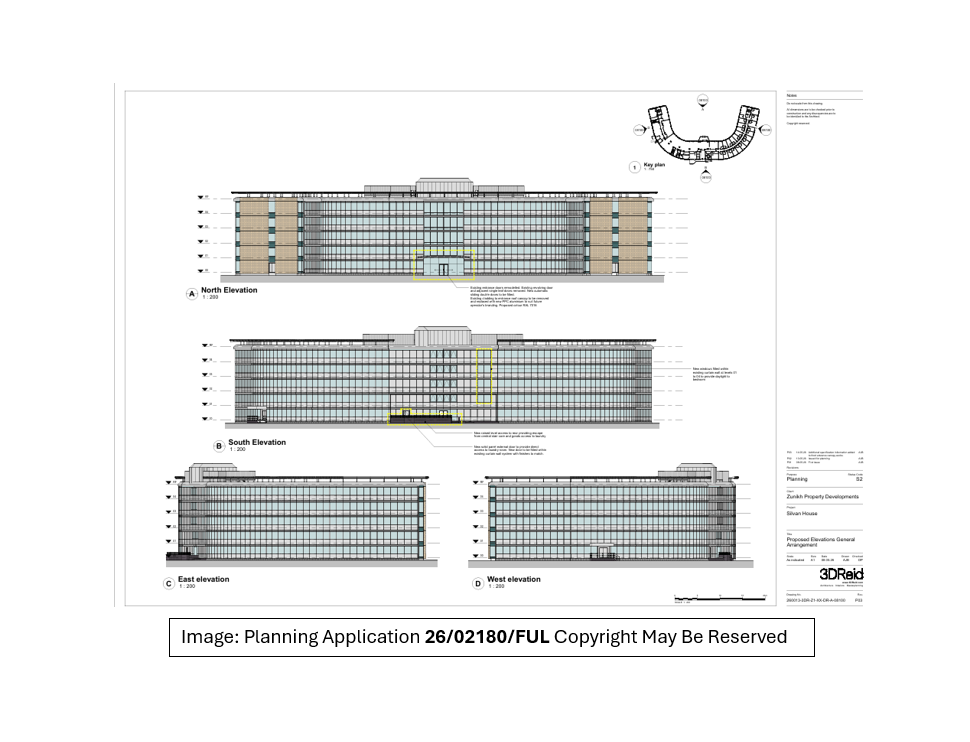
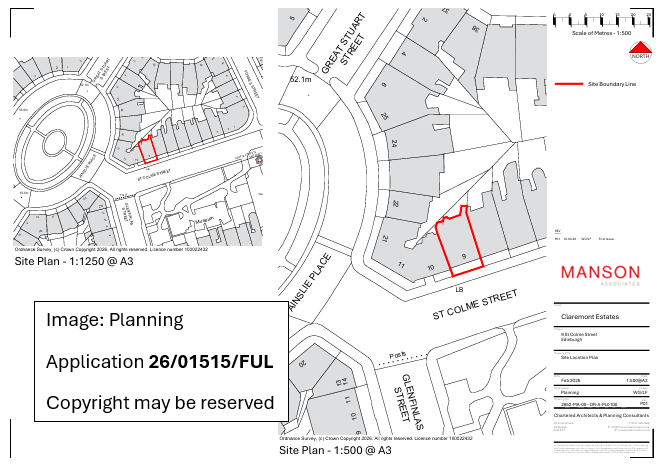
109 Princes Street

Posted on: April 24, 2026

Scaffold advert harms Princes Street’s historic character and coherence

Scaffold advert harms Princes Street’s historic character and coherence

Cockburn Response

The Cockburn Association welcomes the opportunity to comment on this application.

Princes Street is one of Edinburgh’s most important civic frontages, forming part of the World Heritage Site and the New Town Conservation Area. Proposals in this location require a high degree of sensitivity to context, architectural character and townscape coherence.

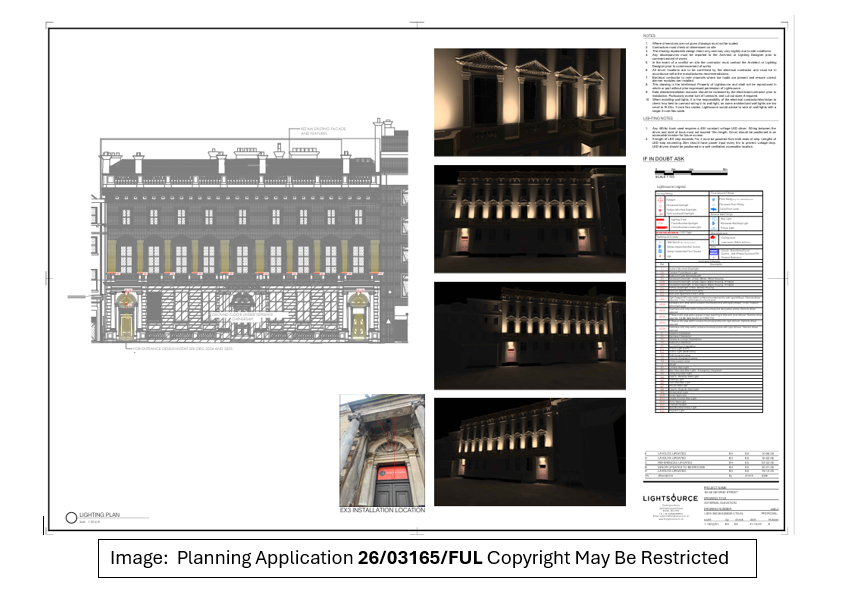
The proposed scaffold-mounted advertisement, incorporating a full-height façade wrap, raises significant concerns. By replacing the architectural expression of a listed building with a large-scale graphic surface, the proposal results in a clear loss of character and legibility. Even as a temporary intervention, its scale and prominence introduce a level of visual impact that is not proportionate to its stated purpose.

The inclusion of illumination further intensifies this effect, contributing to visual intrusion and altering the character of the street, particularly in evening conditions.

The cumulative impact of such proposals is of particular concern. Scaffold advertising on Princes Street has become increasingly frequent, with successive temporary consents creating a pattern that risks becoming established over time. This proposal reinforces that trajectory and contributes to the gradual erosion of the street’s distinctive qualities.

While the practical requirements of building maintenance are understood, the approach taken here does not demonstrate a sufficiently sensitive or contextually grounded response to this highly significant location.

We object to this application in its current form.

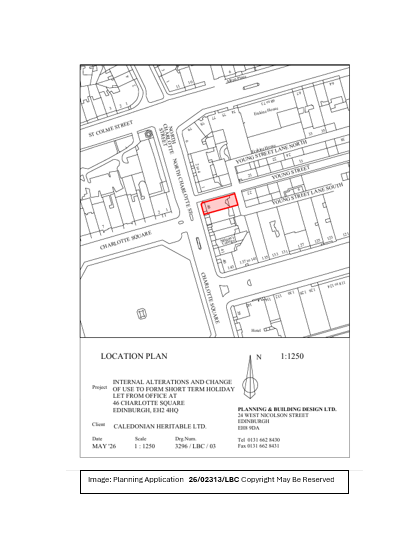
London Street – Serviced Apartments

Posted on: April 3, 2026

Objects to conversion harming heritage, residential use, community balance

Objects to conversion harming heritage, residential use, community balance

Cockburn Response

The Cockburn Association objects to this application.

The proposal seeks listed building consent for the conversion of part of 39 London Street, an A-listed building within the New Town Conservation Area and World Heritage Site, to seven serviced apartments with integral manager’s accommodation. While the re-use of a vacant building is supported in principle, the current proposal raises significant concerns.

The primary issue is heritage impact. The level of internal subdivision required to deliver seven serviced units suggests a substantial intervention in the plan form and spatial hierarchy of the building. The application refers to restoration of original features, but does not demonstrate that the proposed alterations are conservation-led or that the significance of the building will be preserved. The justification advanced is largely functional and economic, which is not sufficient in the context of an A-listed building.

There are also concerns regarding the proposed use. The application relies on the argument that no residential use is being lost. However, this overlooks the importance of maintaining and supporting residential and mixed civic functions within the city centre. The introduction of intensive short-stay accommodation represents a shift towards transient occupation that does not contribute positively to community life.

The applicant suggests that previous concerns regarding amenity have been addressed through management measures, including 24-hour staffing. While these measures may assist operationally, they do not address the underlying issue of use intensity and compatibility with the surrounding residential context. The proposed approach to shared rear garden access further reinforces this concern. Restricting access to staff only, while relying on the garden for emergency egress, introduces a service-based and operational use of a semi-private residential space without providing any corresponding amenity benefit. It has not been demonstrated how this arrangement would be managed or how impacts on neighbouring residents would be mitigated.

Finally, the proposal must be considered in cumulative terms. The application refers to recent permissions for short-term lets nearby. In our view, this reinforces rather than resolves concern. The continued conversion of buildings within the New Town to visitor accommodation risks eroding the character and liveability of the area over time, including through incremental changes to how shared residential infrastructure is used and experienced.

For these reasons, the Cockburn Association objects to the application.

Salamander Street – Demolition and Redevelopment

Posted on:

Positive shift, but design quality and place-making remain weak

Positive shift, but design quality and place-making remain weak

Cockburn Response

The Cockburn Association welcomes the redevelopment of this site and supports the continued transition of this part of Leith towards a predominantly residential neighbourhood.

In particular, we welcome the revised residential mix, including the reduction in purpose-built student accommodation (PBSA) and the increase in mainstream and affordable housing. This represents a positive and policy-aligned shift. We also support the emerging approach to intergenerational living, which has the potential to contribute to a more balanced and sustainable community.

However, while these strategic changes are encouraging, the design quality of the proposal does not yet meet the standard expected for a development of this scale and prominence in Scotland’s capital.

The principal concerns relate to place-making and architectural quality. The scheme remains insufficiently distinctive, reading as a generic development rather than one grounded in the character and identity of Leith. The public realm offer is weak, with limited evidence of a generous and engaging street environment. The development appears inward-looking, with much of the amenity provision internalised.

The ground floor and street interface are underdeveloped, and the proposed active frontage lacks the clarity and robustness required to support a lively and attractive street. In addition, the architectural expression lacks depth and articulation, and does not yet demonstrate the richness of materiality and detailing expected in this context.

There are also outstanding environmental concerns, particularly in relation to air quality and the delivery of a healthy residential environment. The proposal does not yet demonstrate a sufficiently integrated approach to climate resilience and blue-green infrastructure.

In summary, while the direction of travel is supported, the scheme requires significant further design development to achieve the level of quality expected in Edinburgh.

The Cockburn Association would welcome further refinement and continued engagement to address these issues and to realise the full potential of this important site.

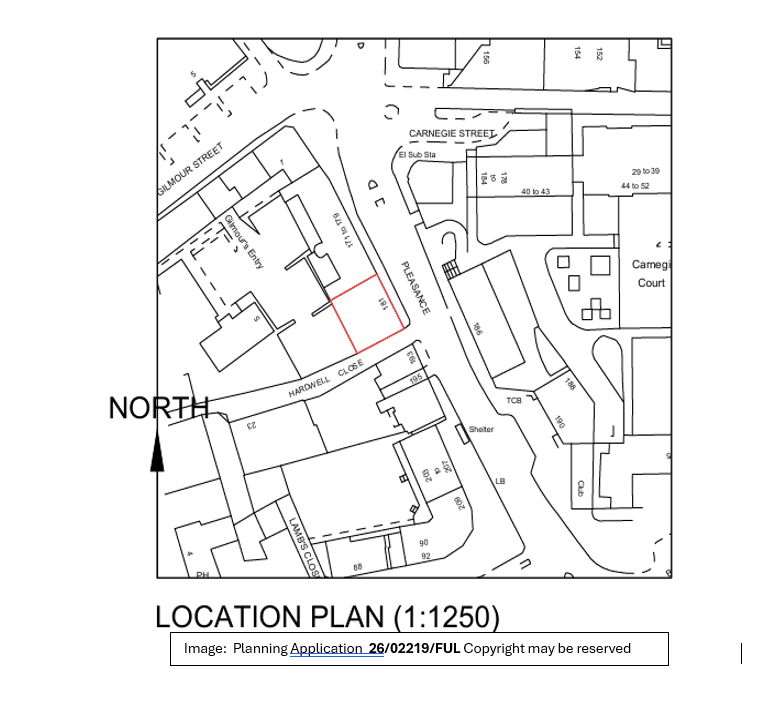
Pleasance – Temporary venue

Posted on:

Supports continued cultural use with management of residential impacts and continued improvement

Supports continued cultural use with management of residential impacts and continued improvement

Cockburn Response

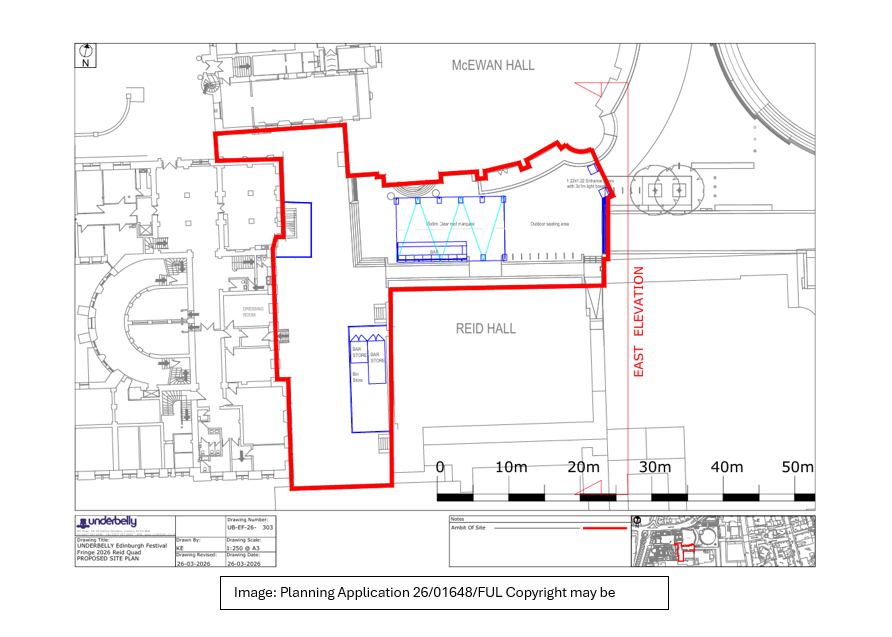
The Cockburn Association recognises that the proposal relates to a long-established Festival Fringe venue at the Pleasance Courtyard and supports the continued cultural use of this site.

The temporary and reversible nature of the development substantially limits its long-term physical impact and supports its acceptability in principle.

The Group welcomes the applicants’ extensive programme of community engagement and the operational improvements introduced in response to resident feedback, including reduced bar hours, revised programming and enhanced noise mitigation.

However, the evidence presented confirms that impacts on residential amenity, particularly in relation to noise and late-night activity, are ongoing and require active management.

Given that the proposal is both temporary and recurring, the Group considers that this raises important issues of cumulative impact. Temporary consent should not be regarded as static, but as enabling an evolving and responsive approach to design, management and community integration.

The Cockburn Association therefore supports the continued use of the site, while encouraging further refinement in the following areas:

  • stronger integration with the surrounding public realm
  • improved visual coherence and design quality of temporary structures
  • continued enhancement of operational management and environmental performance

Future iterations of the scheme should demonstrate measurable improvement in response to community feedback, ensuring that the venue contributes positively not only to the Festival Fringe but also to the everyday life of the surrounding neighbourhood.

Forth Street Apart-Hotel

Posted on: March 17, 2026

Opposes apart-hotel; risks interiors, heritage integrity, and mixed-use balance.

Opposes apart-hotel; risks interiors, heritage integrity, and mixed-use balance.

Cockburn Response

The Cockburn Association objects to the proposed conversion of 16–26 Forth Street from office use to a large apart-hotel.

While the continued repair and reuse of historic buildings is welcome in principle, the scale and intensity of the proposed development raise significant concerns. The level of internal subdivision required to create approximately ninety visitor accommodation units risks undermining the spatial character and architectural integrity of the listed Georgian interiors.

Concerns also arise regarding the design and scale of the proposed rear extension within the courtyard environment, which must remain clearly subordinate to the historic terrace.

More broadly, the proposal contributes to an increasing pattern of converting buildings within the city centre to visitor accommodation. While tourism is an important part of Edinburgh’s economy, the cumulative loss of employment and mixed-use functions risks undermining the balanced character of the New Town.

For these reasons, the Cockburn Association objects to the proposal and encourages the planning authority to carefully consider both the heritage impacts and the cumulative effects of visitor accommodation within this historic area.


Robertson Avenue student residential development

Posted on: March 13, 2026

Design misalignment undermines streetscape; redevelopment principle supported

Design misalignment undermines streetscape; redevelopment principle supported

Cockburn Response

The Cockburn Association supports the principle of redeveloping this long-vacant site and recognises the potential for the proposal to repair the Robertson Avenue streetscape.  However, the Association objects to the proposal in its current form.

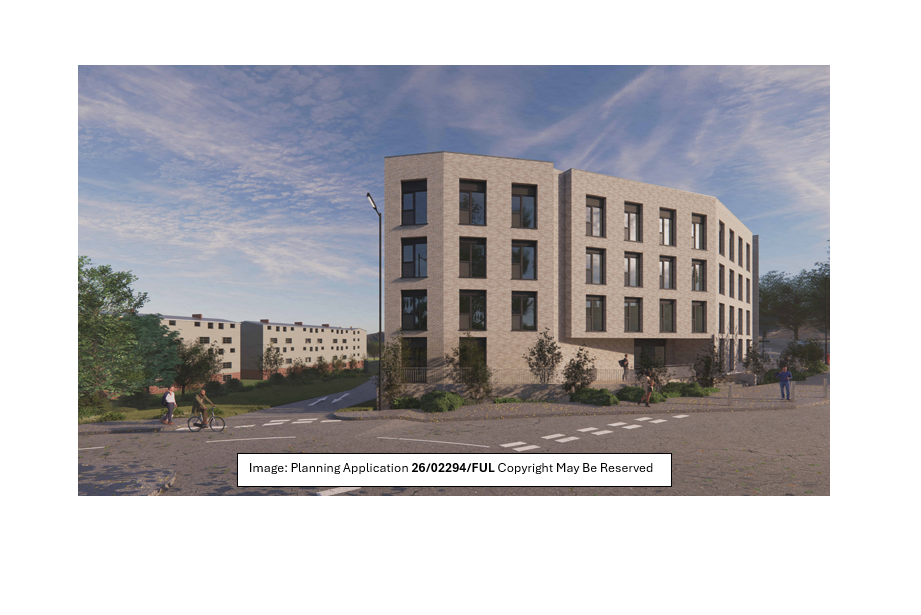
The architectural elevation does not adequately align with the roofline and horizontal string courses of the adjoining traditional tenement, resulting in an unsatisfactory relationship with the established streetscape. A revised design aligning façade elements with neighbouring architectural datum lines would significantly improve contextual integration.

Clarification is also required regarding:

  • the extent of ground-floor activation and the development’s contribution to the street environment;
  • the building’s capacity to be adapted to mainstream residential use in future.

The Association also reiterates its concern regarding the cumulative concentration of PBSA within the Gorgie and Dalry corridor. While modest in scale individually, such developments may collectively undermine balanced communities if not carefully managed.

A revised design addressing the issues identified above would significantly improve the proposal’s relationship with its context and its contribution to the wider neighbourhood.

Rose Street Theatre (former Charlotte Chapel)

Posted on:

Adaptive reuse supported, subject to strong conservation safeguards

Adaptive reuse supported, subject to strong conservation safeguards

Cockburn Response

The Cockburn Association welcomes the opportunity to comment on the revised proposal for the conversion of the former Rose Theatre to hotel use.

We previously raised substantial concerns regarding the extent of internal subdivision and loss of significant historic fabric. It is therefore important to acknowledge that the current submission demonstrates a constructive response. The retention of the principal sanctuary space and the decision to preserve the historic pulpit are positive and reflect a clearer appreciation of the building’s architectural and cultural significance.

The Association supports the principle of bringing a long vacant listed building back into sustainable use. Securing a viable future for heritage assets is essential to their long-term conservation and to the vitality of the city centre.

However, heritage impact remains the central consideration. The special interest of the building lies not only in individual features but in the coherence of its interior volume and its layered history as chapel and theatre. Further assurance is required that hotel adaptation, services installation and subdivision will not undermine that integrity. A rigorous and clearly articulated conservation methodology should underpin any consent, with particular emphasis on reversibility and minimal intervention.

The Association also notes the cumulative reduction of cultural venues within the city centre. While market realities are acknowledged, we encourage exploration of opportunities to retain some element of public or cultural use within the scheme to maintain continuity with the building’s recent history.

Given the improvements made, the Cockburn Association does not object in principle to the adaptive reuse of the building. Our position is conditional. We urge the planning authority to secure robust conservation safeguards and to ensure that the final design exemplifies best practice within he New Town Conservation Area and World Heritage Site.

Subject to those safeguards, the revised proposal has the potential to represent a more balanced and conservation-led outcome than the previously refused scheme.

Photo: Christopher Anderson / Wikimedia Commons, licensed under Creative Commons Attribution-ShareAlike.

Frederick Douglass plaque

Posted on: February 10, 2026

Approve plaque commemorating Frederick Douglass’s historic abolitionist speech in Edinburgh

Approve plaque commemorating Frederick Douglass’s historic abolitionist speech in Edinburgh

Cockburn Response

The Cockburn Association supports this modest and appropriate proposal to install a bronze commemorative plaque to Frederick Douglass at 29A Waterloo Place. The application represents a valuable addition to Edinburgh’s historic environment and offers an important opportunity to recognise the city’s connections to global movements for justice and human rights.

Frederick Douglass (1818–1895) was one of the most significant abolitionist voices of the nineteenth century. Having escaped from slavery in the United States, he became an internationally respected campaigner, writer and speaker. Douglass visited Scotland during his tour of Britain and Ireland in 1846, and spent time in Edinburgh addressing public meetings on the injustice of slavery. His presence in the city forms part of a wider history of Scottish engagement with transatlantic abolitionism, as well as Douglass’s own intellectual admiration for figures such as Robert Burns and Walter Scott.

The proposed plaque is small in scale, sensitively designed, and directly related to the historical significance of the building where Douglass spoke. Such commemorative markers contribute to public understanding of Edinburgh’s layered past and support a more inclusive interpretation of the city’s heritage. The installation would enhance the cultural and educational value of Waterloo Place without adverse impact on the character of the conservation area.

In planning terms, this is a well judged intervention that strengthens place identity, promotes historical awareness, and aligns with wider objectives around civic memory, equality, and the respectful enrichment of the public realm.

For these reasons, the Cockburn Association encourages the Council to support the application, and recommends that the final wording of the plaque inscription be reviewed and verified in consultation with appropriate academic authorities to ensure historical accuracy.

Image: Frederick Douglass, c.1855–1879, public domain photograph.

Radical Road

Posted on: January 13, 2026

The Radical Road is not simply a viewpoint or path

The Radical Road is not simply a viewpoint or path

Cockburn Response

The Cockburn Association welcomes the opportunity to comment on the planning application submitted by Historic Environment Scotland relating to proposed works at the Radical Road in Holyrood Park.

We recognise the complexity of managing risk within a nationally important historic and natural landscape and welcome the clear intention, expressed through this application, to enable a partial reopening of the Radical Road. The proposed installation of safety barriers and fencing, warning signage relating to rockfall risk, vegetation management, and associated measures represents a constructive response following the road’s prolonged closure. Any step that restores public access to this remarkable historic route, while addressing genuine safety concerns, is to be welcomed.

We particularly welcome the timing of this partial reopening, which coincides with the tercentenary of James Hutton’s birth in 2026 and will allow renewed public access to key geological features such as Hutton’s Section and Hutton’s Rock at a time of increased national and international interest in Scotland’s geological heritage.

However, the Association wishes to register concerns regarding Historic Environment Scotland’s proposal to limit public access to only a section of the Radical Road. The full historical, cultural, and experiential significance of the site cannot be appreciated through partial access alone.

The Radical Road is not simply a viewpoint or a discrete section of path. It is a continuous historic route, deliberately engineered in the early nineteenth century as a democratic promenade shaped by Enlightenment ideals, geological curiosity, and social reform. Its meaning lies in its linearity, continuity, and cumulative experience, as walkers move beneath the Salisbury Crags and engage sequentially with the geology, landscape, and surrounding city. Fragmentation of this route significantly diminishes that understanding.

Partial access also risks weakening the site’s intangible heritage. The Radical Road has long functioned as a place of informal learning, embodied experience, and shared civic use, values that depend on continuity, movement, and repeated public engagement over time. Restricting access to isolated sections erodes these lived and experiential qualities, which are central to the Road’s cultural significance.

We are therefore concerned that measures introduced under the present application, unless explicitly framed as temporary and transitional, risk normalising a permanently curtailed version of the Radical Road. While we acknowledge that partial reopening may represent a pragmatic interim solution, reopening the road along its entire length must remain the clear and stated goal.

Accordingly, the Cockburn Association urges the planning authority to ensure that:

  • the partial reopening is explicitly defined as a step towards full reinstatement of the Radical Road, rather than a substitute for it;
  • any permissions granted are time-limited, for example to a period of five years, subject to review, and accompanied by a clear commitment to ongoing monitoring and assessment of options for further reopening;
  • conditions attached to any consent do not inadvertently legitimise the long-term closure of remaining sections of this historic route;
  • the application is considered within the broader context of Holyrood Park as a cultural, geological, and scientifically significant landscape, where public access, understanding, and public benefit are central to its value. This approach would align with National Planning Framework 4, particularly policies supporting public access to the outdoors and the sustainable management of historic assets, as well as City Plan 2030 objectives for inclusive access to Edinburgh’s cultural and natural heritage and the protection and enhancement of greenspaces for public benefit. It would also be consistent with wider Scottish Government policy commitments to wellbeing, outdoor access, and responsible stewardship of nationally significant heritage assets.

Given Edinburgh’s status as a UNESCO World Heritage Site, Holyrood Park’s designation as a Site of Special Scientific Interest, and Scotland’s international reputation for landscape, heritage, and environmental management, it is essential that this internationally important asset is managed with the level of care, resourcing, and long-term planning required to keep it fully accessible wherever safely possible.

The Radical Road remains one of Edinburgh’s most powerful examples of landscape as civic expression. Its full restoration, carefully managed and transparently reviewed, would represent not only a gain for walkers and visitors, but a reaffirmation of Edinburgh’s commitment to shared heritage, public access, and responsible stewardship.

The Cockburn Association therefore supports the proposed partial reopening as an interim measure, but strongly encourages Historic Environment Scotland and the planning authority to treat this application as part of a wider, clearly articulated pathway towards reopening the Radical Road in its entirety.

Coltbridge Terrace

Posted on: January 6, 2026

Support extra-care use, but scale, tree loss, impacts unacceptable.

Support extra-care use, but scale, tree loss, impacts unacceptable.

Cockburn Response

The Cockburn Association welcomes the opportunity to comment on this proposal for an extra-care community at 11–15 Coltbridge Terrace. We recognise the social value of providing accommodation that allows people to live independently with support, and we appreciate the intention to bring the C-listed Lansdowne House back into meaningful use. The removal of later additions of little merit, together with plans to repair the house and retain the Gate Lodge, is encouraging and reflects a heritage-led approach that we support in principle.

However, despite these positive elements, we are concerned that the overall scale and intensity of the development goes well beyond what this sensitive site and its Conservation Area setting can comfortably accommodate. The new buildings proposed along Henderland Road and within the former grounds of Lansdowne House are substantial structures. Even with attempts to break up the rooflines or to step back upper storeys, they read not as villas but as modern multi-unit apartment blocks, and their combined mass diminishes the visual prominence of the listed building, which was historically the centrepiece of its landscape. The grain of the area, consisting of large villas in generous, well-treed grounds, does not naturally lend itself to the level of built form now proposed.

This point is closely tied to the landscape impacts, and here the proposals raise particular alarm. The removal of 29 trees, including several Category A and B specimens, is a significant change to the character of the Conservation Area. These mature trees form an essential part of the visual and environmental fabric of Coltbridge and Wester Coates. While replacement planting is offered and canopy calculations are provided, it is difficult to accept that saplings will, in the short or medium term, compensate for the loss of mature canopy that has defined this corner of the city for generations. A Conservation Area is designated in recognition of such qualities, and once they are eroded they are not easily restored.

Although the landscape plans are attractively presented, the cumulative effect of the works, including regrading, engineered surfaces, a sizeable access route and new terraces, shifts the character from that of a historic villa garden towards something more akin to a semi-urban compound. In winter, when foliage is thin, the new Building C will be considerably more visible from Coltbridge Terrace than suggested by the submitted images. Despite sitting broadly on the footprint of Lansdowne Modern, it appears taller and more assertive in scale, altering the pleasant openness that has long characterised this part of the street.

There are also concerns about circulation and the demands placed on surrounding roads. Extra-care accommodation, even with limited parking, typically generates frequent staff, visitor and service trips. Coltbridge Terrace is narrow, with limited capacity for manoeuvring service vehicles, and it is hard to see how this increased intensity of movement would sit comfortably here. The internal shared-surface design may function within the development, but it risks creating a level of activity unfamiliar to a quiet residential enclave.

Taken together, the scheme suggests a level of intensification that is at odds with the established character of the Conservation Area. We are mindful too of precedent. Approving proposals of this scale risks inviting similar forms of overdevelopment elsewhere in the wider Murrayfield and Wester Coates area. Conservation Areas rely on clear, consistent expectations about density, built form and landscape character. If those expectations are diluted here, it becomes more challenging to defend them elsewhere.

Although the sustainability documentation is extensive and contains a number of positive measures, the project remains heavily reliant on substantial demolition and new-build construction, with a consequential embodied carbon burden. A more modest approach, one that retains more of the existing landscape, reduces building mass and places greater emphasis on sensitive adaptation, would sit more comfortably with the aspirations of NPF4 and with the long-standing civic desire to conserve the character of this part of the city.

For these reasons, while we support the restoration of Lansdowne House and accept the principle of an extra-care use, we believe the development as currently conceived is too large and too impactful for its location. We would encourage a significant reduction in scale and massing, a more ambitious retention of mature trees and a landscape approach that restores the spacious, leafy character for which the Conservation Area is valued. Without these revisions, we are unable to support the application.