Grassmarket Hotel proposal

Posted on: August 8, 2024

The proposals risk compromising the authentic character and historical integrity of one of the few remaining historic structures in the Old Town. 

The proposals risk compromising the authentic character and historical integrity of one of the few remaining historic structures in the Old Town. 

Cockburn Response

We ask that planning and listed building consent be refused.

The Association has studied the proposals at 94-96 Grassmarket (Scotsman Group, Convery Prenty Shields Architects) for the removal of render and exposure of stonework at ground and first floor and reinstatement of side elevation window and introduction of clock feature on corner, 2 new hanging signs and lettering above the ground floor window and door – 24/03209/FUL .

We wish to object to this proposal in the strongest of terms.  The proposals risk compromising the authentic character and historical integrity of one of the few remaining historic structures in the Old Town.
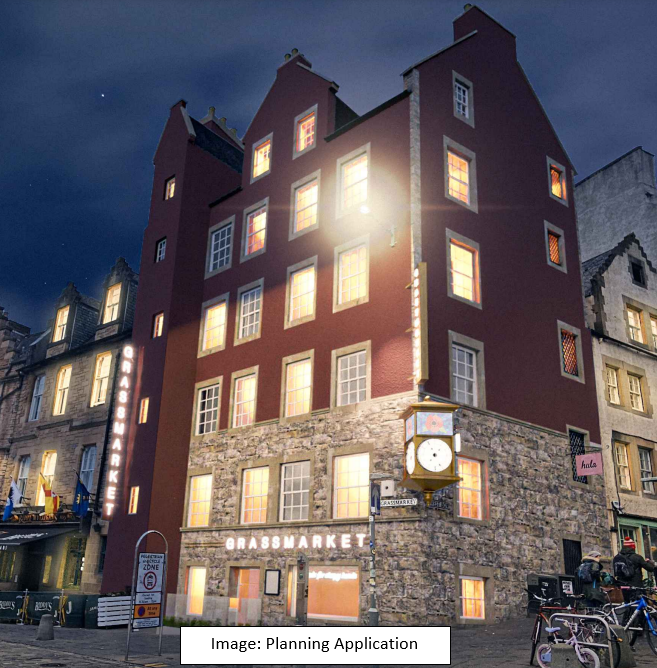
The buildings subject to this application are listed with the corner tenement block being listed Category A.  The proposal sits within the Old Town Conservation Area which forms part of the World Heritage Site.  We disagree completely that the proposals represent a “sensitive alterations” to these important buildings in a highly prominent area.  Instead, they are an insensitive, ill-judged set of proposals that exhibit little understanding of the architectural form of this important building and does not meet the statutory, policy or guidance tests for such developments.

The Statutory List description describes this set of buildings as “Early 17th century with later alterations and additions. 5-storey and attic tenement with gabled stair tower to left and 4-bays with nepus gable to Grassmarket and 2-bay gable with wallhead stack to West Bow. Yellow harled with stone margins.”  A key feature of the listing is the wall finish.

Firstly, we object to the proposed stripping of harling of this building and its replacement with roughcast rendering, which we presume will be cementitious.  The nature of this type of historic wall structure was for it to be harled with a lime-based material to protect the random rubble and to provide a permeable and somewhat sacrificial weather proofing layer.  This gives the building a distinctive quality in both colour and texture.  The proposed stripping of the harling at ground level is inappropriate and objectionable as it exposes the rubble walling and serious undermines both its historic integrity and visual appearance.  Also, the replacement on upper levels by a uniform render further impacts on the quality and characteristics of to the building, much to its detriment.  If it is a cement-based render, its impervious nature will prevent necessary moisture flow through the masonry, leading to increased moisture levels in the walls and interior spaces which could lead to other problems like dry rot.  Additionally, the resulting “banding” across the elevation serious affects its legibility as a single building.  The proposals suggest , a fundamental lack of understanding of the heritage importance of the buildings and  of historic building conservation.

Secondly, we also object to the proposed projecting clock and signs, which have no historic precedent in their proposed form.  The City’s advertisement guidelines suggest that high level overhanging signs, as here, are not normally considered acceptable, and if so should be no more that 0.5m2 in size.   Illuminated signs, as proposed, are also unacceptable.  The proposed clock is out of keeping with the area and has no historic precedent.  Overall, the appearance of these features is more Disney/Toytown than World Heritage Site and represents, in our view, serious impact on the authentic character and historical integrity of the structure.

The statutory tests for alterations to listed buildings can be found in the Planning (Listed Buildings and Conservation Areas)(Scotland) Act 1997.  Sections 14 and 59 apply and require any proposals to “have special regard to the desirability of preserving the building or its setting or any features of special architectural or historic interest which it possesses.”  In terms of Conservation Area management, section 64 requires that “special attention shall be paid to the desirability of preserving or enhancing the  character or appearance of that area.”

In each of these, the Association’s view is that the proposals fail the statutory tests as they pay no special regard to the historic interest of the listed buildings and is ill-considered in its impact on the special architectural characteristics.  In terms of its impact on the character of the Conservation Area, the loss of the historic rendering and intrusive signage and external interventions have a negative impact on the character of the Area.  As such, they fails the statutory tests for proposals in a Conservation Area.  The proposals  also undermine the authenticity and Outstanding Universal Value of the World Heritage Site and is therefore contrary to CEC policy ENV1.


Tartan Weaving Mill, Castlehill

Posted on:

A welcome heritage addition to the city centre

A welcome heritage addition to the city centre

Cockburn Response

The Cockburn supports this application.

The Castlehill Tartan Weaving Mill, which was originally a water storage site, was converted into a shopping complex in 1995. It now has four floors dedicated to retail spaces and an underground weaving mill attraction that is currently inactive.

The present single entry and exit point frequently experiences heavy traffic. Should this application be approved, it will introduce an additional entry point on Ramsay Lane, which is expected to improve the movement of people both inside and outside the structure and its surroundings.

In the plan, the museum will undergo reconstruction to narrate and interpret the story of a significant element of the city’s public health legacy and the building’s initial function in delivering clean water from the Pentland hills to support the city industrial sector and eliminate illness. This is a particularly welcome addition to the heritage resources in the city centre.


Gorgie City Farm – its history, its possible future

POSTED ON August 7, 2024 BY James Garry

The farm celebrated its 40th anniversary in 2022.

The farm celebrated its 40th anniversary in 2022.

Support the Cockburn

Donate
Join Us

Time to ask serious questions about the Greenbelt?

POSTED ON August 2, 2024 BY James Garry

One member thinks it is

One member thinks it is

Support the Cockburn

Donate
Join Us

Proposed new hotel development – 60 Morrison Street, Edinburgh

POSTED ON  BY James Garry

Feedback can be provided until Friday, 16th August.

Feedback can be provided until Friday, 16th August.

Support the Cockburn

Donate
Join Us

Plans approved for revamp of Edinburgh’s iconic Thomas Hamilton Building

POSTED ON July 25, 2024 BY James Garry

Redeveloping the iconic Edinburgh landmark into a brand-new cultural resource

Redeveloping the iconic Edinburgh landmark into a brand-new cultural resource

Support the Cockburn

Donate
Join Us

Pitt Street PBSA

Posted on: July 19, 2024

This site should not be not ‘flipped’ to PBSA accommodation

This site should not be not ‘flipped’ to PBSA accommodation

Cockburn Response

Approval has been granted for the construction of a residential complex comprising 98 apartments for mainstream housing on this site.

The proposed development is set to include 80 student apartments, consisting of seven studios and 73 beds within 16 cluster units. It will also feature associated amenity spaces, cycle parking, and landscaping, all located on the same site.

Considering the City of Edinburgh’s and the Scottish Government’s declared Housing Emergency, it is our stance that this site should be developed for mainstream housing as initially intended, rather than being ‘flipped’ into Purpose-Built Student Accommodation (PBSA).

Castle Street Hotel

Posted on: July 18, 2024

More heritage and access detail is required

More heritage and access detail is required

Cockburn Response

This proposal may represent a sustainable use of an A-listed former office in the New Town.  However, clarification of and expanded detail on a number of important issues is required.

As it stands, the application fails to make completely clear which elements of internal heritage interest are to be retained, restored or removed.  It is particularly concerning that remaining items of original heritage interest may be at risk.

In addition, given the nature of the change of use proposed, details of servicing arrangements and of visitor access provision should have been included in the application.

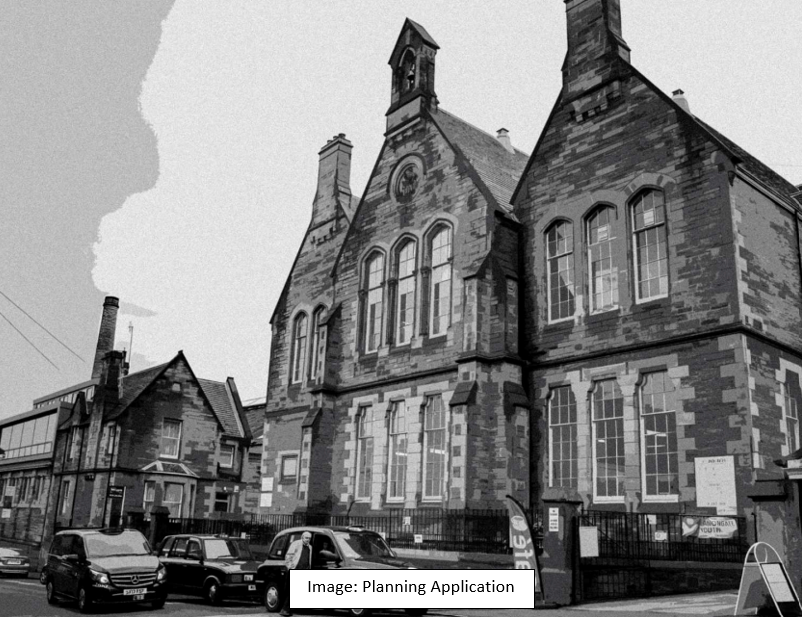
Fringe Hub

Posted on:

There is broad stakeholder support for the redevelopment

There is broad stakeholder support for the redevelopment

Cockburn Response

The Cockburn Association agrees with the broad stakeholder support for the redevelopment of a B-listed building, aiming to create a centralized, modern, and accessible facility for the Fringe Society.

The removal of non-original extensions, the installation of energy efficient windows and the internal cladding of external walls are not of concern.

However, it is unclear whether DDA compliant accessible parking will be retained the remodeling of the former playground.  This  is a real concern given the effort being made to improve accessibility to and within the former resource centre and the lack of publicly accessible DDA compliant parking spaces  in the local area.

The layout of the playground, as proposed, is a lost opportunity to introduced more climate-ready greenspace into this part of the city.  Much more could be done in terms of low cost, low maintenance urban greening.

Moving forward, the modernization of heritage buildings poses numerous challenges. The Fringe Society must adopt best practices and innovative solutions to sustainably utilize their new headquarters. Striking a balance between modern requirements and the conservation of historical charm and ambiance necessitates meticulous planning and inventive strategies. Specifically, meeting energy efficiency standards affordably while preserving the building’s historical integrity will require innovative  methods, especially as the city broadens its low carbon energy infrastructure. Nevertheless, the Fringe Society is in an excellent position to set a precedent for the sustainable adaptation of historic buildings.


Edinburgh’s Radical Road – its history, its uncertain future

POSTED ON  BY James Garry

Debate about the road’s future continues

Debate about the road’s future continues

Support the Cockburn

Donate
Join Us