Restoration by Community
POSTED ON March 31, 2026 BY Lesley Martin / Colin Smith
How is Cockburn Street linked to a little-known Mausoleum in the Scottish Borders?
Chair’s Introduction
I am delighted to bring Members a guest blog by my former colleague Colin Smith, with whom I worked at Scottish Borders Council in the early 2000s. Colin’s keen interest in history has led him in retirement to become involved in a project in the Scottish Borders which has intriguingly close links with the architecture of Cockburn Street and many other notable architectural structures in Edinburgh and across Scotland. The connection is to be found in the work of the architects firm Peddie & Kinnear, whose firm was formed in 1845, just four years before our namesake Lord Cockburn’s letter to the Lord Provost was penned.
Here is Colins’ story:
Many members of the Cockburn Association will be familiar with the names of John Dick Peddie and Charles Kinnear, and aware of the prodigious design output of their practice from around 1856 to the 1880’s. The Dictionary of Scottish Architects (1660-1980) lists some 160 entries, showing commissions right across Scotland, including virtually all the major bank buildings.
A notable example of their work is the development of Cockburn Street, providing the first vehicular link between the Old and New Towns. One has only to walk up Cockburn Street to see examples of their fine architecture and identify the familiar P&K monogram set into the gable ends of several properties including the Scotsman building.
Less well-known is that there was another Peddie, John’s elder brother James, who was also intimately involved in Cockburn Street’s development. James was apprenticed to a civil engineer in Glasgow, where he formed a friendship with another apprentice, Henry Johnston Wylie. They eventually formed an engineering partnership, Wylie and Peddie. One of their early commissions was to design the distinctive rising curve of Cockburn Street. Thus, one brother designed the street, and his sibling designed the buildings that rose from it!
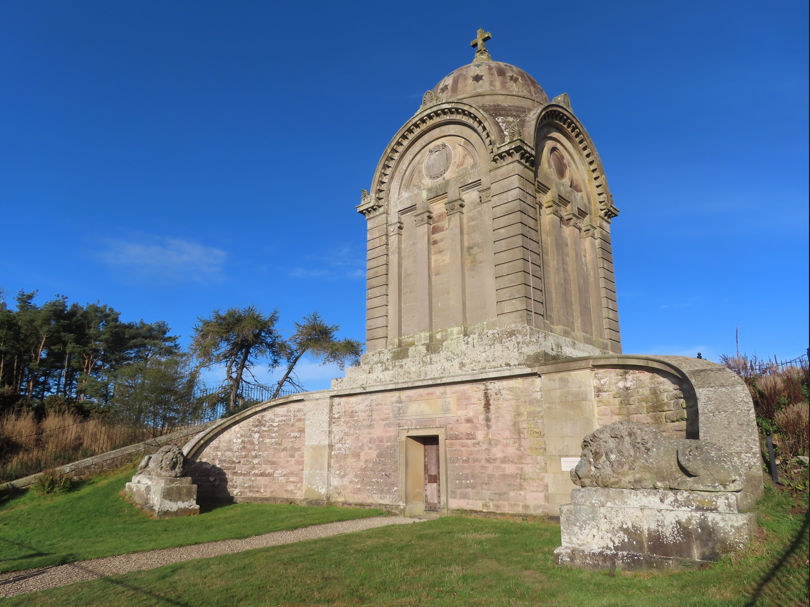
My story begins on a warm summer’s afternoon in 2014. A group of friends were walking along Lilliards Edge in the Scottish Borders when they came across a derelict and ivy-covered building which appeared to have once been a magnificent mausoleum. With little expectation of success, they set up a Friends group and campaigned for the restoration of what was revealed to be the Monteath Mausoleum. The land owners, the local authority, and many local and regional groups supported their efforts and, despite some setbacks, the funding was finally secured in 2018 and work began in October of that year.
By the spring of 2019, the building had been fully restored with new glazed stars in the roof, new oak doors and the whole building made fully watertight. The restored Monteith Mausoleum was formally opened to the public on Sunday 7 July 2019.
The connection with Edinburgh was to be found in the distinctive Peddie & Kinnear monogram which had emerged from beneath the ivy at the base of the Mausoleum on its south-west corner. The connection with a famous firm of Edinburgh architects was revealed, but who had commissioned this extravagant masterpiece, why was it built in the Mughal style, and why had it been located here?
The answer was to be found in the life of General Sir Thomas Monteath Douglas, born in Jamaica, to a Scottish father and an English mother. Sir Thomas entered the service of the East India Company in 1806 at the age of 19. He was heavily involved in the 1st Afghan War (1838-42), wounded six times, and awarded many medals and decorations.
After his return to Scotland in 1845, his cousin’s death in 1850 resulted in Sir Thomas inheriting a vast fortune as well as two substantial estates; Stonebyres and Rosehall, both in Lanarkshire, though now, sadly, demolished.
It was during Sir Thomas’s 18-year residence at Stonebyres that the inspiration for the Mausoleum was apparently sparked. Given the location of the estate in the Clyde valley north of Lanark, he would have visited Glasgow on many occasions, passing the mausoleum of the Duke of Hamilton which was being constructed at that time. It seems that the impact of the impressive structure outside Hamilton, coupled with the recent acquisition of considerable wealth, spurred him to approach Peddie & Kinnear in 1864 to design a mausoleum for himself (the lions were seemingly a Victorian stylistic requirement). The Mughal style evidently stems from his long career in India and Afghanistan.
What of the location near Ancrum? It is easily explained, for one of Sir Thomas’s daughters had married Sir William Scott of Ancrum who owned the land on which the mausoleum was built.
Visit the Monteith Mausoleum today and look up and you will see a miniature version of Peddie & Kinnear’s 1857 design for the banking hall of the Royal Bank of Scotland at St Andrew’s Square. When approached by Sir Thomas in 1864, Peddie & Kinnear must have tempted their client with a similar, though reduced in scale, design of a domed roof.
As a final interesting detail, the Peddie brothers who worked together on Cockburn Street met up again in the Borders. Whilst John was working on the mausoleum, James was involved in the design of the Leaderfoot viaduct, linking the Waverley Line to the East Coast.
The Friends of Monteath Mausoleum warmly welcome visitors and our website provides full details of location and how to reach it, as well as further historical detail.
Colin Smith, founder, Friends of the Monteith Mausoleum.
Chair’s Footnote:
The successful restoration of the Monteath Mausoleum is testament to the determination of a community group sharing a commitment to bring a remarkable architectural structure back to life. The story cannot help but provide an echo of Cockburn members and supporters past campaigns in Edinburgh, documented so memorably in our 150th anniversary book, Campaigning for Edinburgh. Colin’s story also reminds us of the importance of the support of government, land owners and other local bodies. The power of collective effort cannot be overstated.
The Mausoleum is open to the public and there are Open Days throughout 2026, details on the website: https://friendsofthemonteathmausoleum.org.uk/News/Entries/2026/3/open-days-2026.html
Image: Colin Smith – Monteith Mausoleum