Planning for the Future: What Edinburgh Can Learn from China (and Vice Versa)
POSTED ON March 13, 2026 BY James Garry
What Edinburgh and China can learn from each other
This month (March) the Cockburn Association had the pleasure of meeting students from the University of Edinburgh and Heriot-Watt University at the Edinburgh Futures Institute, the remarkable new interdisciplinary research space housed in the restored Old Royal Infirmary on Lauriston Place. The conversation ranged widely, but one question kept surfacing: how do other planning systems around the world handle the tensions that Edinburgh faces every day between growth, heritage, and community voice? The comparison that generated most discussion was perhaps the least obvious one. This is Scotland and China. This blog is an attempt to take that conversation further.
Standing at the east end of Princes Street, it is hard to miss the gleaming curves of the W Edinburgh Hotel rising above the rooftops. To some it represents investment and regeneration; to others, a troubling intrusion into one of the world’s most celebrated historic skylines. Locals have been less than charitable in their nickname for it. The “Golden Turd” has entered the Edinburgh vocabulary, and it probably isn’t leaving any time soon.
The controversy is not just about one building. It captures something fundamental about how Edinburgh, and Scotland more broadly, approaches planning decisions. These are never purely technical exercises. They are arguments about identity, about who the city is for, and about how the past sits alongside the future. They are also, unavoidably, arguments about speed, capacity and resources.
It is worth stepping back occasionally to consider how other places navigate these tensions. Few comparisons are more instructive, or more counterintuitive, than the one between Scotland and China.
Scotland’s planning framework is built around the idea that land should be managed in the long-term public interest. National policy, currently expressed through the fourth National Planning Framework, sets strategic priorities, which local authorities then translate into Local Development Plans. The Planning (Scotland) Act 2019 introduced Local Place Plans, giving communities a formal mechanism to articulate their own visions for how their neighbourhoods should change. In principle, this places communities at the heart of decisions about the built environment.
In practice, development often unfolds through lengthy debate, negotiation and, not infrequently, outright conflict. Edinburgh’s experience is instructive. The £1 billion St James Quarter replaced a much-criticised 1970s complex and brought substantial new retail, residential and hotel development to the city centre. Yet the sculptural hotel tower became almost immediately one of the most contested recent additions to the skyline, provoking protests, heritage debates and social media satire in more or less equal measure. This followed a familiar pattern: think of the long-running Caltongate controversy, when proposals to demolish historic buildings in the Old Town provoked fierce and sustained opposition. Elsewhere, plans for the New Town Quarter on the former Royal Bank of Scotland site in the New Town:housing, offices, student accommodation, have generated significant resistance from residents concerned about density, amenity and impact on the Georgian townscape. In late 2025 councillors refused elements of the proposal despite planning officers recommending approval. An appeal is ongoing.
Public disagreement, in other words, is not an aberration in Scotland’s planning culture. It is a feature of it.
China approaches planning from a very different starting point. Urban development is coordinated through a hierarchical structure in which national priorities are translated directly into provincial and municipal plans. Land ownership arrangements give government considerable leverage over development, enabling infrastructure and urban expansion to proceed at a scale and pace that would be difficult to imagine in any European context. The transformation of Shenzhen is the standard illustration: a small fishing settlement in 1980, a metropolis of more than twelve million people and a global technology hub forty years later. More recently, Chinese cities including Wuhan and Shanghai have implemented ambitious “sponge city” programmes, restoring wetlands, creating permeable surfaces and integrating green infrastructure into urban design to reduce the impact of flooding. In Shenzhen, these measures now cover a substantial proportion of the urban area.
These are not trivial achievements. Scotland has been talking about integrating green infrastructure into urban planning for years. The scale of practical implementation in China puts some of that discussion in perspective.
That said, the Chinese model has exacted real costs. Rapid urbanisation brought environmental degradation and, in many cities, the displacement of traditional neighbourhoods during redevelopment. The social continuity that Edinburgh’s communities fight so hard to protect through the planning system has, in parts of China, been sacrificed to economic expansion. The country’s latest development strategy, including the 15th Five-Year Plan running from 2026 to 2030, places stronger emphasis on ecological protection, green urbanism and liveability. A recognition, if an implicit one, that the previous approach was not without its failures.
The contrast between the two systems reflects deeper differences in governance. Scotland distributes planning authority among national government, local authorities and community stakeholders, and development emerges, sometimes laboriously, through negotiation between them. China emphasises coordination and strategic direction. The difference is not simply cultural; it is also a matter of scale. Scotland plans for 5.5 million people with a strong emphasis on landscape protection and historic conservation. China manages urbanisation across more than 1.4 billion.
Yet both systems are under pressure from the same forces: housing shortages, climate change, ageing infrastructure, and communities asking legitimate questions about what development is actually for and who it benefits.
For Edinburgh, the lessons are uncomfortable in places. The city’s planning departments have faced staff reductions over the past decade, leaving them stretched between processing applications and developing long-term spatial strategies. The result is a system that aspires to empower communities but struggles at times to reconcile competing expectations while keeping pace with development pressure. The housing shortage is not a background condition; it is an active harm, and the planning system’s capacity to address it at the speed required is a genuine question.
The argument here is not that Edinburgh should import Chinese planning methods, or that strategic coordination can substitute for community voice. The Cockburn Association has spent 150 years making the case that Edinburgh’s character is worth protecting, and the planning battles of recent decades have repeatedly vindicated that position. But there is a difference between protecting what matters and allowing process to become an end in itself. If the planning system is to command genuine public confidence, it needs to be resourced adequately, operate with reasonable speed, and be clear about what it is trying to achieve.
China’s planners, for their part, are increasingly incorporating heritage awareness and environmental protection into their work, recognising that the social fabric of places has value that cannot simply be overridden by economic logic. That is a shift worth acknowledging.
Planning is ultimately about the relationship between communities and the places they inhabit. The most effective planning systems, wherever in the world they operate, are likely to be those that combine genuine strategic ambition with deep care for what already exists. Edinburgh has the care. The question is whether it can also find the ambition.
Suggested further reading
Peter Hall, Cities of Tomorrow (Wiley-Blackwell, 4th edition 2014) — the standard intellectual history of twentieth-century urban planning, essential context for understanding how different planning traditions developed.
Cliff Hague and Paul Jenkins (eds), Place Identity, Participation and Planning (Routledge, 2005) — compares planning systems across Scotland, Norway, the Netherlands and Sweden, with a sustained focus on how different planning cultures handle community voice and place identity. Hague is Emeritus Professor of Planning and Spatial Development at Heriot-Watt University.
Abigail Friendly, ‘The right to the city: theory and practice in Brazil’ (Planning Theory & Practice, 2013) — a useful counterpoint on participatory planning in a high-growth context.
Fulong Wu, Planning for Growth: Urban and Regional Planning in China (Routledge, 2015) — the clearest English-language account of how China’s urban planning system actually works, written by the Bartlett Professor of Planning at UCL.
Brian Evans, Frank McDonald and David Rudlin (eds), Urban Identity: Learning from Place (Routledge, 2011) — a wide-ranging exploration of urban character and what makes places distinctive, drawing on the Academy of Urbanism’s work across UK and European cities. Directly relevant to Edinburgh’s ongoing debates about development and identity.
Scottish Government, National Planning Framework 4 (2023) — the policy document itself is readable and sets out current Scottish priorities clearly, including on climate, housing and heritage.
Cockburn Association, Campaigning for Edinburgh (2025) — the Association’s own history, which provides valuable context for understanding how planning debates in the city have evolved.
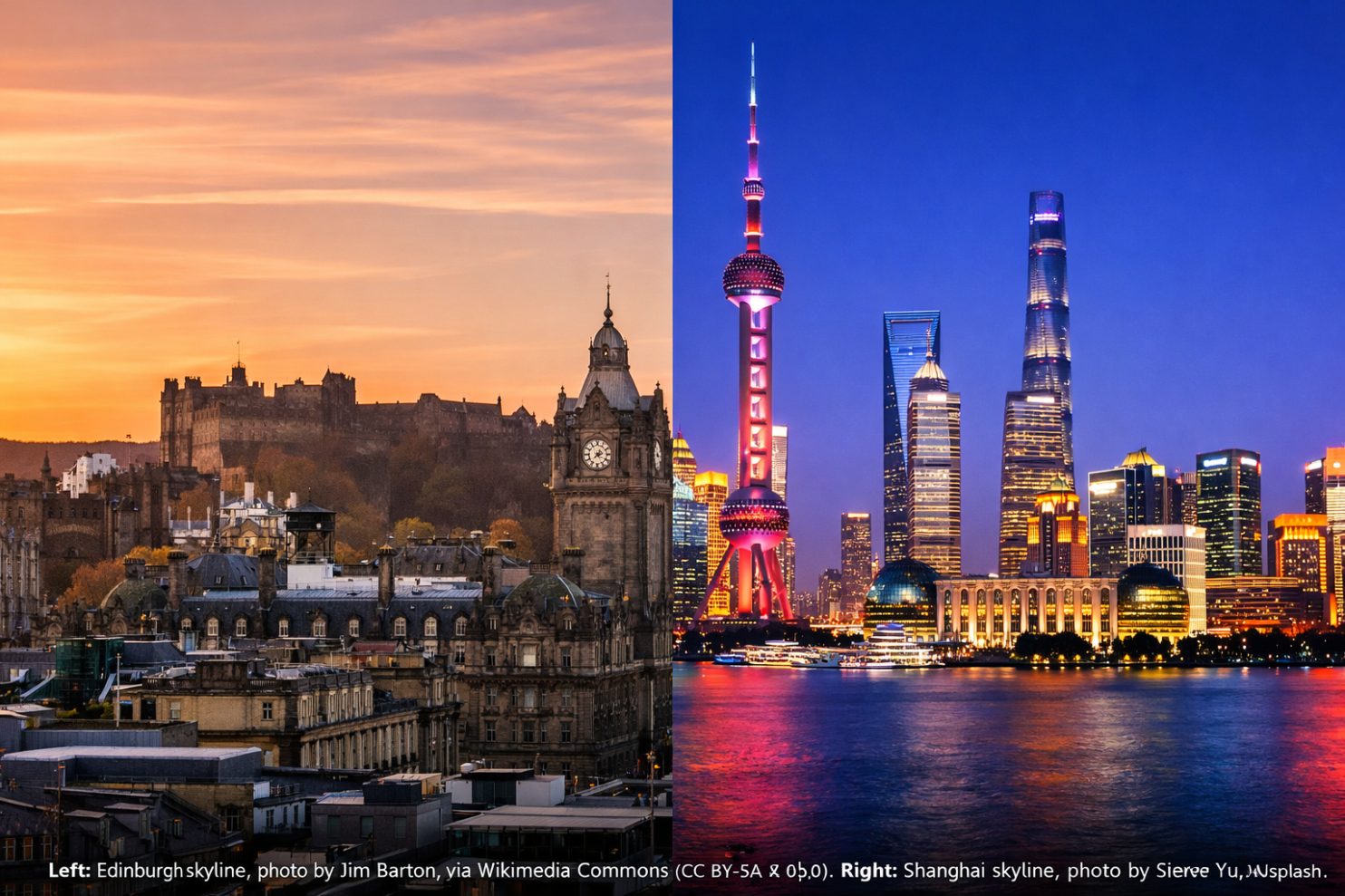
Image: AI generated for illustrative purposes: Edinburgh skyline: Photo by Jim Barton, Edinburgh skyline from Calton Hill, via Wikimedia Commons, licensed under Creative Commons Attribution-ShareAlike 2.0 (CC BY-SA 2.0).
Shanghai skyline: Photo by Sieree Yu, via Unsplash, used under the Unsplash Licence