Opening the Doors: 35 Years of Doors Open Days in Edinburgh
POSTED ON September 18, 2026 BY James Garry
Celebrating 35 years of opening Edinburgh’s remarkable buildings to everyone
From 61 buildings in 1991 to one of the highlights of Edinburgh’s heritage calendar, Doors Open Days has spent 35 years inviting us to look again at the places around us.
In September 1991, 61 Edinburgh buildings did something unusual: they opened their doors to the public. Churches, offices and schools welcomed people who might ordinarily have walked past without ever knowing what lay inside. Fettes College received around 1,000 visitors; the National Trust for Scotland recorded as many as 800. The Cockburn Association, which coordinated that first Edinburgh Doors Open Day, concluded afterwards that if the event was to grow, it would need more volunteers and considerably more publicity. It did — and thirty-five years later, Doors Open Days has become a fixture of Edinburgh’s September calendar, and part of a wider Scottish and European tradition. The idea at its heart has changed remarkably little: that places are better understood once people have the chance to experience them for themselves.
From France to Edinburgh
The concept began in France in 1984, with La Journée Portes Ouvertes, and its popularity soon spread across Europe. Scotland joined the movement in 1990, when Glasgow held an open doors event as part of its year as European City of Culture; Edinburgh followed in 1991, with the Cockburn Association coordinating the programme.
Those early programmes make fascinating reading. The first Edinburgh event included 18 churches, ten offices and nine educational buildings. In the years that followed, the range widened considerably, taking in law courts, theatres, galleries, private houses and gardens, and some less predictable candidates — a mausoleum, a lighthouse, a water treatment works, vaults, police stations and a football ground. By 2015, when Cockburn volunteer Margaret Jessop looked back over the event’s first quarter-century, 613 different Edinburgh venues had taken part, and the annual programme had grown from 48 venues in 1992 to a high of 127 in 2013. Some became familiar faces on the list: the Scottish Poetry Library appeared in 17 of those first 25 programmes, St Bernard’s Well in 16, and the French Institute and Parliament House in 15 each. Even the printed programme changed, growing from a fold-out list and street map into a substantial booklet, a small but telling measure of how far the event had grown.
What happens when a door opens
There is something quietly powerful in being admitted to a building normally closed to you. A familiar frontage acquires an interior; a building passed daily on the way to work becomes a staircase, a hall, a workshop, a garden, or a view from an unexpected window. Details that barely register from the pavement begin to make sense — not least because there are usually people inside who know the building and are glad to explain it.
That has always been one of the strengths of Doors Open Days. Heritage can seem to belong to specialists — architects, planners, historians, conservation officers, archaeologists — and opening a door changes that relationship. It allows people to encounter a place directly and to decide for themselves what interests them about it. Nor need the buildings involved be conventionally grand: Edinburgh’s character owes as much to its schools, workshops, tenements, libraries, places of worship and community buildings as to the monuments that appear on postcards. Doors Open Days has done a great deal to make that broader understanding of heritage visible.
More than a day out
This matters to the Cockburn Association. Since 1875, we have argued that Edinburgh’s buildings, streets and landscapes are a civic inheritance — one that must remain useful to the people who live here. Conservation, properly understood, is not a matter of preserving old things simply because they are old; it is a matter of understanding what gives a place its character, looking after what is valuable in it, and allowing change to happen intelligently. Readers wanting to know more about that history and the Association’s long record of campaigning for the city can find it in Campaigning for Edinburgh.
Doors Open Days puts that principle into practice. It is difficult to care about a place that remains remote or inaccessible, and once people have stood inside a building, heard its stories and met those who use or care for it, their relationship to it tends to change. That is why the word open matters as much as the word doors: at its best, the weekend is not merely about access to interesting architecture, but about widening participation in the conversation about the places around us.
The story continues
The event has, inevitably, changed over 35 years. Digital information now sits alongside the printed programmes of earlier decades, and the range of buildings and activities — like our sense of what constitutes heritage — has broadened considerably. The programme now extends beyond Edinburgh into East Lothian, bringing together historic landmarks, contemporary buildings, community spaces, workplaces and landscapes, along with the people who give them life.
There have been interruptions and changes of direction along the way, and the Cockburn Association has not coordinated every recent edition. But in 2026, we are once again at the helm of Edinburgh and East Lothian Doors Open Days — a welcome return, and one that feels timely. This year’s national theme, Heritage at Risk: Revive, Resist, Reimagine, brings the history of Doors Open Days firmly into the present. The challenges facing our built heritage differ in some respects from those of 1991, though others would be entirely familiar to earlier generations of Cockburn campaigners: buildings fall out of use, maintenance is postponed, development pressures reshape neighbourhoods, and climate change places new demands on historic fabric, even as buildings designed for one purpose must find new ones if they are to survive.
Opening these buildings to the public will not solve those problems. But it can make places visible; it can introduce people to the buildings and landscapes around them; it can bring owners, volunteers, communities and visitors into the same conversation; and, now and again, it can make us notice something we have passed a hundred times without truly seeing it.
Come through the door
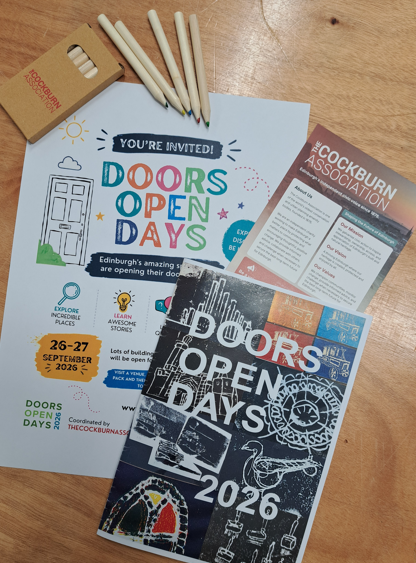
This year’s Edinburgh and East Lothian Doors Open Days takes place on Saturday 26 and Sunday 27 September, and everyone is invited. Across the weekend, buildings and places not normally open to the public will welcome visitors — some familiar landmarks seen from an unaccustomed angle, others places you may have walked past for years without knowing quite what lies behind the door. The event is free throughout, though some venues have limited capacity and require advance booking, so it is worth consulting the programme and planning your route in good time.
You need not be an architectural expert or a committed heritage enthusiast to take part. Come because you have always wondered what is inside a particular building. Come because you want to discover somewhere new. Bring the family, bring a friend, or simply see where the programme takes you — explore the full Edinburgh and East Lothian Doors Open Days programme and start planning your weekend.
Doors Open Days is partly about buildings, but it has never been only about buildings. It is about curiosity, access, and the relationship between people and place; about the volunteers, owners and custodians who look after these buildings and share their knowledge of them; and about the chance, once a year, to look at our surroundings with fresh eyes.
There is a pleasing continuity between that first Edinburgh Doors Open Day in 1991 and the weekend taking place this September. The scale has changed, the programme has grown, and Edinburgh itself has changed enormously — but the invitation has not. Come through the door, look around, and ask the people who know the place. You may find that when you leave and glance back at the building from the street, it looks rather different than it did before. Thirty-five years after those first 61 buildings welcomed the public inside, there are still discoveries to be made on our own doorstep.
Edinburgh and East Lothian Doors Open Days takes place on Saturday 26 and Sunday 27 September 2026. The event is free, although advance booking is required for some venues. Explore the programme and start planning your weekend.
This article updates a history of Doors Open Days written in 2015 by Cockburn Association volunteer Margaret Jessop, to mark the Association’s first 25 years of coordinating the event in Edinburgh.