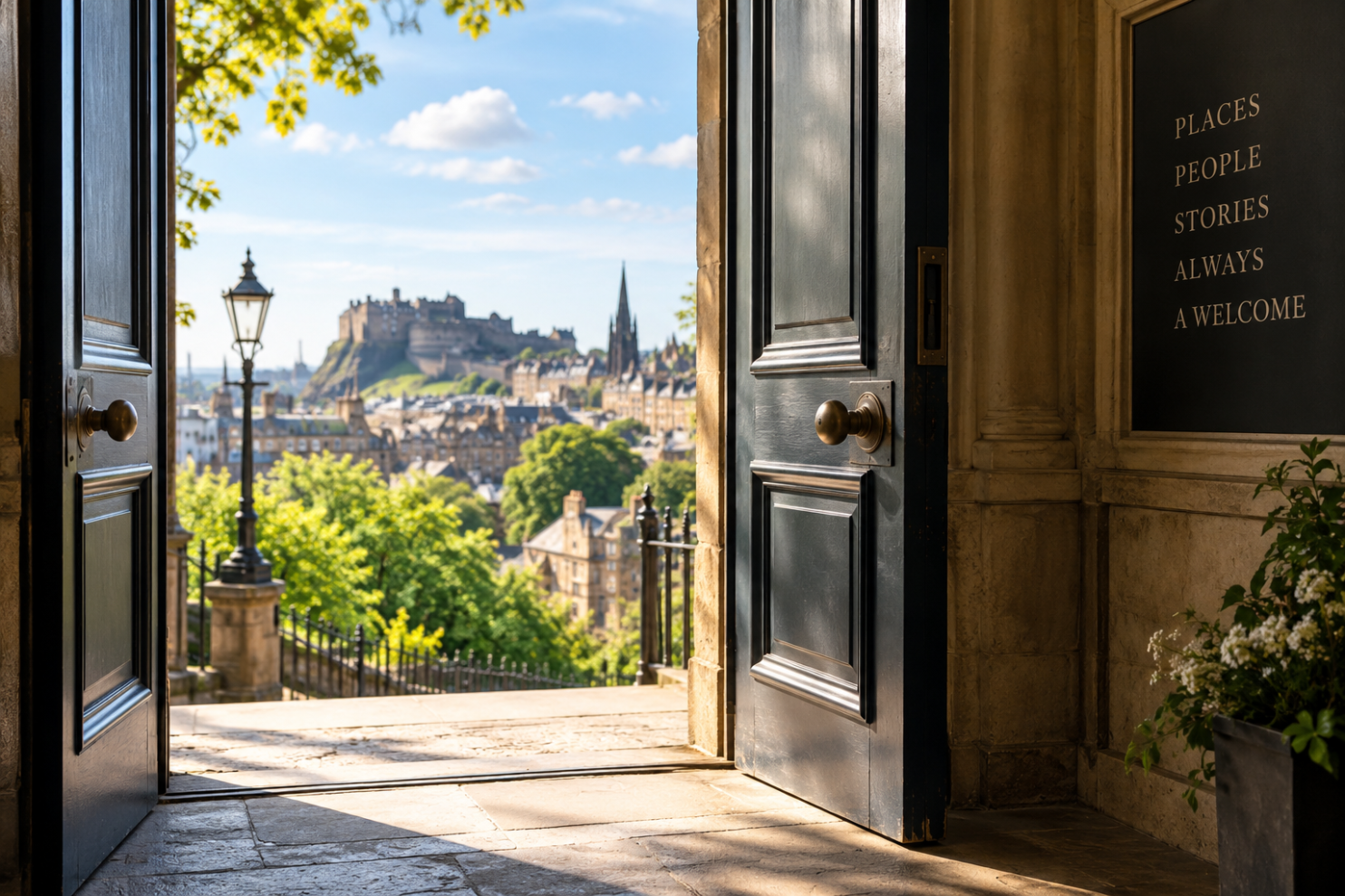
Opening Doors, Opening Conversations: Heritage at Risk
POSTED ON September 4, 2026 BY James Garry
Opening doors to explore, understand and reimagine our shared heritage
In a few weeks’ time, doors will open across Edinburgh and East Lothian. Some belong to buildings we pass every day without a second glance. Others sit behind railings or high walls, glimpsed but never entered. Churches, community halls, workshops, civic buildings, historic houses: on the weekend of 26 and 27 September they will all be open, as part of Edinburgh and East Lothian Doors Open Days 2026.
The Cockburn Association coordinated Doors Open Days in Edinburgh for many years, and more recently in East Lothian too. After a spell away from running the festival, we are back at the helm again this year, and it remains one of the pleasures of our annual calendar. But it is also, we think, one of the more useful things we do, because it is about more than simply getting inside interesting buildings. It is an invitation to look at familiar places differently.
That feels apt this year. The national theme for Doors Open Days 2026 is “Heritage at Risk: Revive, Resist, Reimagine” — three words that Edinburgh, of all places, has good reason to take seriously.
Heritage is not a finished business
There is a comfortable assumption that heritage, once recognised, is safe: a listed building, a monument, a conservation area, a World Heritage Site. Once the plaque goes up, so the thinking goes, the job is done.
It isn’t. Buildings survive because people keep using them, maintaining them and finding reasons to value them. Streets keep their character because of a great many decisions, most of them small, that happen to respect what is already there. Landscapes survive because someone notices when they are being worn away.
Loss is sometimes sudden and dramatic — a demolition, a fire. More often it is gradual: a building left empty a year too long, a repair deferred, an alteration that seemed harmless enough on its own. Add in heavier rain, hotter summers and the general unpredictability of the weather these days, and old buildings are under more strain than they used to be. Add in changing habits of work, shopping and travel, and whole streets can lose their purpose within a generation.
The question is not really how Edinburgh preserves its heritage. It is how the city keeps it in use.
Revive
Edinburgh has no shortage of buildings that have outlived the purpose they were built for. That does not mean they have outlived their use.
The most sustainable building is very often the one already standing. Careful repair and thoughtful reuse save embodied carbon, keep old craftsmanship in daily service, and hold onto the grain of a street — while letting a building earn its keep in the twenty-first century. Done well, that is not a compromise between conservation and progress. It is both at once.
Revival need not involve bricks and mortar at all. It might mean bringing a neglected square back into use, giving a struggling high street a reason for people to linger, repairing railings or stonework that have been quietly rusting away, or finding a community group willing to take on a building nobody else wants. Sometimes revival is no more complicated than opening a door: a building that has faded into the background of a street becomes visible again the moment someone can walk through it.
Resist
There are also times when heritage needs someone willing to argue for it.
The Cockburn Association was founded in 1875 because of concern at the pace and manner in which Edinburgh’s character was being lost. The circumstances have changed a good deal since then; the underlying concern has not.
A living city has to change, and Edinburgh should not be preserved as though under glass. But change ought to start from an understanding of the place it is happening to. Sometimes that means resisting proposals that would demolish a perfectly serviceable building, overwhelm its surroundings, or chip away at whatever it is that makes a neighbourhood recognisably itself. Sometimes it means resisting neglect — the slow, unspoken acceptance that a building or public space has become somebody else’s problem.
Conservation at its best is rarely just a matter of saying no. The better question, more often than not, is: can this be done properly?
Reimagine
Of the three words, reimagine may be the most interesting.
Conservation still gets caricatured, now and again, as the enemy of change. In practice, some of the more imaginative things happening in Edinburgh are conservation projects. Old buildings take on new lives. Former industrial sites become places to live and work. Redundant churches become community spaces. Disused infrastructure becomes a walking or cycling route. Traditional skills and materials turn up in unexpected new applications.
The trick is to allow all of this without letting every place end up looking and feeling the same. Edinburgh’s character lies partly in its layers — medieval closes next to Georgian streets, Victorian infrastructure still doing duty in a modern city, former villages that have kept their own identity despite being swallowed by the wider town. East Lothian’s harbours, farms, towns and villages carry their own, similarly layered, stories. Reimagining any of them well has to start with understanding what is already there.
Why opening doors matters
This is really the point of Doors Open Days.
Conservation cannot rest on planning policy, listing status and professional expertise alone, useful as all three are. Places are looked after best when the people around them understand why they matter — and understanding tends to follow from actually going in.
Step inside a building and your relationship with it changes. You notice the stair worn hollow by generations of feet, a view an architect clearly meant you to see, roof timbers that never show from the street, or the quiet ingenuity of an old building adapted to a use nobody who built it could have imagined. You meet the people who look after these places, and hear the stories that never make it into a Historic Environment Scotland listing description. A building stops being an abstraction the moment you have stood inside it.
That kind of understanding matters later, when harder questions come up about maintenance, investment or development.
It is also a reminder that Edinburgh’s heritage does not begin and end with the famous set pieces. The Castle, the Scott Monument and the Old and New Towns will always draw the crowds, and rightly so. But the character of the city lives just as much in its schools, libraries, places of worship, workshops, tenements, parks, cemeteries and ordinary streets. Doors Open Days gives many of those quieter places their moment.
Heritage needs money too
There is a wider conversation to be had about how Edinburgh pays for the city it wants to remain.
The new Visitor Levy is a genuine opportunity here. People do not come to Edinburgh only for its festivals and events; they come for the place itself — its historic fabric, its museums and galleries, its streets, parks and monuments. Money spent looking after those things is not a cost separate from the visitor economy. It is the visitor economy, and it is also simply what makes the city a good place to live.
Repairing old buildings, improving public spaces and making places properly accessible are not decorative extras to be funded once everything else is paid for. They are part of the basic infrastructure of a historic city that intends to go on working. Much the same applies in East Lothian, where development pressure, changing land use and a changing climate are all bearing down on historic towns, coastal settlements and landscapes at once.
Come and look
On 26 and 27 September, the invitation is a simple one: come and look.
Visit somewhere you have never been. Go back to a building you thought you already knew. Talk to the people who look after it. Look up, above the shopfronts. Ask what a place was built for, what it is used for now, and what it might yet become.
And perhaps carry three questions with you. What is worth reviving? What is worth resisting the loss of? What could be reimagined? The answers will differ from building to building, street to street — which is rather the point of the exercise.
Heritage is not only what previous generations happened to leave behind. It is also what we choose to notice, look after, adapt and pass on. Sometimes the first step is nothing grander than opening a door.
Edinburgh and East Lothian Doors Open Days takes place on Saturday 26 and Sunday 27 September 2026. Full details of this year’s Edinburgh programme are available on the Doors Open Days website: https://www.doorsopendays.org.uk/regions/edinburgh
Image: Illustrative image created using generative AI.