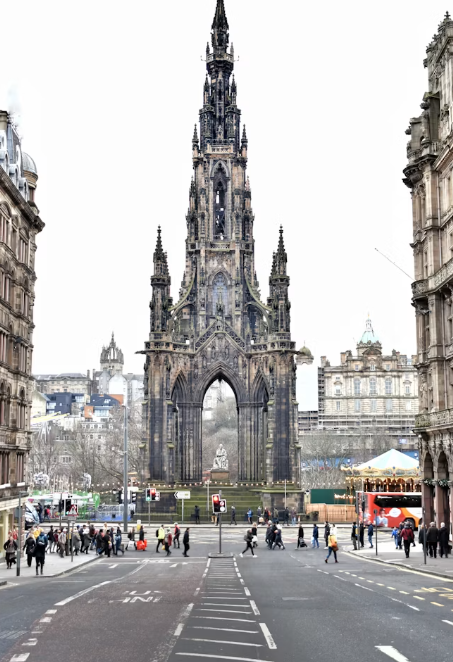
Looking Up: The Story of the Scott Monument
POSTED ON August 7, 2026 BY James Garry
Growth and inheritance need not come at each other’s expense
Every August, the same scene plays out at Waverley Station. Passengers step out onto Princes Street, glance upward, and find the dark Gothic spire of the Scott Monument already waiting for them above the trees of the Gardens. Some photograph it. Some decide, there and then, to climb it. Most simply take it as part of the skyline, alongside the Castle and Arthur’s Seat — a fixture that has always been there and always will be.
It was not always there, and it was not inevitable.
When Sir Walter Scott died in September 1832, his reputation extended well beyond Scotland. Waverley, Rob Roy and The Heart of Mid-Lothian had carried Scotland’s landscape and history to readers across Europe and North America, and his stage-management of George IV’s state visit in 1822 had done a great deal to fix how Scotland presented itself to the world thereafter. Edinburgh judged, reasonably, that a memorial on the usual scale would not do.
A public competition was announced in 1836. More than fifty schemes were submitted, and the winning design came not from an established architect but from George Meikle Kemp, a joiner from Midlothian who had taught himself Gothic architecture by sketching medieval buildings rather than through any formal training. He entered under the pseudonym “John Morvo” — the name traditionally given to the master mason of Melrose Abbey — and proposed not a statue on a pedestal but a soaring spire that looked as though it had grown out of Scotland’s own medieval building tradition.
Construction began in 1840 in Binny sandstone from West Lothian, quarried pale honey in colour. Decades of coal smoke blackened it into the sombre monument that older Edinburgh remembers; recent cleaning and conservation have brought back something much closer to what the city first saw in the 1840s. Kemp himself did not live to see it: in March 1844 he drowned in the Union Canal walking home on a foggy evening, in circumstances that have never been fully established. When the monument was inaugurated in 1846, it stood as a memorial to its designer as much as to the author it was built for.
Sir John Steell’s marble statue of Scott sits beneath the canopy with his deerhound Maida at his side, surrounded by figures from the novels, while the tower narrows above into the forest of pinnacles now familiar from a thousand photographs of the city.
The site repays as much attention as the building. The valley below had been the Nor Loch, a stagnant survival of the old town defences, drained through the later eighteenth century to make way for Princes Street Gardens. The New Town was extending north on Enlightenment principles of order and planning; the Old Town remained the city’s working, historic core; and by the 1840s the railway was cutting directly through the valley between them. The monument was raised into the middle of all this change — neither Old Town nor New, neither wholly historic nor wholly modern, but a piece of Gothic revival set down at the meeting point of both.
It would be tidy to say that Edinburgh’s nineteenth-century citizens resolved the tension between growth and inheritance once and for all. They did not. In the very years the Scott Monument was rising, the medieval Trinity College Kirk was being dismantled a short distance away to clear ground for the expanding railway; its stones were later reassembled, incompletely, as the Trinity Apse on the Royal Mile — a fragment of what had been one of the city’s finest Gothic churches. The same decade, the same city, produced both a monument raised expressly to evoke the medieval past and the demolition of an actual medieval building in the name of progress. It was precisely this kind of trade-off — improvement pursued at heritage’s expense — that Henry Cockburn protested a few years later in his 1849 Letter to the Lord Provost, and that this Association has kept watch for ever since.
Whatever the contradictions of the decade that produced it, the monument’s upper galleries still deliver, after 287 steps, much the view they always did — the New Town’s terraces, the Old Town’s closes, the Castle, Arthur’s Seat, the Forth — as a single historic composition rather than a series of separate sights.
This year gives that fact some point. The monument turns 180 in 2026, and the City of Edinburgh Council is marking it by opening the climb to twelve free places a day between 10 and 17 August, allocated first come, first served. Anyone who completes the 221 steps to the highest platform currently open to the public receives a commemorative certificate. It is a modest gesture, but the right one — the surest way to keep a monument meaningful is to keep people climbing it, not simply photographing it from the Gardens below. Details and booking information are available via Culture Edinburgh.
Monuments such as the Scott Monument are not self-sustaining. Sandstone weathers in Edinburgh’s climate; carved detail needs specialist conservation; the Gardens below carry millions of visitors and residents a year, and the festivals and events that increasingly fill them place real demands on a landscape that was never designed for that volume of use. The Scott Monument’s upkeep is not a matter of preserving one admired building. It is bound up with the wider question this Association exists to keep in view: whether the setting around Edinburgh’s landmarks — the gardens, the sightlines, the coexistence of Old Town and New — is being cared for with more consistency than the city itself managed in the 1840s.
As another Festival season fills Princes Street Gardens, the visitors emerging from Waverley — past the site of the old Trinity Kirk without knowing it — are unlikely to know any of this history. But they are responding, whether they know it or not, to an argument nearly two centuries old, and one this city has never entirely settled: that growth and inheritance need not come at each other’s expense, provided the choice to protect both is made deliberately, and kept.
Image: Upsplash sawantvishwajeet729