Housing as Civic Architecture Vienna: on what a city says about itself when it builds homes for ordinary people
POSTED ON May 15, 2026 BY James Garry
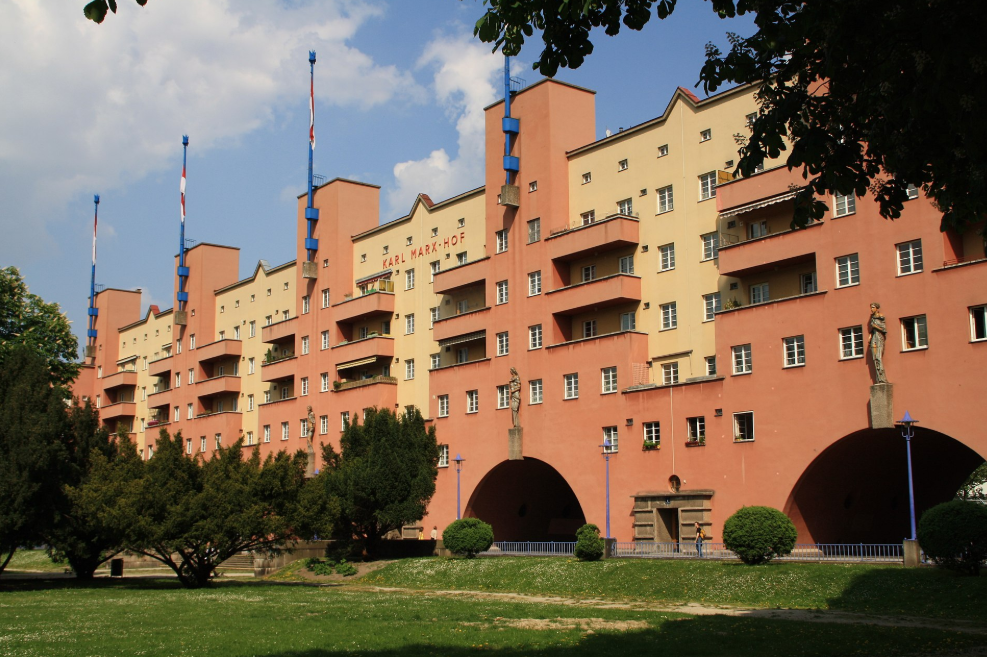
The Karl-Marx-Hof on Vienna’s Heiligenstädter Strasse is hard to miss. Completed in 1930, it stretches for more than a kilometre, rises to six storeys, and announces itself with an entrance archway of palace-like scale. It housed 1,382 working-class families. It was built, quite deliberately, to make a statement: that the quality of homes provided to ordinary people is a measure …
The Karl-Marx-Hof on Vienna’s Heiligenstädter Strasse is hard to miss. Completed in 1930, it stretches for more than a kilometre, rises to six storeys, and announces itself with an entrance archway of palace-like scale. It housed 1,382 working-class families. It was built, quite deliberately, to make a statement: that the quality of homes provided to ordinary people is a measure of the seriousness of a city’s intentions towards them.
Nearly a century later, the Karl-Marx-Hof is fully occupied, well-maintained, and well-regarded. It has outlasted several political regimes, borne witness to tragic and seismic events, and any number of fashions in housing policy. This is not sentiment. It is evidence that the decision to build well was also, in the long run, the economical one.
Vienna has not abandoned this tradition. Around 60 per cent of the city’s residents live in subsidised or municipally supported homes, managed through Wiener Wohnen or through limited-profit housing associations. The scale is remarkable. But it is the quality, not the quantity, that Edinburgh should dwell on. These are not anonymous blocks. They are carefully designed, robustly built, and, crucially, varied in scale, tenure, and social mix.
This is where Vienna’s model feels particularly resonant in an Edinburgh context. The city’s housing does not segregate affluence from affordability but deliberately interweaves them, producing neighbourhoods that are socially and architecturally diverse. Large courtyard blocks sit alongside smaller interventions. Family housing exists beside homes for older residents. Subsidised rents coexist with market units. It is a composition that fosters stability without uniformity.
Such an approach echoes the urban thinking long associated with Patrick Geddes and later defended by the Cockburn Association, a commitment to preserving a rich mix of scale, use, and social life within the city, particularly in the Old Town. Geddes understood that cities thrive not through separation but through proximity: of incomes, of generations, of building types. Vienna, in its own way, has operationalised that principle at scale.
A Viennese social housing tenant does not live in an inferior building in an inferior part of the city. She lives in a well-considered building in a mixed neighbourhood, maintained with the same care extended to everything else. Buildings that people want to live in, because they are dignified, well-integrated, and socially balanced, do not generate the same social or physical repair bills as those that people come to resent.
Good housing is a public good — not a welfare provision, not a residual category for those priced out of the market, but a contribution to the city that will be judged for a hundred years.
Edinburgh’s housing pressures are acute. Tens of thousands are on the waiting list for social rent. Key workers and young households are being steadily pushed outward. The political response has focused, understandably, on numbers: how many homes, how fast, on which sites. These are necessary questions. They are not the only ones.
A city that builds large numbers of poorly designed homes does not thereby solve its housing problem; it defers it while creating new ones. The record of several post-war and later housing developments in parts of Leith and north Edinburgh offers a quieter but no less telling illustration. Estates built quickly and cheaply, with limited attention to materials, maintenance, or shared space, have required repeated cycles of repair, retrofit, and, in some cases, partial redevelopment. They were not structurally unsound in any dramatic sense, but they often proved socially and environmentally fragile, places that could feel neglected rather than cared for. Cheapness at procurement stage is rarely economy over the life of the building.
Edinburgh’s own housing history is instructive in both directions. The Garden City-influenced cottage layouts at Longstone and Stenhouse produced streets and shared spaces that remain genuinely pleasant nearly a century later. These were not luxury buildings; they were considered ones. The system-built estates at Wester Hailes and parts of Craigmillar, where industrialised construction was prioritised over design, produced environments that residents found difficult to inhabit and which the city has spent subsequent decades repairing at considerable public expense.
The flatted development that filled the Western Harbour from the early 2000s suggests the lesson was not fully learned. Built by private developers in materials chosen for cost rather than durability, it looks poorly after barely twenty years: render stained, details mean, spaces between blocks cheerless. Nobody has described these buildings as the heritage of tomorrow. They are exactly what Owen Hatherley means when he writes of Edinburgh architecture judged “not on what it does, but on what it doesn’t do — if it’s in keeping, if it’s not in the way of any sightlines, wave it through.”
Vienna suggests a different standard is achievable on the same budgets. At Granton Waterfront, where the city council holds the majority of the land and leads the first development phase, there is an unusual opportunity: to commission housing that reflects what the city actually believes its future residents deserve. Vienna’s Gemeindebauten are not extravagant — they are carefully made, humanly scaled, and built for the long term. The practical difference between a building worth living in after a century and one deteriorating in twenty years is primarily a matter of priorities.
These wider questions about growth, liveability, and the kind of city Edinburgh is trying to become were also explored at last Tuesday’s Cockburn Association Festival of Europe event at the City Chambers, where researchers and campaigners examined how historic European cities are responding to the pressures of overtourism, housing strain, and civic change. Discussions ranged from Amsterdam and Venice to Barcelona and Dubrovnik, focusing on regulation, taxation, digital management tools, legal challenges, and stronger forms of community participation. The conversation forms part of the wider Festival of Europe Scotland programme, which continues through the weekend with further public events and discussions on Europe, cities, culture, and civic life. The full programme can be viewed at Festival of Europe Scotland programme.
Craigmillar, where the masterplan is still producing new housing phases, and Leith Fort, where regeneration of the former military site north of the Kirkgate is under way, offer similar openings. Public bodies are direct commissioners in all of these places. They have a choice that private developers on speculative sites simply do not.
Exercising that choice well requires procurement that rewards quality. In Scotland, the structure of public procurement too often does the opposite: fee competition continues to favour bids selected on cost rather than design ability or long-term value. Germany and the Netherlands use paid design competitions for public housing as standard. The result is visible in the cities. Scotland has an Architecture and Design Scotland agency, a government architecture policy, and strong placemaking commitments in NPF4. It also has a procurement system that makes the realisation of all of this difficult for the practices best equipped to deliver it. These things cannot coexist without consequence.
Several Edinburgh practices have already demonstrated that publicly commissioned housing in this city can be well-made and worth living in. What they need is not encouragement or policies or further consultation. They need commissions. That is a political choice, available right now.
Next week: Stockholm’s Hammarby Sjöstad — and what it means to treat sustainability not as aspiration but as a starting point from which everything else is designed.
Further Reading
Wiener Wohnen — Vienna’s municipal housing — management of Vienna’s social housing stock
Vienna Social Housing — English overview — dedicated English-language resource on the Vienna model
Das Rote Wien im Waschsalon (Red Vienna in the Laundry Room) — permanent exhibition inside Karl-Marx-Hof
→ https://dasrotewien-waschsalon.at/english
Owen Hatherley, ‘The Slow Ruin of Edinburgh’, Prospect (2017) — on the PFI schools failure and the Western Harbour
Craigmillar Urban Design Framework (Masterplan)
→ https://www.edinburgh.gov.uk/directory-record/1099602/craigmillar
Shelter Scotland, Edinburgh Housing Need — housing need analysis and advocacy
Image: “Karl-Marx-Hof 2009” by Dreizung, via Wikimedia Commons (CC BY-SA 3.0).