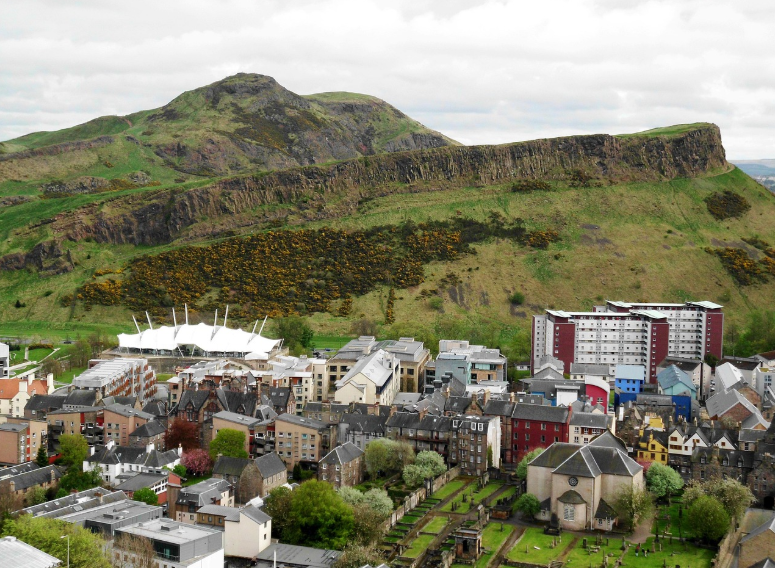
Arthur’s Seat: Why Edinburgh’s Mountain Still Matters
POSTED ON July 31, 2026 BY James Garry
Arthur’s Seat reminds us that Edinburgh’s landscape shaped the city first
There are few cities where you can leave a bustling capital and, within half an hour, be standing on the summit of an extinct volcano. For generations of Edinburgh residents, climbing Arthur’s Seat has become close to a rite of passage — schoolchildren scrambling up on a summer outing, students watching the sunrise at the start of term, families picnicking on the lower slopes, visitors making the climb on their first day in the city to see the shape of the place they’ve just arrived in.
That familiarity can dull the strangeness of it. Arthur’s Seat is so woven into the idea of Edinburgh that it’s easy to forget it isn’t really a hill in the park sense at all. It’s the landscape that decided where the city could go, long before the city existed to go anywhere.
A landscape millions of years in the making
Arthur’s Seat is what’s left of a volcano last active around 341 million years ago, in the early Carboniferous period. The hard volcanic rock here and at Castle Rock resisted the ice and water that wore away the softer rock around it over millions of years, leaving the skyline Edinburgh is now instantly recognised by. Take away that geology and the city that grew up around it would look nothing like the one we know — the Old Town’s ridge, the Castle’s outcrop, the way the New Town had to build around rather than over the landscape.
Why is it called Arthur’s Seat?
Nobody actually knows. One explanation ties the name to the legendary King Arthur; another traces it to an older Celtic place name whose original sense has been lost. The earliest written references are medieval, and they don’t settle anything. There’s something fitting in that uncertainty — a reminder that this landscape has been carrying stories for longer than anyone’s been able to write them down accurately.
A place shaped by people, long before it was a park
Long before Holyrood Park existed as a formal designation, this was a lived and worked landscape. Iron Age communities fortified nearby summits and farmed the surrounding ground; later generations grazed livestock here and used the hills as a route between Edinburgh and East Lothian. By the eighteenth and nineteenth centuries it had become something else again — a destination for artists, geologists and writers drawn by scenery that shows up, transformed, in paintings and poems from the period. None of these uses replaced the last one; they layered on top of it, the way most of Edinburgh’s real history works.
No entrance fee, no gate, no ticket
Perhaps the most unusual thing about Arthur’s Seat is how little ceremony surrounds it. You arrive on foot, by bike, or off the bus, alone or with friends, and nobody asks you to justify being there. Some people go for the summit; others just sit on the lower slopes and watch the city shift below them for twenty minutes before heading back down. Some, like our new colleague, Anna Dowling-Clarke, conquered the Seven Peaks Challenge! Few places in the city are held so evenly across generations and backgrounds — which is presumably part of why it ends up marking so many private milestones: a first sunrise after moving to the city, a proposal of marriage, the walk taken the day exams finished, or, for generations of Edinburgh residents before this one, the early climb every May Day to wash your face in the dew before sunrise, a custom with roots in Beltane that once drew thousands to the hill each year and persisted, in smaller numbers, well into living memory.
More than a view
From the summit, the Castle, Calton Hill, the two towns, the Forth and the Pentlands resolve into a single picture rather than a list of landmarks. That view says something true about how Edinburgh was actually built: never as a set of isolated monuments, but as a relationship between architecture and landscape. It’s a large part of why the city’s UNESCO World Heritage Site status treats protected views as seriously as protected buildings — the two aren’t really separable here.
Looking after it
Hundreds of thousands of people climb Arthur’s Seat every year, and that popularity leaves marks: worn paths, disturbed wildlife, litter that shouldn’t be there. Successive fires have scarred it, through carelessness, criminal negligence and climate crisis. None of the answer to that is to make the hill harder to reach. It’s modest drainage work, path repair, and the unglamorous maintenance that keeps a much-loved place from being loved into the ground — so that the version of Arthur’s Seat a child climbs in thirty years still has the geology, the archaeology and the habitats intact underneath the view.
When Lord Cockburn wrote of Edinburgh’s “curious and matchless position,” he wasn’t only describing the architecture. He meant the whole relationship between what people built and what the land had already decided the city would look like. Arthur’s Seat is where that relationship is most visible, and least explained.
Most visitors are back down within the hour. What they carry back down with them tends to last considerably longer than the walk.
Further Reading
· Historic Environment Scotland – Holyrood Park and Arthur’s Seat
· NatureScot – Holyrood Park National Nature Reserve
· City of Edinburgh Council – Edinburgh World Heritage Site
· Edinburgh Geological Society
· The Cockburn Association – Campaigns and Planning
Image: Pixabay – DesignFife