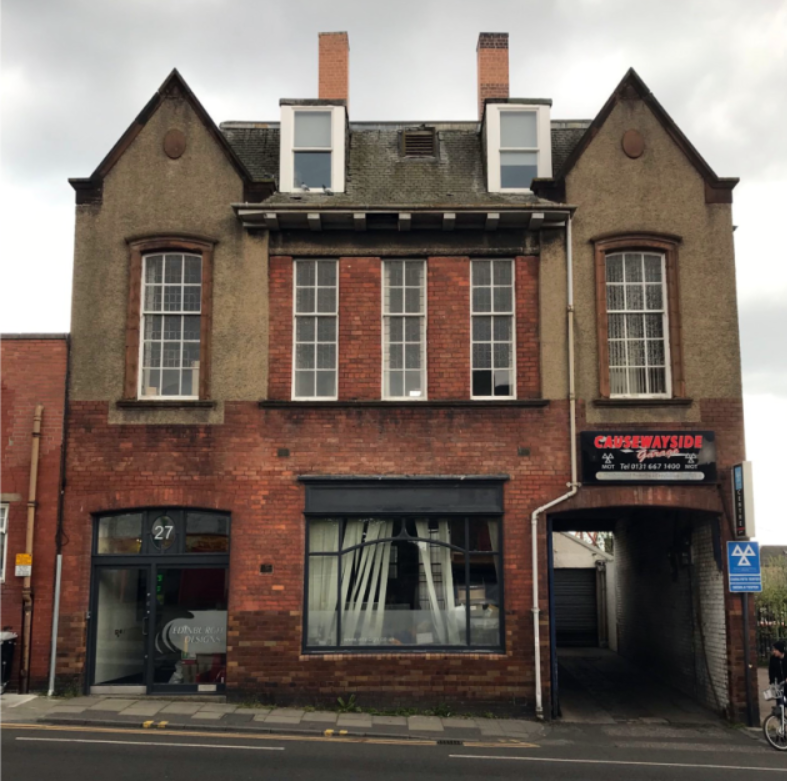
A Quiet Victory for Community Heritage: The Listing of the Former Lads’ Institute, Ratcliffe Terrace
POSTED ON April 22, 2026 BY James Garry
Interior significance reveals community use and meaning
There are moments in the life of a city when the quieter decisions matter most. The recent designation of the former Lads’ Institute at 27–29 Ratcliffe Terrace as a Category C listed building is one such moment. It may not command the skyline like Edinburgh’s great set pieces, nor draw the crowds of our better-known landmarks, but its value lies elsewhere, in the everyday fabric of the city, and in the lives it once served.
Built between 1906 and 1907, the Institute is a remarkably intact example of an Arts and Crafts building designed with purpose. Its restrained detailing and careful proportions speak to a period in which architecture was expected not only to endure, but to contribute meaningfully to civic life. This was not simply a building, it was an idea made solid: a place of education, recreation, and moral improvement for young men at the turn of the twentieth century.
Such institutions once formed part of a wider network of social provision across the city, reflecting a belief that the built environment could shape opportunity and aspiration. Today, few survive in anything like their original form. That this building does is significant.
Why the interior matters
Historic Environment Scotland’s decision to designate the former Lads’ Institute is important not just because of the building’s external appearance, but because of what survives inside it. The designation recognises that the interior layout, fixtures, rooms and circulation spaces all help to tell the story of how the building was used, who it served, and why it mattered to its community. In this case, the interior is not incidental decoration. It is central evidence of the building’s social, educational and communal role.
Historic buildings are often valued for their façades, but their interiors can carry equal, and sometimes greater, significance. Interiors reveal patterns of everyday life, collective activity and social purpose that may not be visible from the street. Protecting only the exterior risks losing precisely the elements that explain why a place mattered in the first place.
What is equally striking is the strength of public feeling behind its recognition. The consultation process revealed overwhelming support for listing, with 98 per cent of respondents in favour. In a city where debates about change can often be polarised, this level of consensus is notable. It suggests a shared understanding that heritage is not only about grand monuments, but about the places that tell quieter, more local stories.
The timing of this designation is particularly welcome. In 2025, the then-unlisted building faced a planning application (25/02904/FUL) for its demolition and replacement with purpose-built student accommodation for 66 beds. That application was refused by the City of Edinburgh Council in October 2025, with subsequent attempts to pursue demolition separately also unsuccessful. Strong local representations, alongside input from community councils and heritage organisations, helped highlight the building’s architectural and social value. In that sense, the listing reflects not only appreciation, but a timely recognition of significance that might otherwise have been lost.
Why this matters for communities and development decisions
For community stakeholders involved in development or reuse proposals, this designation highlights the importance of having a full understanding of heritage value, not just what is visible externally. Decisions made on partial information can unintentionally damage or erase nationally and locally important assets.
A comprehensive understanding of both exterior and interior significance allows communities to engage more confidently and constructively in planning processes, challenge assumptions that interiors are easily replaceable, and argue for reuse approaches that respect cultural meaning as well as architectural form.
Crucially, recognising interior significance helps reframe heritage as a living community resource, not simply a decorative shell. It strengthens the case for thoughtful adaptation that retains identity, memory and social value alongside physical fabric. In doing so, it supports better outcomes for heritage, communities and future use alike.
For the Cockburn Association, this outcome reflects a principle we have long sought to uphold in the face of continuing development pressures: that Edinburgh’s character depends as much on its modest, well-loved buildings as on its internationally recognised icons. The Lads’ Institute is part of a broader townscape, one that gives texture and continuity to the Southside, and which risks being incrementally eroded if not properly recognised.
Listing does not freeze a building in time, nor should it. Instead, it provides a framework within which change can be managed thoughtfully. It acknowledges significance while allowing for adaptation, an approach that is essential if historic buildings are to remain part of a living city.
There is also something worth noting about how this decision was reached. The consultation process allowed local voices to be heard, and they were heard clearly. In an era when engagement can sometimes feel procedural rather than meaningful, this is a reminder that participation still matters, and can shape outcomes.
The recognition of buildings such as this one is rarely accidental; it is often the result of sustained civic awareness, careful scrutiny, and the willingness of individuals and organisations to speak up for places that might otherwise be overlooked.
We welcome Historic Environment Scotland’s decision to recognise the Lads’ Institute’s architectural and social value, and we extend our thanks to all those who took the time to contribute to the consultation. Their input has helped secure not just the future of a single building, but the recognition of a shared heritage.
Edinburgh is often celebrated for its dramatic vistas and historic grandeur. But its true richness lies in the layering of stories, some prominent, others easily overlooked. The former Lads’ Institute is one of those quieter stories, now given the protection and attention it deserves.
And that is something worth marking.
Find out more:
Image: Andy Arthur – Threadinburgh