
Guest Blog: Doors Open Days and the National Library of Scotland
This blog post was written by staff at the National Library of Scotland’s Causewayside and George IV Bridge sites.
From 26-27 September 2026, over 120 venues opened their doors across Edinburgh and East Lothian as part of Doors Open Days, the largest free cultural festival in Scotland. Coordinated regionally by The Cockburn Association, the festival offered a variety of experiences, from behind-the-scenes tours of working institutions to hands-on activities for all ages.
In this guest blog post, the National Library of Scotland reflects on its Doors Open Days weekend across its two sites at Causewayside and George IV Bridge. It is a good illustration of what Doors Open Days does best: opening up the everyday work of institutions that most people only see from the outside.
______________________________________________________________________
Doors Open Day and the National Library of Scotland
The National Library of Scotland has taken part in Doors Open Day for several years. It’s a brilliant chance to allow visitors to learn more about the work of the library and explore areas usually off-limits to the public. This year we offered activities in two locations, at our main library building on George IV Bridge and our Causewayside building on Salisbury Place.
Causewayside Building
Our Causewayside Building was open on Saturday 26th September for tours and drop-in activities. This year we had the Doors Open Day bunting displayed around our entrance, as well as posters. This seemed to be very effective in prompting more casual drop-in visits from passers-by.
Tours
Tours started with a brief introduction to the history and collections of the National Library of Scotland and the history and architecture of the Causewayside building.
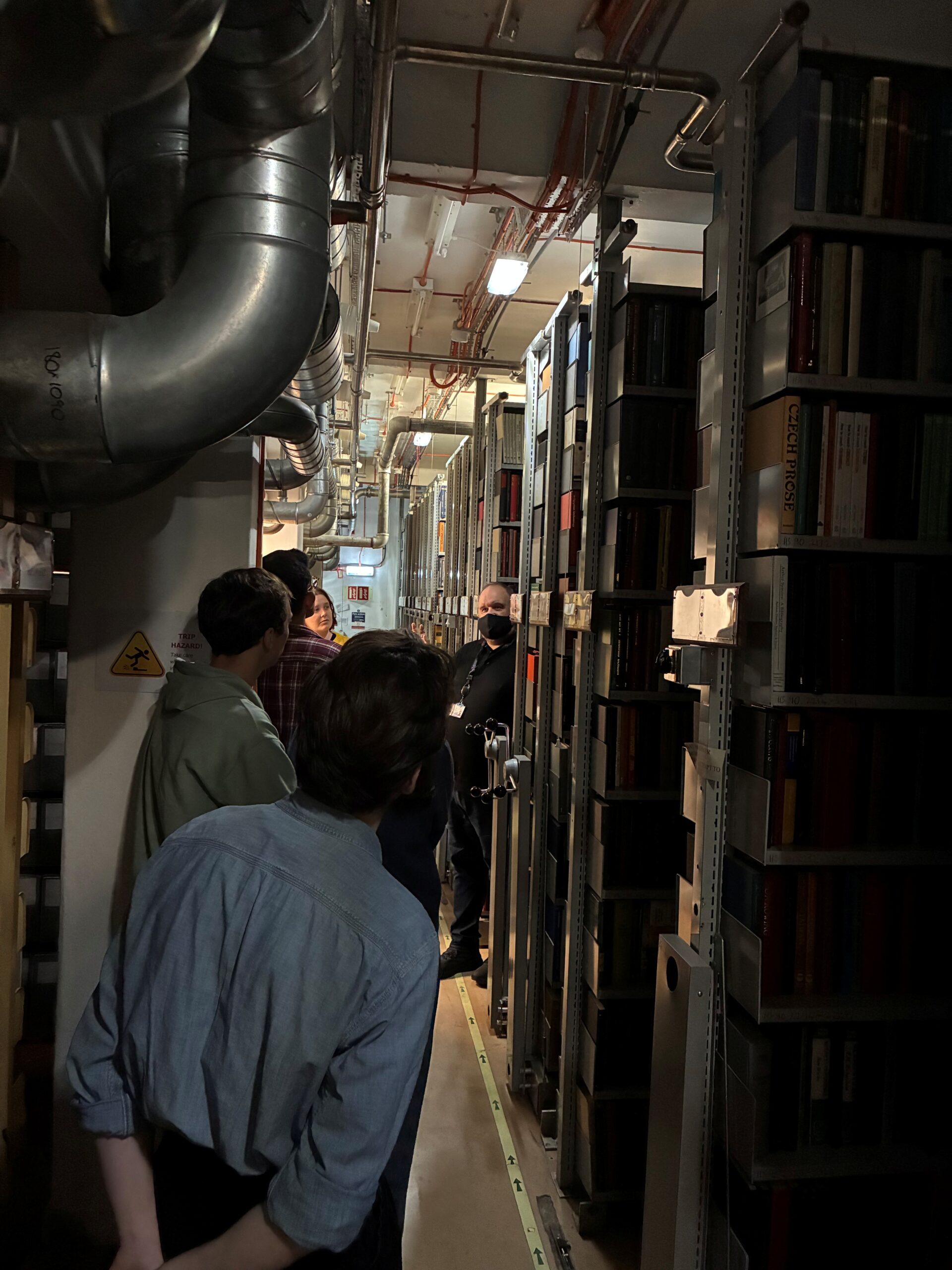
The first stop on the tour was a display of recent acquisitions, including books, magazines, newspapers, posters and leaflets. Staff from our cataloguing and digital preservation teams discussed the range of items collected by the library, and how these are processed and catalogued. The sizing cards, bespoke archival boxes and challenges of digital storage prompted lots of questions. The tour then visited a stack floor to see where collection items are stored.
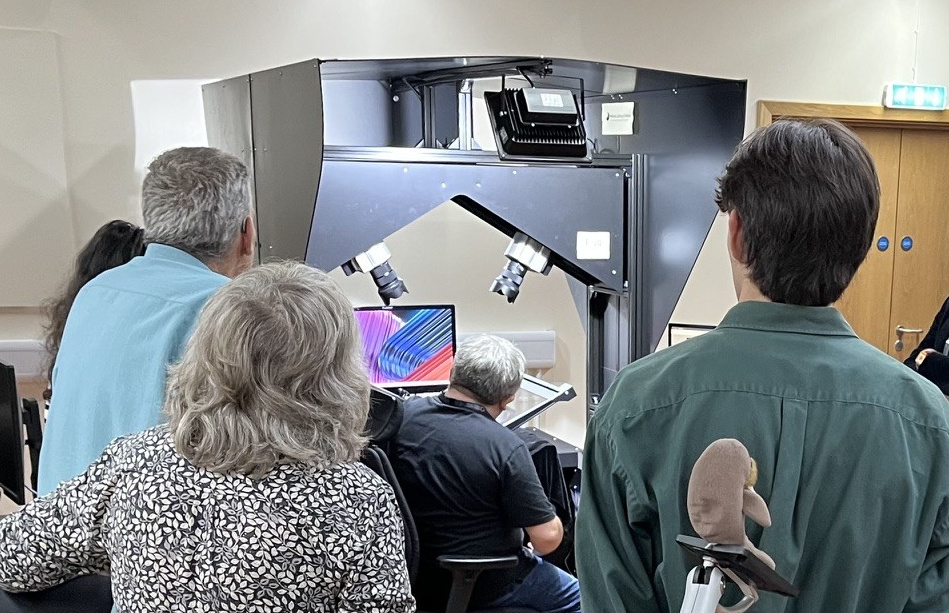
On to the digitisation suite, where the digitisation team demonstrated different scanners, which allow us to photograph a wide range of collection items. Participants were keen to learn more about how items were selected for digitisation and each step of the process.
Tours finished in the maps reading room, with a quick introduction to the map collection. Visitors could view a display of maps and atlases. This included a sequence of maps showcasing the areas affected by the recent fires near Glasgow Central Station and on Princes Street, Edinburgh to support the theme of heritage at risk.
Drop-in Activities
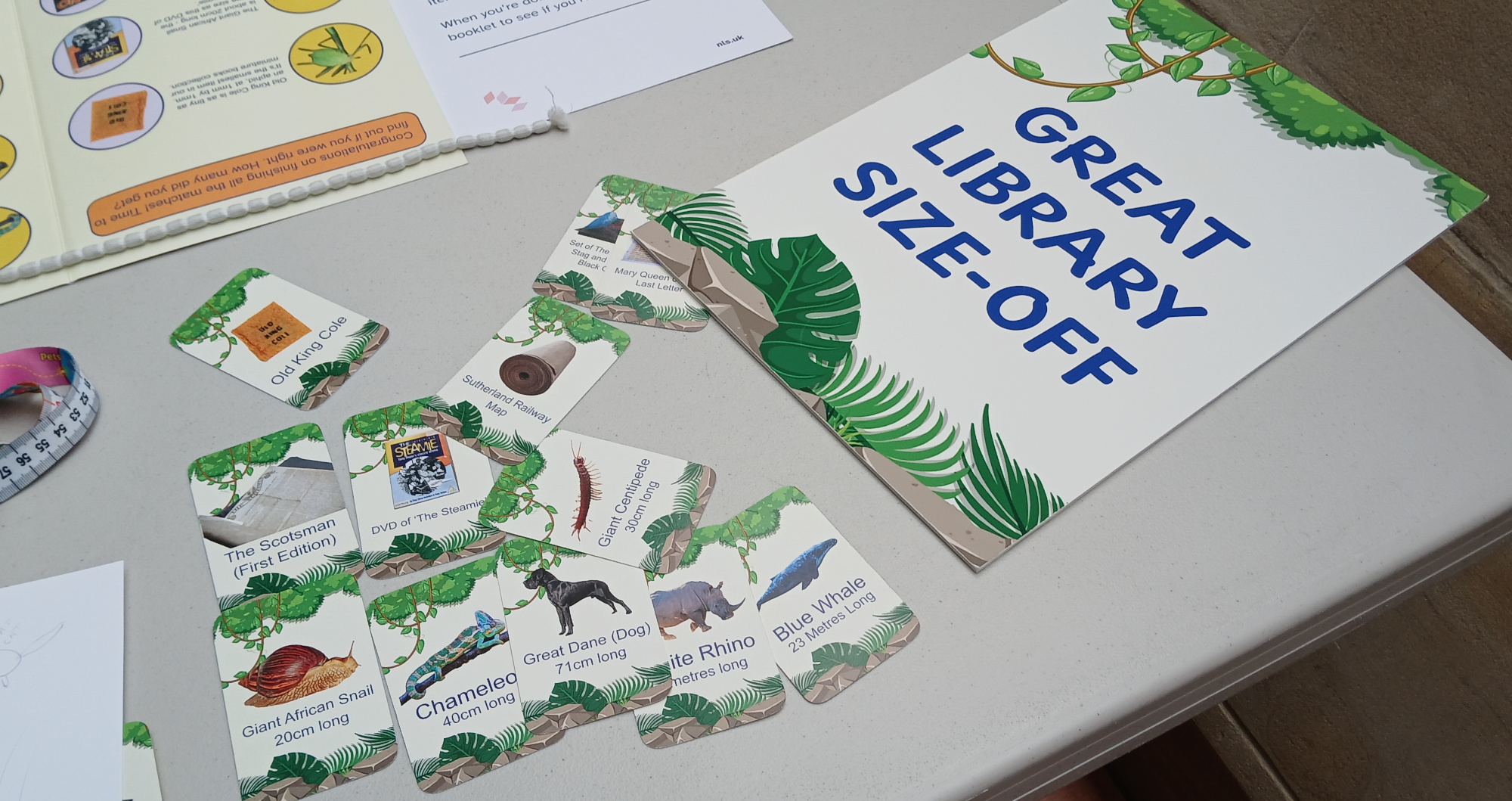
As well as the tours, there were displays and a range of games and activities that visitors of all ages could enjoy. These included a map display and a colouring area with both map colouring sheets and the Doors Open Day colouring competition. Library-themed games include the Great Library Size-off (match the collection item to a similar sized animal), Library Snakes and Ladders, map jigsaws and an opportunity to try and interpret old handwriting with the Palaeography Challenge. A recent project has been transferring old computer games from floppy disks, and a visitors could test some 1980s games during their visit.
It was good to offer the mix of tours and activities, as some visitors only wanted to spend a short time in the building, while others were looking for the in-depth one hour tour.
George IV Bridge
Our George IV Bridge Building offered Doors Open Days activity on Sunday 27th September in the shape of two pre-bookable events which were each offered four times throughout the day. These were all fully booked well in advance, with a total of 67 people turning up to attend on the day itself.
Tours
In the spirit and ethos of “Doors Open Day”, the tours literally opened doors to areas of the Library which are hitherto inaccessible to the general public.
After a brief introduction to the Library’s history at the foot of the slate-clad main staircase – beneath the large panelled windows engraved the Scottish illustrator, designer and academic, Helen Monro Turner – the tours then ventured down many flights of stairs, deep into the bowels of the National Library, for an insight into how things operate behind-the-scenes.
Much of the National Library building – designed by the Scottish architect, Reginald Fairlie – is hidden beneath George IV Bridge and so it is often difficult to convey the true scale of the Library’s collections, which are among the largest in Europe. From the entrance hall – which is actually on the 11th Floor of the Library – the tours were escorted down to the 4th and 5th Floors, where they were shown two of the labyrinthian stack floors which house part of the 120 kilometres of shelving which hold the Library’s collections. To make sure we didn’t lose anyone in the dark confines of the stacks, two members of staff accompanied each tour!
Whilst on the stack floors, staff explained how the National Library’s collections are stored, maintained, and grown for current and future generations; work which largely goes on behind closed doors. They were also able to demonstrate the ‘path of a book’ – i.e. how a book is ordered, located on the stack floors and then sent to the Reading Rooms for consultation. From the stack floors the tours then made their way back up through the Library and to the General Reading Room on the 13th Floor, where most of the Library’s modern collections are consulted. Some of those who attended the tours had consulted material in the General Reading Room before, but they had never seen how the books were supplied to them from the stack floors, and so left with a greater understanding of the work undertaken beyond the public areas of the Library.
Special Collections Reading Room Showcase
With the Doors Open Day theme of Heritage at Risk in mind, the Special Collections Reading Room of George IV Bridge was turned into a “behind the scenes” tour of our collections. The Special Collections Reading Room, incidentally one of the best views in Edinburgh, is where readers consult anything older than 1925 or that has been marked as especially fragile or significant for other reasons.
Taking this as our starting point, curator Suzanna Beaupré took visitors through a selection of items that might be consulted there with a range of obvious conservation issues, such as a detached front board, through to more subtle ones, such as unopened pages that would need attention before the book could be read. We looked at some general good handling advice and discussed with the Reading Room staff some of the handling and conservation issues they experience day-to-day in their jobs.
We then turned from the reading room to go to our next table – set up as “The Curator’s Office”. Here we looked at how curators and other library staff analyse the physical nature of a book to both help with its conservation, and to unearth more about the book itself. Here, curator Laura Cooijmans-Keizer “unboxed” John Duns Scotus’ Quaestiones in primum librum Sententiarum Petri Lombardi. Published on 5 November 1472 by Venice-based printer Vindelinus de Spira, this volume represents the first time a Scottish author’s work was printed anywhere in the world. The Library’s copy of this book has been changed and added to over the course of its life: metalwork has been removed, leather patches were added to damaged corners, the spine, and former clasps, and the old spine label has been reattached on top of a new repair. All of these changes tell us something about how the book was looked after and valued and our Doors Open Day visitors were invited to discuss what that might be, with the aid of a physical assessment form. The collaborative part of the tour let the visitors think both about the Library’s books and their own in a new way, with many taking home the sheets to carry out similar analyses on their personal collection.
The group then moved from “The Curator’s Office” to “The Conservation Studio”, where the tour concluded with a hands-on introduction to conservation. Using detached pages from a deaccessioned children’s book in the library’s sacrificial training collection, attendees practised applying a delicate remoistenable tissue repair. They also explored an array of conservation tools and materials through a tactile show-and-tell session. Together, these activities demonstrated how curatorial knowledge and conservation expertise are applied side-by-side to help to preserve Scotland’s published heritage for future generations.
We received some great feedback from visitors over the two days:
- ‘I live nearby and pass this building all of the time, so it was fantastic to see inside.’
- ‘I got to understand the building, its performance, maintenance and conservation, and I learnt about the work of the National Library, which is extremely interesting.’
- ‘Friendly staff, so welcoming.’
- ‘I will recommend it to everyone. Thank you.’
- The tour was incredible and the guide was so knowledgeable! Learnt so many cool things today, thank you!
- Amazing tour, loved the enthusiasm of the staff! They were so keen and the
whole tour was so well organised I felt it really gave me a sense of the type and kinds of work the NLS is involved in. - The stacks are so interesting to see and our tour guides were very knowledgeable and friendly. I hope you continue to do this in the future.
Visiting the National Library of Scotland
George IV Bridge
George IV Bridge, Edinburgh EH1 1EW
- Monday to Thursday: 10am to 7pm
- Friday and Saturday: 10am to 5pm
- Sunday: Closed
The café closes an hour earlier than the rest of the building, Monday to Thursday.
Causewayside (Maps Reading Room)
33 Salisbury Place, Edinburgh EH9 1SL
- Monday to Thursday: 10am to 5pm (closed 1pm to 2pm)
- Friday to Sunday: Closed
Causewayside is open by appointment only. You’ll need to join the Library (it’s free) before you can book.
Opening times can change, particularly over holidays, so please check before: National Library of Scotland | Home
Edinburgh and East Lothian Doors Open Days is supported by:



Event Sponsor
