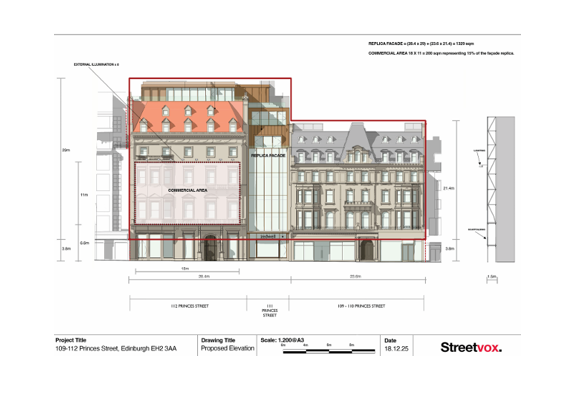
Tale of Two Streets: Regenerating Princes Street and Sauchiehall Street
Wed, 10 Dec, 6pm - 8pm GMT
Princes Street’s evolving character reflects shifting visions of urban life
The Cockburn Association has reviewed the proposal for the demolition of existing buildings and the development of purpose-built student accommodation at 36 Russell Road. While we appreciate the intention to bring the site back into productive use, we cannot support the application in its current form.
At seven storeys and approximately 25 metres in height, the proposed building would be overly dominant within its setting and out of keeping with the surrounding townscape. Its form, massing, and roofline have not been convincingly justified and would risk appearing intrusive when viewed from neighbouring streets and from key protected views looking into the city centre. Before any scheme progresses, a more robust visual impact assessment is required to demonstrate that the proposal will not compromise Edinburgh’s valued skyline or wider landscape setting.
We are also concerned that this application will, in effect, set the parameters for how the rest of the adjacent site comes forward. In the absence of an agreed masterplan, piecemeal development risks undermining the potential for a coherent, well-designed neighbourhood. A site-wide masterplanning approach would provide clearer guidance on height, density, movement, public realm, and the mix of uses appropriate for this location, ensuring better long-term outcomes.
The site sits within easy walking distance of active travel routes, rail connections, and frequent bus services. Its highly accessible location makes it well suited for mixed-tenure, affordable or lower-cost housing that would support long-term residents and contribute to a more balanced and sustainable community. The exclusive focus on student accommodation fails to take advantage of this opportunity.
We further note that Edinburgh continues to face significant pressure from an expanding pipeline of student accommodation. A detailed, citywide assessment of supply, demand, distribution, and emerging trends is still required to guide decision-making. Until such evidence is available, approving additional large-scale, single-use student blocks risks exacerbating existing imbalances in local housing markets.
Although most rooms in the proposal are designed as cluster flats, the scheme as a whole offers little in the way of wider community benefit, usable amenity space, or meaningful integration with its surroundings. Given its scale, density, and narrow land use, we remain unconvinced that the proposal represents the best use of this strategically located site.
For these reasons, the Cockburn Association objects to the proposal as submitted.
The Cockburn Association objects to the proposed change of use of 14–15 Claremont Crescent from hotel to seven serviced apartments. This application represents a clear retreat from the principle of restoring permanent residential use to this listed New Town terrace, a principle that underpinned the Council’s recent approval for residential conversion and which aligns with wider strategic objectives to sustain living communities within the historic city centre.
Claremont Crescent forms part of a sensitive, predominantly residential environment whose character depends not only on architectural form but on stable, long-term occupation. The replacement of consented residential flats with commercially managed serviced apartments introduces a transient model of occupation that is fundamentally different in nature, intensity, and impact. Experience elsewhere in the New Town demonstrates that such uses erode residential amenity through regular guest turnover, increased servicing activity, vehicle movements, waste handling, and the gradual loss of neighbourly continuity. These impacts are not mitigated simply because the former use was a hotel; the direction of travel approved by the Council was explicitly toward permanent housing, not a reshaped version of commercial accommodation.
Although the applicant states that no additional physical alterations are proposed, the change in operational use has the potential to affect the way the building is used, managed and maintained, with implications for the long-term care of its listed fabric and the character of the terrace. Serviced apartments often introduce cumulative pressures, including increased wear, signage, access systems and servicing infrastructure, which can undermine both heritage value and residential amenity if not rigorously controlled.
This proposal conflicts with the spirit and intent of NPF4, particularly Policy 16 (Quality Homes), and with City Plan 2030 policies seeking to protect residential environments from inappropriate commercial encroachment. Allowing this change would also set an unhelpful precedent, signalling that recently approved residential conversions can be reversed for short-stay commercial purposes, weakening the Council’s efforts to rebalance the city centre toward permanent habitation.
For these reasons, the Cockburn Association considers the proposal unacceptable in principle and detrimental to the long-term sustainability and character of the New Town. We therefore object to the application and urge the Planning Authority to refuse consent. Should the Council nonetheless be minded to consider approval, we strongly insist that stringent conditions be imposed to prevent unmanaged short-term use and to safeguard residential amenity and the historic fabric of the building.
The Cockburn Association objects to this proposal for a telecommunications monopole and associated cabinets on Cluny Avenue, within the Morningside Conservation Area.
The proposed siting is inappropriate. The mast would sit immediately beside a very busy bus stop, where the surrounding space is already heavily used throughout the day. This is an important seating area for residents. Introducing a substantial pole and cabinets at this point would constrict pedestrian movement and reduce comfort and safety for bus users at one of the area’s key public transport stops.
We acknowledge that the application proposes the relocation of the existing public seating. However, if the scheme is revised, it is essential that the seating is fully retained and that no layout results in its loss or in reduced accessibility for those who rely on a place to rest while waiting for the bus.
There is also no evidence that alternative or shared locations have been meaningfully explored. In a Conservation Area, where minimising visual and physical clutter is a priority, the absence of such analysis is a significant weakness in the proposal. The cumulative spread of poles, cabinets, and related equipment continues to erode the coherence of Edinburgh’s historic streetscape.
Although Scottish Government regulations limit the Council’s ability to refuse telecommunications applications, this does not remove the responsibility to avoid pedestrian pinch points, high-use bus stops, and sensitive locations within the historic environment.
We therefore urge the Council to reject this application unless a less intrusive location, preferably through mast-sharing or consolidation, is identified, ensuring that telecommunications upgrades are delivered without diminishing the accessibility or amenity of this important public space.
The Cockburn Association objects to this application. It has been brought to our attention by a local resident, and we share significant concerns about the impact of the proposal on both the heritage value of Royal Terrace and the amenity of neighbouring properties.
Royal Terrace is one of Edinburgh’s most architecturally important streets and forms a defining part of the Georgian New Town and the UNESCO World Heritage Site. Its Category A listing reflects its exceptional national significance. Any intervention within its curtilage, or which may affect its setting, must therefore be subject to the highest level of scrutiny. The elevated position of the site means that the proposed development would be highly visible and risks introducing an intrusive presence into a deliberately formal and coherent historic streetscape.
We are particularly concerned about the commercial nature of the proposal and the potential for increased activity, noise, and overlooking. These issues raise clear risks to residential amenity for properties along Royal Terrace and within the wider area, especially given the prominent siting and proximity of the proposed works to long-established homes. The potential for disturbance is considerable.
In our view, the works would have a material impact on the setting of the Category A-listed terrace. As such, a separate application for Listed Building Consent (LBC) is likely to be required under Section 8 of the Planning (Listed Buildings and Conservation Areas) (Scotland) Act 1997. We urge the planning authority to confirm this requirement and to request a full heritage impact assessment before progressing the application.
On policy grounds, the proposal appears contrary to several key provisions of the Edinburgh City Plan 2030. In particular, Hou 8 (Listed Buildings and Their Settings), which requires developments to preserve and, where possible, enhance the character and setting of listed buildings; and Des 2 (Alterations and Extensions), which calls for high-quality, context-appropriate design that does not harm the established character of its surroundings. The concerns about noise, disturbance, and overlooking also raise issues under Hou 9 (Protecting Residential Amenity). These matters align closely with NPF4 Policy 7 (Historic Environment), which places strong emphasis on safeguarding nationally significant heritage assets and their settings.
In summary, the Cockburn Association objects to this application on the grounds that it would harm the setting of a Category A-listed terrace, introduce unacceptable impacts on residential amenity, and does not comply with the relevant policies in City Plan 2030 or NPF4. We recommend refusal unless the applicant can demonstrate, through a substantially revised and fully justified proposal, that no detriment would arise to the historic environment or neighbouring amenity.
Floating bus stops need careful, inclusive design to build public confidence