How Should Edinburgh Look in 2040? Why Your Voice Matters Now
POSTED ON July 3, 2026 BY James Garry
Help shape Edinburgh’s future: your ideas today will influence the city’s 2040 vision
In 1849, in the last months of his life, Lord Cockburn sat down to write a letter to the Lord Provost. He titled it, with characteristic bluntness, A Letter to the Lord Provost on the Best Ways of Spoiling the Beauty of Edinburgh. It was not a celebration. It was a warning — that a city as remarkable as Edinburgh, with what he called its “curious, and matchless position” and its endless aspects seen from every height and plain, could be ruined not by any single catastrophe but by a thousand small, careless decisions, each one defensible on its own terms.
That is the warning the Cockburn Association was founded to answer in 1875, and it is the warning behind everything we do today. It is also, unmistakably, the question now sitting in front of every resident, business owner and community group in Edinburgh: how do we want this city to look in 2040?
The Council wants to hear from you — now, not later
The City of Edinburgh Council has opened its City Plan 2040 Call for Ideas, running until the end of September 2026. This is not a consultation on a single planning application, building or street. It is a rare opportunity to shape the policies that will decide where future proposals come from in the first place: where homes are built, which employment land is protected, how climate adaptation is embedded in development, and what role heritage plays in Edinburgh’s future over the next fifteen years.
By the time a contentious proposal lands on a site near you, many of the strategic decisions have usually already been made. City Plan 2040 is being shaped now. This is the moment to influence it, rather than react to it later.
What you can actually do this summer
You do not need to be a planner, an architect, or a member of an organisation to take part — and you do not need to wait for the Cockburn Association or anyone else to speak for you. The Council is asking for direct, local and specific input. That might mean:
- Submitting an idea through the Council’s Consultation Hub — a short task that can flag a single site, a missing pedestrian link, a building worth protecting, or a street that needs more trees.
- Writing to your local councillor or community council to raise concerns or priorities before the Plan’s policies are drafted.
- Joining or supporting your local Community Council or Local Place Plan group, where neighbourhood-level priorities are being gathered and will feed directly into the wider plan.
- Responding as a business if you trade on a high street or in the city centre — the balance between visitor accommodation, hospitality and everyday local services is one of the most contested questions in this Plan, and the Council needs to hear from people who work and trade here, not only from those who visit.
- Telling us what you think, so that our own submission — and the wider submission being coordinated through the Edinburgh Civic Forum — reflects what residents and businesses are actually seeing on the ground, not just what policy documents assume.
None of this requires expertise. It requires only what Cockburn himself relied on: a willingness to look closely at the city you actually live in, and say plainly what you see.
Why the Cockburn Association is involved
We are preparing our own formal response to City Plan 2040, and will be working alongside the Edinburgh Civic Forum, which brings together civic, community and voluntary organisations from across the capital to identify shared priorities. Recurring themes in those early discussions will be familiar to anyone who has followed our recent planning work: how Edinburgh accommodates growth without losing what makes it liveable; how housing, employment and tourism are balanced; how historic neighbourhoods adapt to a changing climate; and how local knowledge is allowed to shape decisions genuinely, rather than arriving after they have already been made.
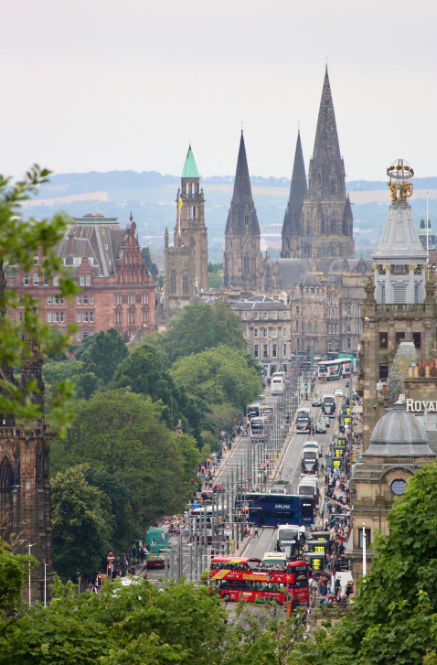
Recent debates over the future of Princes Street illustrate the stakes well. It is not simply a shopping street; it is one of Edinburgh’s defining public spaces. Decisions about pedestrian access to the Gardens, the quality of the public realm and the future of the transport corridor cannot sensibly be made in isolation from one another. The same logic runs through every part of the city: new development should meet the highest design standards, climate resilience should be built into the fabric of neighbourhoods rather than added as an afterthought, and the historic environment should be treated as an asset, not a constraint.
Cockburn would have recognised this argument instantly. He did not object to Edinburgh changing — he had watched the New Town rise in his own lifetime and lived at its heart, in Charlotte Square. What troubled him was change pursued without judgement: improvement that, in the long run, diminished the very thing it claimed to improve. That distinction — between growth that strengthens a place and growth that merely adds to it — is exactly what City Plan 2040 will be tested against.
The city will be shaped by thousands of decisions, not one
Edinburgh’s future will not turn on a single masterplan or planning application. It will be the sum of thousands of smaller decisions, made over many years, many of them traceable back to choices being made through City Plan 2040 now. That is why this consultation matters more than it might first appear, and why it rewards being specific rather than general: a single comment about a park, view, building, bus route or missing local service can carry real weight if it is grounded in local knowledge.
Cockburn’s letter to the Lord Provost worked because he did not deal in abstractions — he wrote about particular streets, particular buildings, particular acts of carelessness he had watched happen. The Council’s Call for Ideas rewards the same approach from residents today.
How to take part
The City of Edinburgh Council’s City Plan 2040 Call for Ideas is open until 30 September 2026. Whether your priority is heritage, housing, climate, transport, biodiversity, local services or simply your own street, this is the moment to say so — directly to the Council, through your community council, or to us, so that we can help ensure those priorities are reflected in our submission and in the work of the Edinburgh Civic Forum.
Edinburgh has never stood still. Every generation has shaped the city it inherited — for better, and sometimes, as Cockburn knew all too well, for worse. This generation now has the chance to decide which it will be.
Image: Central Edinburgh by Serinus on Pexels