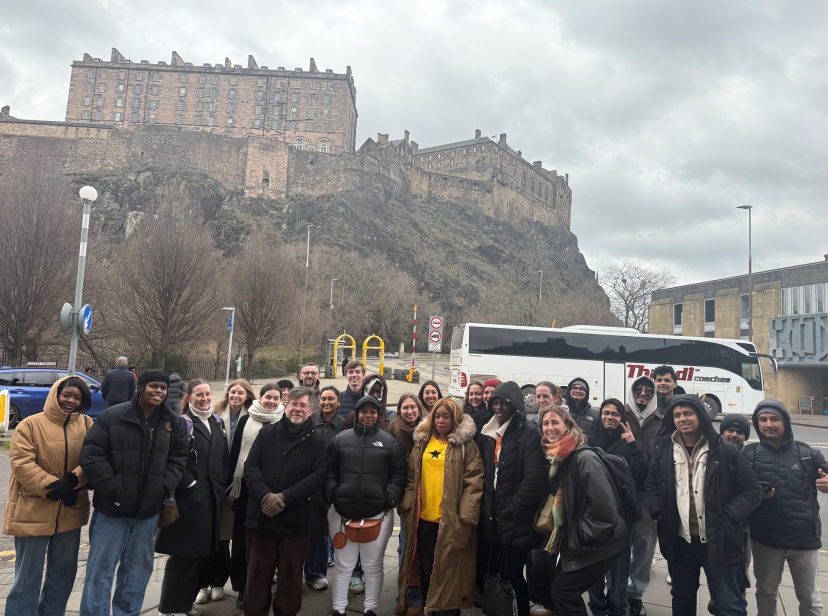
Future global leaders experience Edinburgh with the Cockburn Association
POSTED ON May 29, 2026
Exploring Edinburgh’s public realm through the eyes of students
Edinburgh is often celebrated for its remarkable architecture, historic streets and dramatic landscape. Yet the city’s character is shaped not only by its buildings, but by the spaces between them: the streets, squares, gardens and routes that connect neighbourhoods and bring people together. These public spaces are where many of the city’s most important debates play out, from transport and tourism to climate resilience, heritage conservation and economic development.
To explore these questions in practice, I joined a group of students on a field trip through Edinburgh city centre. Beginning at the Royal Lyceum Theatre and ending at Waverley Station, the walk provided an opportunity to consider how a range of contemporary planning, heritage and public realm issues are shaping the city today.
Reflecting on the experience, field trip organiser Jason Boccarro observed:
” In February, I accompanied 13 North Carolina State University (NCSU) students enrolled in the Shelton Leadership Center’s Global Leadership and Team Decision-Making Minor. As part of the programme, students complete four courses across three countries during the Spring semester. One of these courses is a partnership between the University of the West of Scotland (UWS) and NC State, where students explore key leadership issues and challenges facing the sport, tourism and event sector. As part of the experience, we travelled to Edinburgh to examine how the event and tourism industry can present both challenges and opportunities for local communities.
During our visit, we had the privilege of exploring the city with James Garry from the Cockburn Association. His knowledge and passion for Edinburgh’s heritage made a lasting impression on both the NC State and UWS students. Our time with James was far more than a walk through historic streets. It provided a meaningful lens through which students could better understand the relationship between urban development, conservation, and community identity.
Inspired by what they saw and heard, the students were able to reflect on the dilemmas Edinburgh faces in preserving and enhancing its open and green spaces. These conversations highlighted the complexity of balancing growth with stewardship in a city that is so rich in history and character.
Experiences like this are critical to leadership education, bringing students into real-world contexts, encouraging dialogue, and learning from those who care deeply about place. We are grateful to the Cockburn Association and to James for their generosity, insight, and time to share some valuable insights as well as their commitment to shape Edinburgh’s future. I hope to return with a new cohort of NC State students in 2027 to continue these discussions with James and the Cockburn Association”.
The route itself provided a useful reminder that Edinburgh’s future cannot be understood through individual planning applications or policy debates alone. The issues discussed along the way, whether traffic management on Lothian Road, the role of privately managed public spaces, the impact of tourism on residential communities, the future of modern buildings such as Argyle House, or the competing demands placed on Princes Street Gardens, are all interconnected.
What united these conversations was a shared recognition that Edinburgh’s public realm is one of the city’s greatest assets. It supports everyday life, welcomes visitors, creates opportunities for business and culture, and contributes to the city’s unique sense of place. At the same time, these spaces are under increasing pressure from growth, climate change, changing patterns of movement and evolving expectations about how the city should function.
The Cockburn Association has long argued that successful cities are shaped through careful stewardship rather than short-term decisions. That means taking the long view, recognising cumulative impacts, and ensuring that change contributes positively to the character, resilience and liveability of Edinburgh.
The discussions sparked by this walk offered no simple answers. They did, however, demonstrate the value of bringing people together to explore the city on foot, to observe its successes and shortcomings first-hand, and to engage in informed debate about its future. As Edinburgh continues to change, these conversations will become ever more important in helping to shape a city that works for residents, visitors and future generations alike.
Thanks to:
Professor Jason Bocarro
Owens-Shelton Distinguished Professor of Leadership with a Global Perspective
James Buzzard Leadership Development Program Director
Professor | University Faculty Scholar
College of Natural Resources
Box 8004, 3028F Biltmore Hall
North Carolina State University
Raleigh, NC
Image:
NCSU and UWS students on walking tour of Edinburgh with James Garry, Cockburn Association. Source: Jason Bocarro.