Building for the Future We Say We Want
POSTED ON May 22, 2026 BY James Garry
Hammarby Sjöstad: on closing the gap between what plans say and what buildings deliver
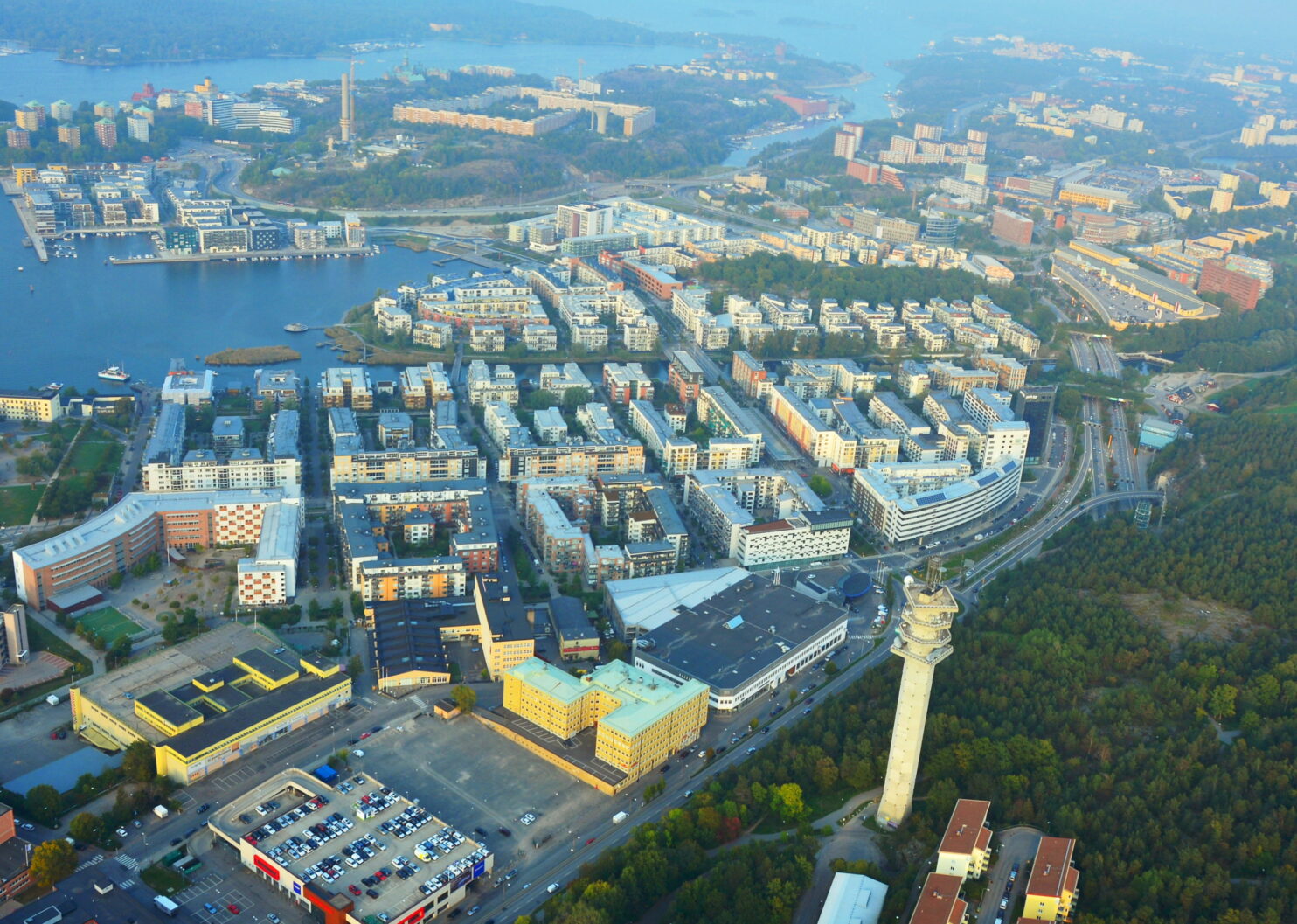
Stockholm’s Hammarby Sjöstad was planned in the early 1990s as Sweden’s showcase for the 2004 Olympic bid. The bid went to Athens. The neighbourhood was built anyway and has become one of the most studied examples of sustainable urbanism in the world — not because of any single innovation, but because environmental principles were embedded in every decision, from the first masterplan sketch to the last building on the last plot.
Hammarby occupies former industrial land to the south-east of Stockholm’s centre. Energy, water, and waste flow through an integrated closed-loop system: biogas from the sewage plant heats homes; waste heat from the data centre feeds the district energy network. The tram line was running before the first residents arrived — not promised for a future phase or subject to a funding review, but operational on day one. Buildings vary in architect and expression, but a design framework, consistently enforced, keeps them coherent without making them uniform. The parks and waterways are structural elements of the layout, not afterthoughts fitted around the blocks.
Edinburgh reads this uncomfortably. Not because the model is unachievable, but because the gap between what the city’s planning documents promise and what its development actually delivers is persistent and rarely acknowledged with any directness. NPF4 is ambitious. The Granton Waterfront Development Framework is serious about environmental performance. The outline conditions at Winchburgh and Blindwells require active travel provision and above-minimum energy standards. The language is not the problem.
The gap between what Edinburgh’s plans say and what Edinburgh’s development delivers is the most important unresolved problem in the city’s built environment policy. Hammarby closed that gap. Edinburgh has not.
Delivery is the problem. British planning relies on conditions attached to outline permissions, enforced application by application across decades. This is a structural weakness that Edinburgh did not create. But it is particularly visible here because the rhetoric has been particularly ambitious. The Western Harbour remains the sharpest example. The masterplan existed; a development company was established; the ambitions — mixed uses, high-density urbanism, excellent public realm, sustainable transport — were clearly stated. What was built, in the development rush before the 2008 crash, was none of those things. Speculative flatted blocks in cheap materials, cheerless spaces between them, a car dependency the promised tram connection never resolved. The people who designed the masterplan moved on. Those who built the buildings answered to different clients with different priorities. Nobody was held to account for the gap.
Hammarby worked because Stockholm’s administration stuck firmly to its principles. The same environmental performance requirements applied in phase fifteen that had been agreed in phase one. When developers proposed to reduce insulation standards, the answer was no. The integrated energy, water, and waste systems were procured as infrastructure and delivered as a coherent whole, rather than assembled piecemeal from whatever individual developers could be persuaded to contribute. The result is a neighbourhood using approximately half the energy of a comparable conventional district. It is also, by any measure, a pleasant place to live. Those facts are connected.
Edinburgh has evidence of what this discipline produces when applied. The Edinburgh Home Demonstrator at Granton, delivered by Anderson Bell Christie, is a pilot programme for net zero homes that sets out to prove — on a real site, with real budgets — that high environmental performance and genuine affordability are not in conflict. If it works, and the early signs are encouraging, it provides a template that could govern subsequent phases of the Granton programme. That is exactly the kind of first-phase decision Hammarby’s planners made in the early 1990s: establish the standard, demonstrate it concretely, hold to it.
The architectural and institutional questions are entangled. Richard Murphy identified Scotland’s procurement system as the structural cause of a generation of disappointing public buildings: ninety per cent of points in a public appointment process go on project management credentials, ten per cent on design experience. The most talented practices are systematically excluded from the commissions where their abilities are most needed. Murphy’s Danish colleagues, he noted, were astonished to learn that Scotland maintained a government architecture unit, an annual design festival, and a formal architecture policy while operating a procurement system that made high-quality public design nearly impossible to achieve.
The St James Quarter, completed in 2022, illustrates the unresolved tension. The W Hotel’s Ribbon Building — a twelve-storey coiled structure in bronze-coloured metal, visible from Calton Hill and across the New Town rooftops — divided critics: some saw genuine presence, a willingness to make a statement in a city that too often retreats to the blandly contextual; others saw spectacle substituting for quality. What is harder to contest is that the wider development — the retail podium, the ground-floor streetscape, the relationship to the surrounding city — represents an enormous volume of construction in a World Heritage setting that will be with Edinburgh for generations, and that it does not command the level of confidence such an opportunity should have warranted
Regensburg, Lyon, Vienna, Hammarby: cities that decided the places they were building would be inherited by people not yet born, and acted accordingly. This series has moved through four different aspects of that decision — building around heritage with confidence; extending the city with a governing idea; housing people well as a civic commitment; embedding sustainability from the start rather than grafting it on later. They are not separate lessons. They are different angles on the same underlying question: what does a city owe the people who will live in it?
Edinburgh has the talent to answer that question well. Practices across the city have demonstrated, repeatedly and often on constrained budgets, that architecture here can be contextually serious and genuinely inventive. What is missing is not ability or ambition but a procurement system that rewards the former and a planning culture that holds the latter to account in the growth areas as rigorously as it does in the historic city.
The Cockburn Association has spent a hundred and fifty years defending Edinburgh’s built heritage against the persistent pressure to accept less than the city deserves. The argument of this series is that the same standard of expectation — the same refusal to wave through the mediocre because it avoids the conspicuously bad — should apply to the new fabric being built now in Granton and Leith, in Craigmillar and Shawfair. These places will define Edinburgh for the next century as surely as the New Town defined it for the last.
We are building that inheritance now. The Festival of Europe Scotland is, among other things, an invitation to consider what European civic culture has worked out about doing so well. Edinburgh has every reason to take it seriously.
Further reading
Hammarby Sjöstad — official project site — city-linked project overview and environmental model
Hammarby Sjöstad 2.0 — ongoing sustainability initiatives and updated ambitions
Owen Hatherley, ‘The Slow Ruin of Edinburgh’, Prospect (2017) — the essential starting point for any serious reading on Edinburgh’s architectural condition
Richard Murphy, interview in The Scotsman (2016) — on procurement failure and its consequences
Edinburgh City Council, Granton Waterfront Development Framework — adopted 2021, including climate commitments
Scottish Government, National Planning Framework 4 (2023) — six qualities of successful places
Festival of Europe Scotland — programme and partner organisations, 7–17 May 2026
Cockburn Association — publications and campaigns on Edinburgh’s built environment
Photo: Johan Fredriksson / Wikimedia Commons (CC BY-SA 3.0)