
Centrum House
Posted on: May 19, 2026
Improved scheme, but concerns remain over scale, demolition, and design quality
Address: 108 – 114 Dundas Street, 116 Dundas Street Edinburgh
Proposal: Erection of hotel development (Class 7) with ancillary restaurant and bar etc
Reference: 26/01504/FUL
Closing date for comments: Tue 15 May 2026
Determination date: Fri 07 Aug 2026
Result: Pending
Cockburn Response
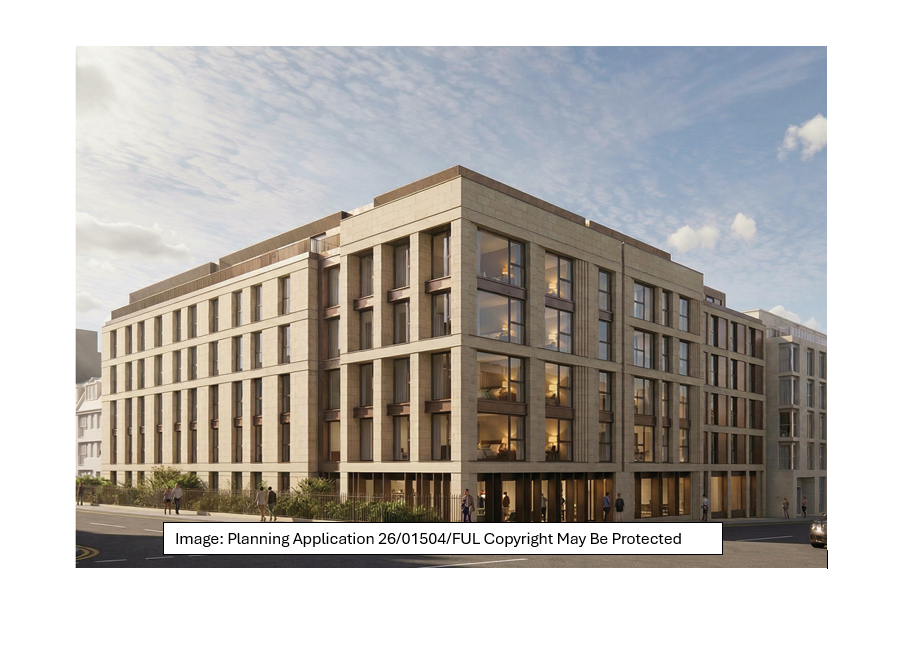
The Cockburn Association recognises that the current application represents a material improvement on earlier redevelopment proposals previously submitted for the Centrum House site. The revised scheme demonstrates greater architectural discipline, a clearer urban structure, and a more coherent response to the Dundas Street frontage than previous iterations. The simplification of the programme into a primarily hotel-led development has also resulted in a more unified and legible architectural approach.
The Association additionally acknowledges the opportunity presented by the replacement of the existing buildings, which make a limited positive contribution to the New Town Conservation Area and wider townscape.
However, despite these improvements, significant concerns remain unresolved.
In particular, the proposal continues to appear overly large in scale and insufficiently articulated for such a sensitive New Town context. While materially more restrained and coherent than earlier schemes, the overall massing still risks reading as an overly continuous large-format intervention within a townscape characterised by finer grain, hierarchy and rhythm. Further articulation and modulation would help reduce perceived bulk and strengthen contextual integration.
The Association is also concerned by the increasingly formulaic architectural character of many major redevelopment proposals emerging across central Edinburgh. While the current scheme is more disciplined and coherent than earlier iterations, it nevertheless reflects a wider pattern of commercially standardised hotel-led architecture that risks contributing to a gradual homogenisation of the city centre. Edinburgh’s historic environment was not created through architectural caution alone; many of the city’s most valued buildings and townscapes were innovative interventions in their own time. Development at such prominent gateway locations should therefore aspire not merely to competence, but to a higher level of architectural originality, civic presence and contextual imagination.
The Association also remains concerned by the continued reliance on demolition-led redevelopment. Given Edinburgh’s climate commitments and the increasing importance of embodied carbon considerations within the planning system, the application would benefit from a substantially more robust justification for demolition and clearer evidence that meaningful retention, retrofit or adaptive reuse options have been comprehensively explored.
In addition, the proposal should be considered within the wider cumulative context of increasing hotel intensification within central Edinburgh and the New Town edge. While hotel use may be acceptable in principle at this location, repeated large-scale visitor accommodation schemes risk contributing to the gradual erosion of mixed-use balance, townscape diversity and architectural grain within the city centre.
Overall, the proposal appears materially different from — and improved compared to — the earlier scheme previously objected to by the Cockburn Association. On balance, a robust and critical planning comment now appears more proportionate than a formal objection, while still clearly identifying the remaining concerns regarding scale, demolition, sustainability, architectural quality and cumulative impact