Oliver Barratt MBE (1941–2026): A Life in Service of Edinburgh
POSTED ON April 23, 2026 BY James Garry
A quiet force behind Edinburgh’s modern conservation movement
Oliver William Barratt MBE, who died peacefully on 17 April 2026 at the age of 84, was one of the most influential figures in the conservation of Edinburgh’s historic environment during the late twentieth century. For two decades, he helped shape how the city understood and protected its architectural heritage. His leadership was vital at a time when that heritage faced sustained pressure from powerful redevelopment forces and changing planning priorities.
His contribution to conservation in Scotland was recognised with the award of an MBE. The work itself was never simply about resisting change. It was grounded in a belief that development could and should be guided by a deep understanding of place. Through careful research, thoughtful advocacy, and a commitment to public engagement, he helped establish a more informed and constructive approach to civic debate in Edinburgh.
He took up his post at the Cockburn Association in the early 1970s and remained in position until 1992. These were years of considerable transition. Edinburgh was adapting to new economic realities, increasing traffic pressures, and a growing awareness of its international cultural significance. When he began his tenure, the work of conservation bodies was often reactive, focused on opposing demolition or poor design after proposals had already taken shape. Under his guidance, the Association developed a more strategic and engaged role within the planning process.
During the 1970s and 1980s, Barratt worked from the Association’s offices on the Mound. From this central location, he was closely involved in planning debates affecting both the Old and New Towns, where questions of traffic management, commercial development, and the treatment of historic buildings were increasingly intertwined. These were also the years in which parts of Edinburgh’s traditional urban fabric came under significant pressure.
The Southside, long a mixed neighbourhood of industry, tenement housing, shops and small businesses, had already been identified earlier in the twentieth century as one of the most overcrowded and poorly maintained areas in the city. Many buildings suffered from neglect, inadequate sanitation, and severe overcrowding, conditions that had prompted successive waves of legislative and municipal intervention. From the 1920s onwards, demolition became the dominant response. Over several decades, the University’s desire to modernise, the Highway Department’s desire to build, and the Edinburgh Corporation’s belief that residents should live outwith the Southside, led to thousands of homes cleared and families displaced, often rehoused on the expanding edges of the city. Between 1950 and 1973 alone, more than sixteen thousand homes were closed or demolished, and over thirty-five thousand residents removed from the area. While these policies addressed pressing housing concerns, they also fractured long-established communities and eroded the social fabric of the area.
By the time Barratt assumed his role, the consequences of this approach were becoming more widely recognised. New planning frameworks in the early 1970s began to give residents a greater voice in shaping the future of their neighbourhoods. In the Southside, community groups became increasingly active in challenging further large-scale demolition, and in some cases were successful in altering or reversing proposals.
Colleagues and later researchers have pointed in particular to his role in helping to bring the influence of the Cockburn Association to bear on proposals that threatened wholesale clearance. He worked to support local campaigns and to strengthen the case for retaining both buildings and communities. What emerges from recollections of this period is a figure who understood that conservation was not simply about preserving architectural form, but about sustaining the life of the city at a human scale.
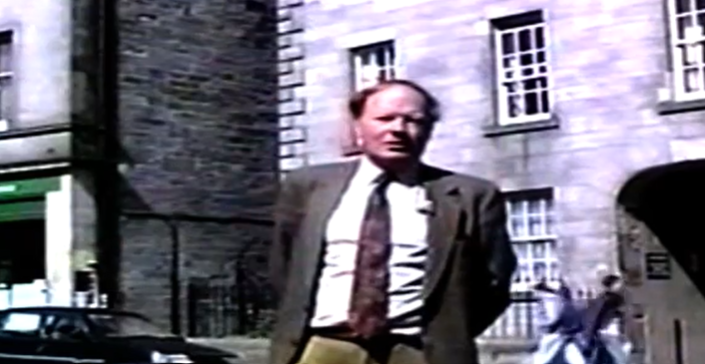
A short film produced by the Southside Association in the late 1990s includes Barratt reflecting on these years in his own words. In it, he recalls the campaigns to resist large-scale demolition in the Southside, and the effort to work alongside local residents and public figures to bring about a different approach to planning and conservation.
Much of his work was carried out quietly. A typical week involved close reading of planning applications, careful preparation of written responses, and early engagement with architects and officials. His interventions were rarely rhetorical. Instead, they were grounded in evidence and framed in a way that encouraged dialogue rather than confrontation. Over time, this approach helped establish the Cockburn Association as a respected and credible voice within the city’s planning system.
By the 1980s, the Association was no longer seen simply as a campaigning body. It had become an informed civic participant whose views were taken seriously by decision makers. His insistence on clarity, accuracy, and constructive criticism contributed significantly to this shift. Good conservation, in his view, depended not only on protecting buildings, but on helping others to understand why they mattered.
The period during which he served was marked by a number of important debates about the future of the city. Proposals for large office developments, concerns about road schemes, and the redevelopment of vacant or underused sites all raised questions about how Edinburgh should evolve and what was required by its communities. In these discussions, the Association consistently argued for design that respected context, for the retention and reuse of existing buildings, and for an approach that recognised the importance of scale, materials, setting and local community needs. Not every intervention led to a successful outcome, but the cumulative effect of this work was to raise expectations and influence the tone of planning decisions. He established the Edinburgh Civic Forum in 1988 to provide a platform for collaboration, shared learning, and coordinated input on issues affecting the city’s future,
He also recognised that conservation needed wider public support if it was to endure. One of his most significant contributions was his role in the early development of Doors Open Days in Edinburgh. By opening buildings that were not usually accessible, the initiative allowed people to experience the city’s heritage directly. It helped shift conservation from an abstract concern into something tangible and shared. In later reflections, he described this as one of the most effective ways of building a wider constituency for heritage.
Alongside his work with the Association, Barratt was closely involved in the development of building preservation trusts, including the Cockburn Conservation Trust and other related organisations. This reflected a broader commitment to not only opposing loss but to enabling the repair and reuse of historic buildings in practical and innovative ways.
He retired in 1992, just a few years before Edinburgh’s Old and New Towns were inscribed as a UNESCO World Heritage Site in 1995. Although he was not involved in the final designation, his work helped to create the conditions in which such recognition became possible. He had spent two decades reinforcing the idea that the city should be understood as a coherent historic landscape, and that its preservation required both care and judgement.
Those who worked with him remember a man who was thoughtful, measured, and quietly determined. He did not seek public recognition and preferred to work behind the scenes. Much of his influence was exercised through correspondence, committee discussions, and informal conversations rather than public campaigns. He was also known as a fine writer, with a clear and distinctive voice, and someone who took pleasure in the quieter aspects of life, including cooking and hospitality.
In later life, Barratt returned to Cumbria, where he had long-standing personal connections. He remained interested in conservation issues, although he lived more quietly. His funeral will take place at St Anthony’s Church in Cartmel Fell on 1 May 2026.
Oliver Barratt’s legacy is not tied to a single project or campaign. It can be seen instead in the way decisions are now approached in Edinburgh, often in small, procedural ways rather than grand gestures. The expectation that development should respect its surroundings, that proposals should be carefully examined, and that civic voices should be heard has become part of the city’s culture. These were not assumptions that existed fully formed when he began his work in the early 1970s. They took shape gradually, through persistence, care, and a belief in the value of thoughtful stewardship.
Described by the Scotsman as ‘the man who dared to ask’ Oliver leaves behind a city that continues to benefit from his work, and a conservation movement that is stronger, and perhaps a little more self-aware, for his example.
Image: Southside Association – Pull It Doon: The changing face of Edinburgh’s Southside