North Edinburgh Connections: A Chance to Get Street Design Right
POSTED ON March 19, 2026 BY James Garry
Streets as civic spaces, not just routes for movement
A consultation is now open on the North Edinburgh Connections project, previously known as NEAT. Though framed as an active travel scheme, it is more consequential than that label suggests. It will reshape some of north Edinburgh’s most important streets and, with them, the everyday experience of the communities they serve.
What is proposed
The project centres on West Granton Road, Pennywell Road and Ferry Road. These are key corridors linking established neighbourhoods with an area undergoing significant change, particularly around Granton, where ambitious regeneration plans have been underway for some years.
The proposals include reducing sections of Pennywell Road to one lane in each direction, introducing segregated cycle routes, widening pavements, improving crossings, upgrading bus stops, and adding trees and planting. Taken together, this represents a substantial reallocation of space: less priority for general traffic, more for walking, wheeling and cycling, and a stated intention to improve the public realm along these routes.
Streets as places, not just routes
The language of “active travel” is useful shorthand, but it can obscure what is truly at stake. Streets are not simply corridors for movement. They are the most immediate and widely shared public spaces in any city. For decades, many of Edinburgh’s arterial roads have been shaped around vehicle throughput, often at the expense of pedestrian comfort, safety and environmental quality. North Edinburgh’s main roads are a clear example: wide carriageways, fast-moving traffic and fragmented crossings have created places that feel inhospitable, particularly for those on foot or using mobility aids.
Rebalancing that space is both necessary and overdue. Safer conditions, cleaner air and more greenery are all outcomes worth pursuing. But the success of this project will depend not on intent alone, but on execution.
The risk of doing it halfway
Edinburgh’s experience of street redesign over recent years offers some instructive lessons, and not all of them are encouraging. Cycle routes interrupted at junctions, planting that feels incidental, materials that age poorly, layouts that do not reflect how people actually move through an area: these are not minor imperfections. They erode confidence in the process and limit the long-term value of the investment.
There is a risk that schemes of this kind become standardised exercises, applied uniformly rather than shaped by place. North Edinburgh is not a blank canvas. It has its own character, formed by its communities, its landscape and its history. From the post-war housing schemes of Muirhouse and Pennywell to the emerging waterfront at Granton, these corridors carry layers of social and built history that deserve thoughtful integration, not off-the-shelf templates. If road space is to be reduced and reallocated, the resulting public realm must be of a quality that justifies and sustains that change.
Inclusion must be more than a commitment on paper
The consultation refers throughout to walking, wheeling and cycling. That framing matters, but only if it translates into streets that genuinely work for everyone. Inclusive design must be a non-negotiable standard, not an aspiration. This means older residents, people with limited mobility, families with prams, and those who rely on vehicles for essential journeys. Improvements must support women’s safety design principles and encourage active travel, mitigating the nationwide decline. It means crossings that are safe and convenient rather than merely compliant, surfaces that are consistently usable in all weathers, and routes that are coherent from end to end rather than broken up by compromises at difficult junctions.
Trade-offs deserve honest acknowledgement
It is also important to be candid about the adjustments these changes will bring. Reducing traffic capacity will affect journey times, deliveries, servicing and parking for some residents and businesses. With financial and wellbeing impacts at stake, interventions need to be carefully thought through, and mitigations put in place to avoid any negative consequences.
At the same time, the current situation is not a neutral baseline. It already favours vehicle movement over other uses of street space. The question is not whether change is warranted, but whether it is carried through with sufficient skill and care to produce a bespoke and positive community outcome, deserving of Scotland’s capital city.
A question of civic ambition
This consultation offers the chance to ask a broader question about what the city is trying to achieve. Is the aim to retrofit active travel infrastructure into existing streets? Or is it to create places that are genuinely attractive, coherent, and built to last? The distinction matters. Edinburgh’s reputation as a city of quality rests not only on its historic centre, but on the care given to all its neighbourhoods. North Edinburgh deserves the same standard of attention to detail, innovation and civic spend.
Why local voices matter here
The consultation is the moment when the detail begins to take shape: the positioning of crossings, the treatment of junctions, the continuity of routes, the choice of materials, the placement and species of planting. These are the elements that will determine whether the scheme succeeds or falls short in practice. Local knowledge is critical. Residents and regular users understand how these streets function, where the difficulties lie and what would actually improve matters. Their input should shape not just whether change happens, but exactly how it is delivered.
North Edinburgh Connections has real potential. It could deliver safer, greener and more usable streets, help reconnect communities and support the area’s continuing transformation. But potential must be matched by quality of delivery, responsiveness to local experience, and a genuine commitment to treating streets as civic assets rather than engineering problems.
Edinburgh’s future as a liveable city depends on getting these everyday transformations right. North Edinburgh deserves no less.
Take part
If you live, work or travel in north Edinburgh, the consultation is an opportunity to influence its future. You can view the proposals and respond at:
https://consultationhub.edinburgh.gov.uk/sfc/neat/
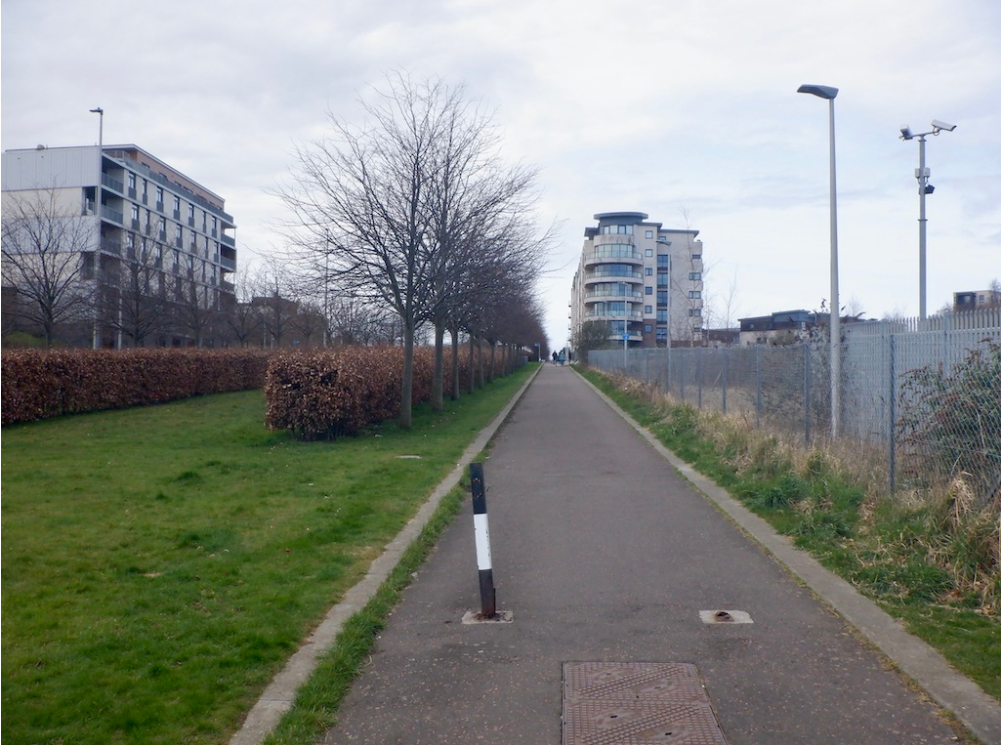
Photo: Path beside Waterfront Avenue, Granton by Richard Webb, via Wikimedia Commons (CC BY-SA 2.0)