In Their Footsteps: The Women Behind Edinburgh’s Built Heritage
POSTED ON March 5, 2026 BY Anna Dowling-Clarke
Edinburgh is full of stories, threaded through the very fabric of the city
Edinburgh is full of stories, threaded through the very fabric of the city. Some threads boast vibrant colours and remain ever-present, their significance never doubted. Others blend quietly into the background, their colours muted. And some have become so frayed with neglect that they risk being cut away entirely.
It is these overlooked threads, the muted and the frayed, that fascinate me most, and which I believe deserve our attention.
The history of Edinburgh is celebrated across the world. Its dramatic skyline, old closes and grand Georgian streets form a narrative so compelling that millions of people are drawn here every year.¹ Guided tours, books, exhibitions, documentaries and an ever-growing body of popular history all contribute to a powerful image of the city as a place steeped in heritage and meaning.
Yet, while these stories are impressive, it is worth asking: whose stories are being told, and whose are being left behind?
To understand why certain narratives seem protected from fading while others exist on the periphery, it helps to consider how history is made. It is not simply a record of what happened. It is shaped by what survives, what is written down and, crucially, what is considered worth preserving in the first place. These are not neutral decisions but are choices, made by people, reflecting the assumptions of their time.
In a world where women have always made up roughly half of the population, yet, as argued by the historian Bettany Hughes, occupy only around 0.5% of recorded history, it is perhaps unsurprising that many of Edinburgh’s muted and frayed stories belong to women.²
For centuries, women’s contributions to the city’s social, economic and physical development were overlooked, undervalued or excluded from official records altogether. Their labour often took place in domestic, informal or poorly documented spaces. Their creativity and expertise were frequently attributed to male relatives or employers, and their influence was rarely commemorated in stone, plaque or street name.
When women do appear in mainstream narratives of Scottish history, they are often reduced to a small handful of exceptional figures. Mary, Queen of Scots remains one of the most recognisable women associated with the nation’s past, her life and legacy explored in countless books, films and exhibitions. While her story is undoubtedly significant, it represents only a tiny fraction of the women who shaped Edinburgh.
Beyond these poster figures, most historical narratives remain overwhelmingly male. This is reflected not only in academia and public memory but in how history is taught in schools. One study from 2021 demonstrates that in Scotland, women’s history is mentioned in most secondary classrooms, but only a small minority of schools, just around 5%, have made substantial changes in recent years to integrate diverse and under-represented stories, including those of women, in their curricula; nearly one-third reported no meaningful curriculum change at all in the last three years.³ This study
further notes that when women do appear in Scottish history teaching, they are often treated as isolated topics (for example, suffrage or individual royal figures) rather than woven deeply into the broader narrative.⁴
Despite this, it must be acknowledged that there is some great work being conducted to address this imbalance. Historians, archivists and local groups are working to recover lost voices and challenge traditional interpretations. These efforts remind us that history is not fixed; it is something we constantly re-examine and reshape.
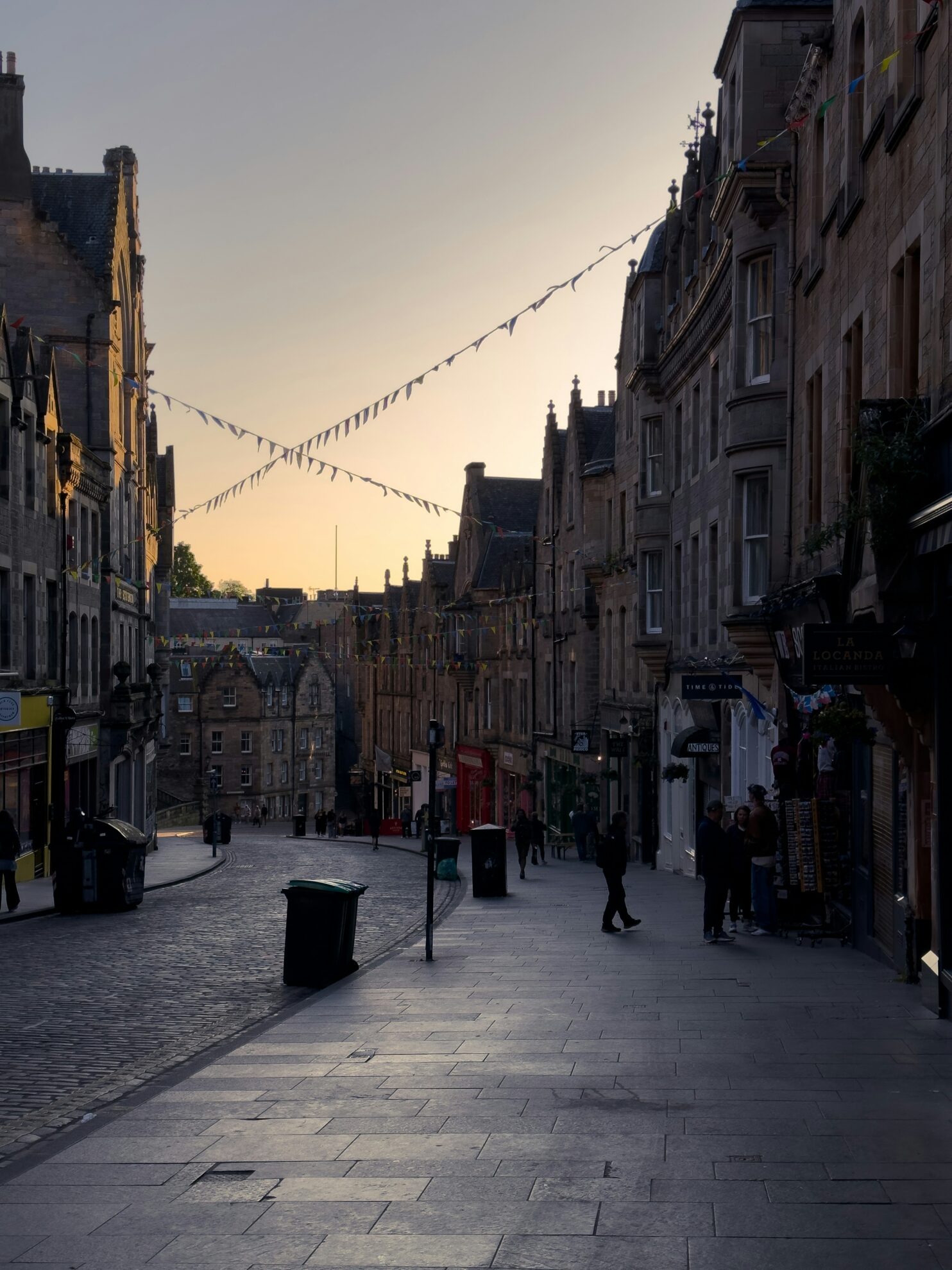
My tour, In Their Footsteps: The Women Behind Edinburgh’s Built Heritage, in partnership with The Cockburn Association, grows out of this ongoing rethinking. It is an invitation to look again at familiar streets and buildings, and to see them differently; to recognise the women whose lives and work are embedded within them, even when their names are absent from the main guidebooks and tours.
The tour visits five sites across Edinburgh’s Old Town connected to The Cockburn Association’s history: buildings it has fought for, helped preserve and in one case mourned the loss of. At each one, we focus on the women who were always there. A fifteenth century queen who commissioned a collegiate church in her own name. A sixteenth century businesswoman who completed a Cowgate chapel with her own money and is buried inside it, hidden under an old carpet. A woman who founded a society to save a Georgian square. It will also trace the stories of the women who shaped
The Cockburn Association itself, from the first four women admitted to its council in 1919 to the campaigners who fought alongside it to save some of the city’s most threatened spaces. It feels particularly fitting that the association today is led predominantly by women with its Chair, Director, Development and Outreach Manager and voluntary archivists among them, continuing a tradition of female dedication to Edinburgh’s built heritage that this tour sets out to celebrate.
My decision to develop this tour in partnership with The Cockburn Association to celebrate Women’s History Month 2026 grew from both a personal and an intellectual conviction. I was born and raised in Edinburgh, and it was only when I began researching women’s history in this city that I felt a deeper and more intimate connection to the place I had grown up in. Learning about the women who built, funded, fought for and inhabited these streets gave me a sense of belonging to Edinburgh’s history that I had not felt before. I wanted to share that feeling and I believed that The
Cockburn Association, an organisation that has spent 150 years protecting, preserving and promoting Edinburgh’s built heritage, was the natural partner for a project asking what stories that heritage contains.
This is not about replacing one dominant narrative with another but is about widening the lens through which we understand our past. The Cockburn Association has spent over 150 years fighting to keep Edinburgh’s historic buildings standing, and it is precisely because of that work that many of these women’s stories remain recoverable at all. I truly believe that Edinburgh’s history is richer, more diverse and more compelling when we acknowledge the full range of people who created it. By recognising women’s contributions, we gain a deeper understanding of the city itself: how it functioned, how it evolved and how it continues to change.
I want to end this post by arguing that places matter because of the stories we tell about them, and when we neglect certain voices, we narrow our sense of belonging and possibility. But when we recover them, we strengthen our connection to the past and to each other. Many of these overlooked threads of Edinburgh’s history are still there, woven into its walls, streets and communities. With care and attention, they can be brought back into view, restored and preserved for future generations.
References
- VisitScotland, Edinburgh and the Lothians: Research and Insights, 2024. Available at:
visitscotland.org/research-insights/regions/edinburgh-lothians - Hughes, B., ‘Why were women written out of history? An interview with Bettany Hughes’,
English Heritage, 29 February 2016. Available at:
english-heritage.org.uk/visit/inspire-me/blog/blog-posts/why-were-women-written-out-of-history-an-interview-with-bettany-hughes - Smith, J., Burn, K. and Harris, R., 2021 Historical Association Survey of History in Scottish Secondary Schools, Historical Association, London, 2021. Available at:
history.org.uk/secondary/categories/409/news/4014/historical-association-secondary-survey-2021 - There is no more recent, comprehensive national dataset showing how often women are featured in exam questions or assessment material.
Written by Anna Dowling-Clarke of WHIPS (Women Hidden in Plain Sight)
Image: Author’s own