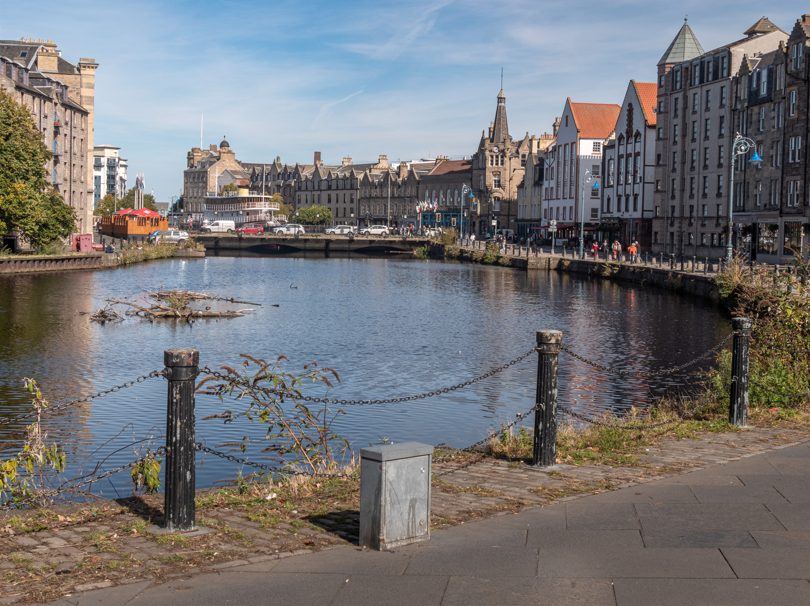
Leith Chooses
POSTED ON February 27, 2026 BY James Garry
What Participatory Budgeting Looks Like When It Actually Works
Edinburgh debates its future constantly. Supplementary guidance, development frameworks, design briefs, heritage impact assessments: the apparatus of planning is extensive, and the Association engages with it seriously. But there is a quieter, more direct form of civic decision-making happening in Leith right now, and it deserves more attention than it has received.
Leith Chooses is the participatory budgeting process serving Ward 13 (Leith) and Ward 12 (Leith Walk). This year, following a January voting day and an extended online ballot, residents selected ten projects to receive community funding, bolstered this year by revenue linked to Edinburgh’s new visitor levy. No remote committee. No weighted score matrix. The people who live on these streets decided where the money goes.
The ten projects that emerged are worth sitting with for a moment, because they reveal something important about what communities prioritise when genuinely given the chance.
What the Community Actually Chose
Several projects address social isolation in ways that planners rarely manage to specify, let alone fund. The Milan Senior Welfare Organisation’s Leith Connections and the Pilmeny Development Project’s Wellbeing in Leith: Supporting Older People Out of Isolation both tackle loneliness among older residents, a consequence of urban change that regeneration masterplans seldom acknowledge. The Kin Collective’s Kin Begins supports families through pregnancy and early parenthood: another stage of life when people can fall through the gaps of a neighbourhood undergoing rapid transformation.
Dr Bell’s Family Centre, through Wellbeing in Leith, offers broader holistic support, the kind of flexible, relationship-based help that statutory services increasingly cannot provide.
Then there are the environmental projects. Leith Community Growers will establish Dùthchas: Growing an Orchard for the People, creating a permanent green space in a densely built neighbourhood. The Water of Leith Conservation Trust’s Coalie Coalition Resources continues vital conservation and educational work along one of Edinburgh’s most important ecological corridors.
These sit alongside four projects that go to the heart of what we would call intangible heritage. The Living Memory Association’s Wee Hub will record and share local oral history, irreplaceable in an area shaped by successive waves of migration, maritime labour and industrial change. Roots and Routes: Conversations on Easter Road, run by Mustard Seed Edinburgh, creates genuine dialogue around migration and belonging. Edinburgh Community Food’s Tasty Tales of Leith brings people together through cooking, storytelling and cultural exchange. And the Edinburgh & Lothians Regional Equality Council’s Efficient and Healthy Cooking addresses food insecurity while building practical skills across diverse communities, a reminder that economic resilience and cultural inclusion are as much a part of neighbourhood wellbeing as any built intervention.
Read together, this is not a random collection of community projects. It is a neighbourhood describing itself, its vulnerabilities, its strengths, its understanding of what sustains a place over time.
It is also worth noting that Leith Chooses is not starting from scratch. Previous rounds have supported youth provision, community arts initiatives and small-scale environmental improvements that continue to operate well beyond their initial funding period. The quiet measure of success is that these projects do not feel temporary. They become part of the local landscape, embedded in everyday life rather than treated as pilot exercises. That continuity matters.
The Visitor Levy Connection
Edinburgh’s appeal as a destination is one of its great strengths, and the visitor levy offers a genuine opportunity to ensure that the benefits of that appeal are felt across the city’s communities, not just in its headline attractions. The connection between Leith Chooses funding and visitor levy revenue is an encouraging sign that this opportunity is being taken seriously.
Revenue generated by the city’s drawing power is being directed, through a democratic process, into neighbourhood infrastructure chosen by residents themselves. That is a model worth celebrating and worth building on.
There is an important principle here for how visitor levy revenues are deployed more widely. Community-level decision-making should not be an add-on; it should be a condition.
Why This Matters Beyond Leith
Participatory budgeting has a growing international track record, and the evidence on its effects is reasonably robust: increased civic engagement, stronger community networks, more contextually appropriate investment. But Edinburgh has been cautious in adopting it at scale, and that caution has costs.
The lessons from Leith Chooses are not complicated. Local knowledge produces better-calibrated priorities. Small investments in social infrastructure, an orchard, a memory hub, a cooking project, can have effects on social cohesion that far outweigh their modest budgets. And when residents are trusted with decisions, they tend to take that trust seriously.
Leith has now demonstrated this across multiple funding cycles. Organisations return with refined proposals, residents engage not simply as voters but as advocates, and the process itself has become more familiar and confident with each iteration. Participatory budgeting works best when it becomes routine rather than exceptional. In Leith, that routine is beginning to take shape.
The Association would like to see an honest conversation about how such mechanisms can become standard practice across the capital. Could other wards adopt similar processes? Could heritage-led regeneration projects build in structured community benefit decisions from the outset? Could visitor levy revenues routinely support neighbourhood-level participatory spending?
We suspect the obstacles are less about feasibility than about institutional habit. Leith Chooses demonstrates the feasibility. The question is whether Edinburgh’s institutions have the appetite to learn from it.
A Note on Heritage and Community
The Association’s founding concern is the built and natural heritage of Edinburgh. But we have long held that a city’s character is not reducible to its fabric. The continuity of community, the informal networks, the intergenerational relationships, the everyday rituals that make a neighbourhood knowable to itself, are as much a part of Edinburgh’s heritage as the Georgian New Town or the medieval closes of the Old.
Projects like The Wee Hub and Roots and Routes are, in this sense, heritage projects. They record and renew the social memory of a neighbourhood in the act of change. That is something no conservation area designation can do.
The Association has long argued that stewardship flourishes when people feel a genuine stake in decision-making. Leith Chooses offers a contemporary expression of that principle. It is conservation in its broadest sense: conserving social infrastructure, local knowledge and the habit of participation.
Leith Chooses is not, of course, a solution to the pressures Edinburgh faces on housing, on infrastructure, on climate adaptation. But it is a working example of what it looks like to trust communities with decisions that affect them. At a time when public confidence in planning processes is fragile, that is not a minor achievement. The real success is not this year’s list of projects, impressive though it is. It is the steady normalisation of shared civic responsibility. That is a habit Edinburgh would do well to cultivate more widely.
Image: G Gainey