Green Claims Meet Planning Reality: Lessons from Edinburgh’s South Gyle Data Centre Rejection
POSTED ON February 12, 2026 BY James Garry
Edinburgh rejects ‘green’ data centre amid sustainability scrutiny
Unexpectedly, Edinburgh councillors voted unanimously in early February 2026 to refuse a proposed hyperscale data centre at the former Royal Bank of Scotland headquarters in South Gyle. The decision matters not just because one development was turned down, but because it shows planning authorities starting to test environmental claims with real rigour. Projects billed as “green” are now being asked to prove it in measurable terms, not just assert it through branding.
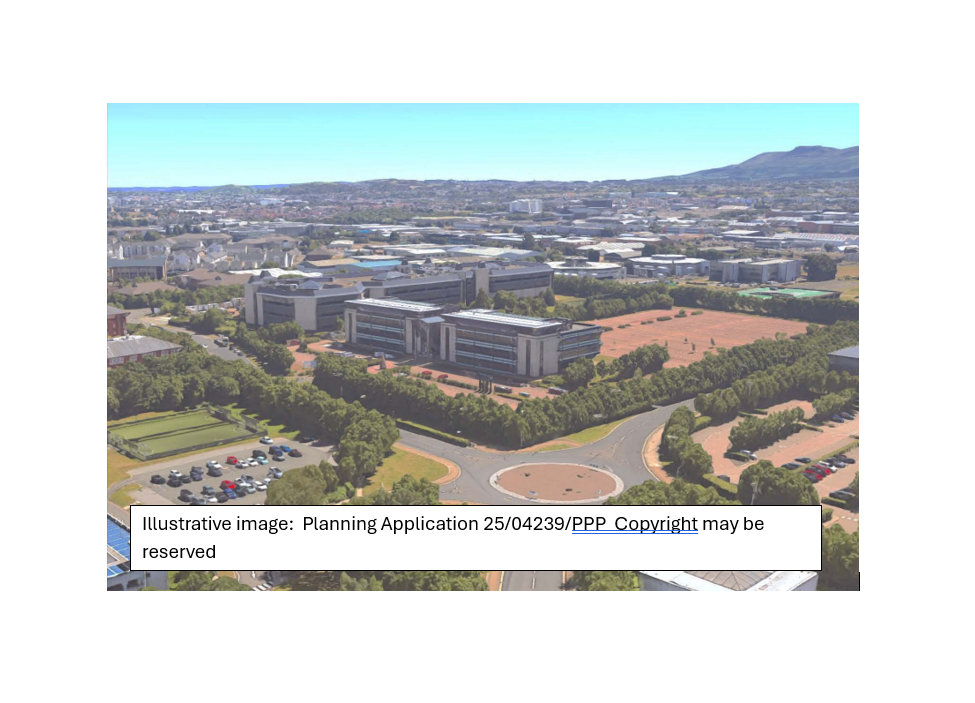
The scheme, brought forward by landowner Shelborn Asset Management, proposed a large data centre with public realm improvements including new open (green?) space. Planning officers recommended approval in principle. After a lengthy committee discussion, though, councillors from across the parties concluded that the proposal left too many questions unanswered about environmental impact, land use compatibility, and the longevity of existing infrastructure. Community concerns?
This wasn’t a blanket rejection of data centres. Committee members acknowledged the real and growing demand for digital infrastructure driven by AI, cloud computing, financial services, and public use. The debate focused instead on whether this particular proposal met verifiable sustainability standards, aligned with planning policy, and justified its substantial environmental footprint. Press coverage highlighted councillors’ unease about the scale of projected energy use and the thin evidence offered to back up the mitigating green credentials.
The site and its planning context
The former RBS headquarters at 1 Redheughs Avenue sits within Edinburgh Park, an office district built largely from the 1990s onward on former agricultural land. The area has become an important employment hub, but it’s long been criticised for poor integration with neighbouring communities like South Gyle and Corstorphine, car-dependent layouts, and limited local amenity. City Plan 2030 now envisions something different: a more mixed-use environment with housing, leisure, and better connections to adjacent areas, building on the newly improved transport links offered by the trams and the redeveloped railways.
In that context, councillors questioned whether a large, energy-intensive data centre with extensive service infrastructure and relatively few jobs actually supported the regeneration aims for the area. The discussion went beyond the environmental performance of one building to ask how strategic employment sites should evolve over coming decades in harmony with communities.
What “green” actually means in infrastructure planning
The South Gyle debate exposed a persistent problem in contemporary planning: there’s still no universally applied definition of a “green” data centre. Developers point to renewable electricity sourcing, cooling efficiency, water conservation, landscape improvements. Planning authorities are increasingly recognising, though, that the overall lifecycle impact matters too: total electricity demand, grid capacity, realistic plans for waste heat reuse.
Committee discussions highlighted the uncertainty about the facility’s long-term renewable energy sourcing, the feasibility of the proposed heat recovery, and the scale of projected emissions. Green councillor Alys Mumford put it bluntly: “On power from renewable energy sources, we’ve been told there is something in place but we haven’t been given the figures… If this isn’t a green data centre, which I believe it isn’t, there are major issues with this proposal which can’t be balanced out.”
The facility’s peak electricity demand of 210 to 213 MW alarmed members. That’s equivalent to the combined annual household consumption of Glasgow and Edinburgh. Committee papers indicated projected annual emissions of approximately 200,000 tonnes, comparable to Edinburgh Airport’s and representing roughly 10% of the city’s total emissions. Conservative councillor Joanna Mowat epitomised the frustration: “If you look at guidance on green data centres – who the hell knows?”
These concerns reflect a wider European conversation. Dublin and Amsterdam have already tightened controls on large-scale data centre expansion after recognising the pressure such facilities place on electricity networks and carbon reduction targets. In Dublin, data centres now consume over 20% of Ireland’s electricity.
The lesson isn’t that digital infrastructure is incompatible with climate policy. It’s that sustainability claims need clear evidence: where will the energy come from, how will efficiency be monitored, what wider system impacts may result? Future proposals for sites like Edinburgh Park will have to show in numbers, not aspirations, how power will be sourced and how waste heat could actually be used.
Economic competitiveness and climate credibility
For a knowledge-based city like Edinburgh, the attraction of digital infrastructure investment is obvious. Universities, research institutes, financial services firms, technology companies, charities and SMEs all depend on secure and scalable data capacity. The city’s economic strength rests heavily on other factors too, though: environmental quality, urban liveability, resilient and diverse communities, – all outcomes of responsible planning. Climate credibility has become an economic asset in its own right.
The South Gyle decision illustrates the balancing act. Cities need to embrace increasing digital capacity and infrastructure while ensuring developments don’t undermine long-term environmental and/or community commitments or strategic land use goals. By scrutinising sustainability claims carefully rather than approving projects solely on projected investment value, planning authorities reinforce the principle that growth and climate responsibility must go hand in hand.
Such values reflect the Cockburn Association’s long-held vision for Edinburgh. Just as the Association has scrutinised proposals affecting the Old and New Towns, Leith’s waterfront, and other key sites, the South Gyle case shows that environmental integrity and community benefit matter across all parts of Edinburgh, not just the historic core. Quality urbanism and environmental responsibility apply whether a proposal affects a Georgian terrace or a business park.
Raising the bar for future proposals
Planning refusals are sometimes portrayed as barriers to progress. They often serve another function: clarifying expectations. When authorities identify gaps in evidence or policy alignment, future applicants know to return with stronger proposals: clearer renewable energy agreements, demonstrable efficiency measures, convincing strategies for integrating new infrastructure into local energy systems.
Across Europe, cities are experimenting with precisely these approaches. Some Nordic developments now capture waste heat from data centres to supply district heating networks. Facebook’s data centre in Odense, Denmark, supplies heat to 100,000 residents. Other regions require detailed reporting on operational energy demand before granting approval. These examples show the question isn’t whether digital infrastructure should be accommodated, but how it can be designed to contribute positively to wider urban sustainability goals.
Planning the digital city responsibly
Demand for large-scale data processing capacity will continue to grow as AI, remote services, and smart technologies become embedded in everyday life. Cities can’t realistically opt out of hosting such infrastructure. The challenge is ensuring new facilities are located, designed, and powered in ways that support climate commitments, infrastructure resilience, and long-term urban strategy.
Edinburgh’s decision at South Gyle demonstrates that careful, evidence-based scrutiny of sustainability claims is both possible and necessary. By asking how projects will operate in practice—how energy will be sourced, how emissions will be managed, how developments fit into wider planning objectives—cities can accommodate technological change without compromising environmental integrity.
For organisations like the Cockburn Association, which have long advocated for development that strengthens rather than diminishes the city’s character and liveability, the principle is straightforward. Environmental responsibility and planning quality aren’t obstacles to growth. They’re the conditions that allow growth to endure.
Suggested Reading
-
- City of Edinburgh Council Development Management Sub-Committee report and minutes (February 2026) – available via City of Edinburgh Council planning portal
- National Planning Framework 4 (Scottish Government, 2023)
- International Energy Agency, Electricity 2024: Analysis and Forecast to 2027
- Action to Protect Rural Scotland press release (February 2026) – available via APRS website
- Coverage from Data Centre Review, Deadline News, The Herald, The National and Holyrood (February 2026)