Reopening the Radical Road: Access, Risk and Civic Heritage
POSTED ON January 9, 2026 BY James
A historic path where public access, landscape and civic values meet
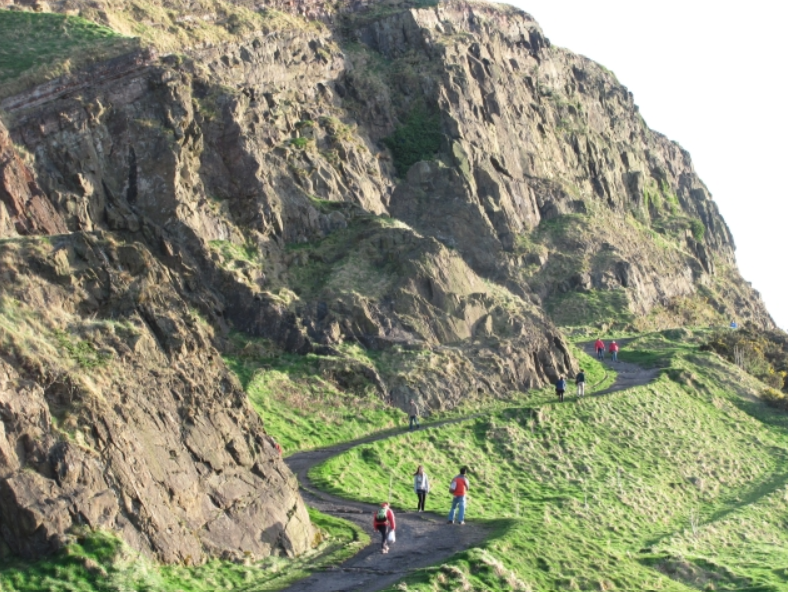
Walking beneath the Salisbury Crags, with the city unfolding to the north and volcanic rock rising sharply to the south, is one of Edinburgh’s most distinctive shared experiences. For over two centuries, the Radical Road has offered precisely this encounter, combining access, education and civic idealism in a single, carefully constructed route.
The Cockburn Association has long championed the careful stewardship of Edinburgh’s historic landscapes, particularly where public access, heritage and civic value intersect. Recent proposals by Historic Environment Scotland to install safety measures along the Radical Road in Holyrood Park, including post and chain fencing, mesh panels, vegetation management and interpretive signage, bring these questions sharply back into focus.
The Radical Road is far more than a convenient footpath or scenic viewpoint. Constructed in the early 1820s as part of a relief works programme following the Radical War of 1820, it was deliberately designed as a democratic promenade: wide, level and accessible, allowing citizens of different backgrounds to walk, learn and engage with the landscape. Set at the base of the Salisbury Crags, the route was shaped by Enlightenment ideals of improvement, education and civic participation, as well as by contemporary enthusiasm for geology and natural history.
Few urban paths anywhere in Europe offer such an intimate encounter with world-changing geological ideas. Along the Radical Road, walkers pass Hutton’s Section and Hutton’s Rock, sites associated with James Hutton’s observations that helped lay the foundations of modern geology. In this sense, the Road is a linear cultural artefact. Its meaning lies in continuity and movement, in the experience of walking beneath the Crags and gradually shifting perspective between city and landscape. Opening only isolated sections risks reducing this cumulative journey to a series of disconnected viewpoints.
The prolonged closure of the Radical Road following rockfall concerns has understandably prompted debate about public safety, liability and long-term management. Holyrood Park is both a nationally important historic landscape and a dynamic natural environment, where geological processes cannot be frozen in time. Historic Environment Scotland’s current proposals represent a constructive attempt to balance risk management with renewed public access, and any step that allows people back onto this remarkable route, even partially, is welcome.
The timing is also significant. A partial reopening would coincide with the tercentenary of James Hutton’s birth in 2026, a moment of heightened national and international interest in Scotland’s geological heritage. Enabling access to Hutton-related sites within Holyrood Park during this period would send a powerful message about Scotland’s commitment to public education and scientific heritage.
However, there is a real risk that partial reopening becomes an end point rather than a stepping stone. Unless clearly framed as temporary and transitional, limited access can quietly become normalised, eroding the ambition and expectation of full reinstatement.
Across Scotland, challenging paths in dramatic landscapes are routinely managed through a combination of informed consent, clear communication of risk and ongoing maintenance rather than blanket closure. At Grey Mare’s Tail in Dumfries and Galloway, steep and potentially hazardous paths lead visitors into a dramatic hanging valley and waterfall system. Rather than restricting access entirely, land managers rely on warnings, path management and an understanding that outdoor access involves personal responsibility.
Similarly, routes such as the Quiraing on Skye, the Cobbler in Argyll and sections of the Falls of Clyde all involve known environmental and geological risks. These places remain accessible because risk is contextualised rather than eliminated, allowing people to engage with Scotland’s landscapes in an informed and respectful way. Holyrood Park is unusual only in its urban setting, not in the presence of natural hazard, and treating it as different risks undermining Scotland’s long-established outdoor access ethos.
Beyond its physical fabric, the Radical Road also holds powerful intangible value. It has long functioned as a place of informal learning, embodied experience and shared civic use. Generations of Edinburgh residents have walked its full length for leisure, teaching, reflection and quiet engagement with the city’s geology and history. These qualities depend on continuity. Movement along the route, repetition over time and shared familiarity all contribute to its cultural meaning. Restricting access to isolated sections weakens this lived heritage, reducing the Road’s role as a democratic civic space.
The Cockburn Association therefore supports the proposed partial reopening of the Radical Road as an interim measure, but only if it is explicitly positioned as part of a wider, clearly articulated pathway towards full reopening. Any consent should define partial access as a step towards reinstating the entire route, be time-limited and subject to regular review, and include a clear commitment to monitoring and exploring further reopening options. The proposals should also be considered within a holistic understanding of Holyrood Park as a cultural, geological and scientific landscape where public access is central to its value.
Such an approach would align with National Planning Framework 4, City Plan 2030 and wider Scottish Government commitments to wellbeing, outdoor access and responsible heritage stewardship. Given Edinburgh’s status as a UNESCO World Heritage Site and Holyrood Park’s designation as a Site of Special Scientific Interest, it is essential that this internationally important landscape is managed with the level of care, resourcing and long-term planning required to keep it accessible wherever safely possible.
The Radical Road remains one of Edinburgh’s most eloquent expressions of landscape as civic ideal. Its careful, phased restoration, openly reviewed and properly resourced, would not only benefit walkers and visitors but reaffirm the city’s commitment to shared heritage, public access and informed engagement with risk. The Road has always been a challenging place. The question is whether we still believe, as its builders once did, that citizens should be trusted to encounter landscape, history and geology as active participants rather than passive observers.
Related consultation
Historic Environment Scotland is currently consulting on its Properties and Collections Strategy: Towards Sustainable Stewardship. This consultation addresses how HES manages and resources the historic sites under its care, including Holyrood Park. The questions raised about long-term stewardship, public access and sustainable management are directly relevant to the future of the Radical Road. The consultation closes soon and is open at: www.historicenvironment.scot/about-us/what-we-do/consultations/properties-and-collections-strategy-towards-sustainable-stewardship-consultation
Photo credit: Radical Road, Holyrood Park, by Richard Webb, licensed CC BY-SA 2.0 via Wikimedia Commons.