Brutalism and the Future of Edinburgh’s Modern Heritage
POSTED ON November 14, 2025
Edinburgh’s concrete landmarks challenge us to adapt, not erase
The Cockburn Association has long championed a city that evolves without erasing its layers. Brutalism: raw, bold, and born of post-war optimism, tests that ethos like few other styles. In Scotland, it wasn’t just concrete; it was a blueprint for better lives. Yet today, as demolition looms for icons like Argyle House, we are reminded that conservation is not about freezing time but about breathing new purpose into the past.
Brutalism in Scotland emerged from the urgency and idealism of the post-war years, when cities were rebuilding and reimagining how people should live, work, and worship. Taking its name from béton brut (raw concrete), the style prized honesty of materials, functional form and a monumental aesthetic that revealed, rather than concealed, the workings of a building. Across Scotland, Brutalism found expression in housing estates, government offices, university buildings and churches, reflecting both architectural innovation and the social ambition of the welfare state.
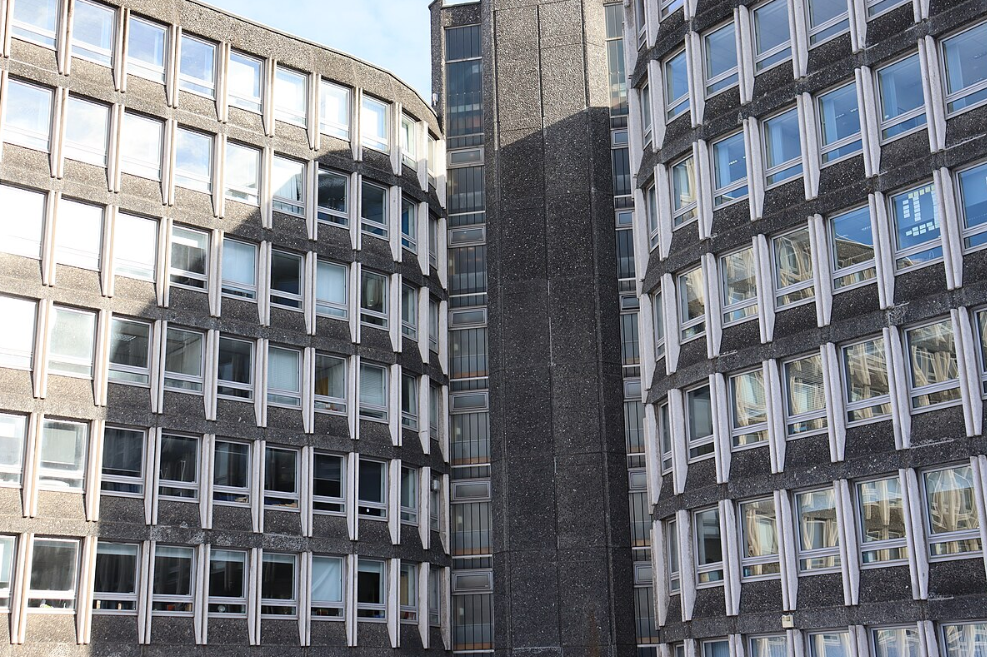
In Edinburgh, the contrast between the city’s classical skyline and its post-war experiments has long divided opinion. Argyle House, on Lady Lawson Street, is perhaps the capital’s most striking and controversial example. Completed in 1968 by Michael Laird & Partners, it first served as government offices before later becoming home to technology firms such as CodeBase. Its heavy concrete façade and angular geometry dominate views from the Grassmarket and the Castle Esplanade. To some, Argyle House is an eyesore; to others, it is an essential part of the city’s twentieth-century architectural story. Now facing proposed demolition, it stands at the centre of a debate about modern heritage, sustainability and the city’s future form.
Other Edinburgh works by Sir Basil Spence: Mortonhall Crematorium, the former Scottish Widows building, and his distinctive interventions along the Canongate—demonstrate how Brutalism intertwined with sculptural form and civic purpose. Spence’s commissions, often bold and uncompromising, helped shape the city’s post-war identity and remain touchstones in debates over modern architectural value.
Nearby in Leith, Cables Wynd House, better known as the “Banana Flats”, offers a different perspective on Brutalism’s social mission. Designed by Alan Hutchison & Partners and built in the mid-1960s, the ten-storey curved housing block was intended to rehouse communities from older, overcrowded tenements in a modern, light-filled environment. Inspired by Le Corbusier’s Unité d’Habitation, its deck-access layout sought to foster communal life and modern living. Once criticised, it is now Category A listed and widely recognised for both its architectural and social significance. It remains a powerful reminder of post-war ambition and the ongoing challenges of maintaining large concrete structures within evolving urban and social frameworks.
Beyond the capital, Scotland produced a remarkable range of Brutalist landmarks. St Peter’s Seminary in Cardross, now a protected ruin, is considered internationally significant and one of the most poetic examples of the style in a religious context. Anniesland Court in Glasgow, a 22-storey tower by J. Holmes & Partners, has been likened to a Glasgow tenement laid on its side. Other Glasgow examples include the Woodside Estate (1970–74) by Boswell, Mitchell & Johnston; the Bourdon Building at the Glasgow School of Art (1977); and the Hunterian Art Gallery (1970–81) designed by William Whitfield, whose bold concrete forms and dramatic handling of light brought sculptural Brutalism into the academic sphere at the University of Glasgow.
Brutalism’s Scottish story is one of both ambition and ambivalence. These buildings were born of a moment that sought to deliver better housing, education and civic life, yet many became unpopular as maintenance costs rose and tastes shifted. In Edinburgh, a city celebrated for its Georgian order and medieval texture, the exposed concrete of Argyle House and Cables Wynd House appears almost defiant. But to dismiss these works as “ugly” is to miss the wider story they tell: a time when architects believed that design could help build a fairer, more cohesive society.
Today, a more imaginative approach to retention and reuse is gaining momentum. Many Brutalist buildings were constructed with durable materials and generous structural spans, making them strong candidates for adaptive retrofit. Thoughtful refurbishment can dramatically reduce demolition waste and embodied carbon, vital steps in addressing the climate emergency, while preserving the narratives embedded in Scotland’s twentieth-century architecture. Across Europe, former office blocks and housing schemes have been transformed into studios, social housing and cultural venues. Scotland can follow suit, demonstrating that sustainability and heritage are not opposites but allies.
At the Cockburn Association, we continue to advocate for adaptive reuse over the wrecking ball, for seeing creative potential where others see only concrete. Buildings such as Argyle House need not be relics; they can be catalysts for renewal, providing affordable workspaces, cultural hubs or new forms of housing that respect the city’s skyline while reusing what already exists. Heritage thrives not through preservation alone, but through thoughtful adaptation, and Edinburgh’s Brutalist landmarks still have stories to tell.
For more on the Cockburn Association’s long-standing advocacy, see Campaigning for Edinburgh.
Further reading
General & Post-War Scotland
- Glendinning, M. (1997) Rebuilding Scotland: The Post-War Vision, 1945–1975. Edinburgh: Tuckwell Press.
Michael Laird & Partners
- Walker, D. & Woodworth, M. (2015) The Buildings of Scotland: Edinburgh. New Haven: Yale University Press.
- Glendinning, M. & MacInnes, R. (1996) A History of Scottish Architecture. Edinburgh: Edinburgh University Press.
Sir Basil Spence
- Hardman, C. (2010) Basil Spence: Architect. Edinburgh: Birlinn.
- Sharp, D. (2012) The Architecture of Basil Spence. London: RIBA Publishing.
Alan Hutchison / Cables Wynd House
- Historic Environment Scotland (2017) Cables Wynd and Linksview House, Leith: Category A Listing.
- McKean, C. (2001) Edinburgh: An Illustrated Architectural Guide. Edinburgh: RIAS.
Gillespie, Kidd & Coia / St Peter’s Seminary
- Glendinning, M. (2007) Gillespie, Kidd & Coia: Architecture 1956–87. Edinburgh: RIAS.
- Boyd, R. (2014) ‘St Peter’s Seminary: Afterlives of a Modernist Icon’, Architectural Heritage, 25.
William Whitfield
- Stamp, G. (2010, September) ‘William Whitfield: A Modern Classical Master’, Architectural Review.
- MacInnes, R. et al. (2013) Scotland’s 20th-Century Architecture. Edinburgh: RCAHMS.
Photograph: Argyle House, Edinburgh, by Mike Shaw, licensed under CC BY-SA 4.0, via Wikimedia Commons.
Original file: https://commons.wikimedia.org/wiki/File:Argyle_House,_Edinburgh_01.jpg