Changing Edinburgh: What Should the City Gain?
POSTED ON November 12, 2026
Edinburgh’s changing places must deliver lasting public and community value
Summerhall, Argyle House and the Castle Esplanade each raise the same question: when a place in Edinburgh changes substantially, what lasting public value should the city expect in return?
Edinburgh’s arguments about development tend to start with a picture. A familiar building is to go, a new roofline is proposed, or an unexpected idea surfaces beneath the Castle rock. Discussion then turns, quite properly, to architecture: height, materials, views, and whether the replacement would be an improvement on what stands there now.
Those questions matter, and the Association will continue to ask them. They are not, however, the whole of the assessment.
Major development also changes who can use a place, what goes on there and who controls its future. The benefits shown in a planning presentation may be years from delivery, while some of the benefits a place already provides can vanish the day its doors close.
The emerging proposals for Summerhall, the application to demolish and replace Argyle House, and the recently aired idea of a permanent amphitheatre on the Castle Esplanade are very different in purpose and in status. Taken together, they prompt a wider question about what Edinburgh should ask of substantial change. Our answer begins with an honest account of what the city already has, followed by convincing evidence of what it stands to gain.
Knowing what is there
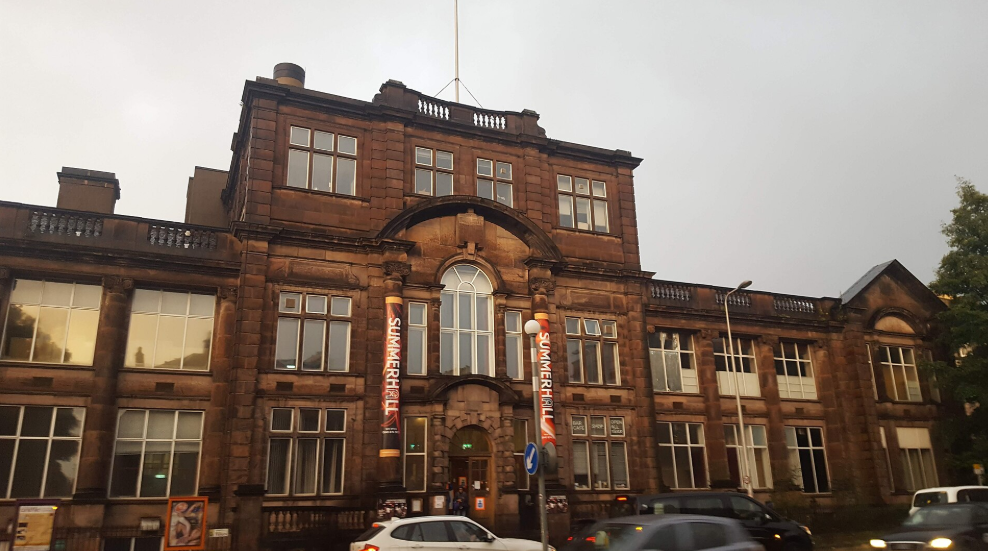
At Summerhall, AMA (New Town) has set out options for the former Royal (Dick) Veterinary College that combine arts space with hotel and student accommodation, alongside restoration, adaptation and partial demolition (consultation site). The stated aim is to secure the complex’s future as an arts quarter. Following the strength of public response to the first round of consultation, the developer has said its proposals are being revised before a second round in December (The Scotsman). The mix of uses and the extent of demolition remain the central questions.
The Association has already set out its initial concerns on cultural continuity, historic character, townscape and housing (Cockburn Association). The question now is how a stated ambition would work in practice.
An arts quarter needs space where people can afford to make work, take risks and found small organisations. Galleries and performance venues are part of that, but so are rehearsal rooms, workshops, storage and the unglamorous spaces in which cultural work is actually produced. Summerhall currently houses more than a hundred tenants. Any redevelopment worthy of the name should show how those functions would be accommodated, managed and supported over the long term, not simply that a venue would remain.
Southside Community Council’s Local Place Plan offers a constructive way for those concerns to influence what happens next. It seeks to protect Summerhall’s cultural, creative and community space, recognising the difficulty of replacing its concentration of studios, workshops and venues elsewhere. That gives the community a clear position against which emerging proposals can be tested (Southside Local Place Plan).
At Argyle House, an application has now been lodged to demolish the 1960s block on Castle Terrace and replace it with homes, offices and hotel accommodation. The discussion therefore moves to a new stage, in which the submitted evidence must be tested.
The Association has not always admired Argyle House, and has said so in the past. Our position on its future, however, has never rested on taste. In responding to the proposal of application notice in February, we asked that the site’s prominence on the edge of the Old Town and within the World Heritage Site be treated with exceptional care, that no irreversible decision be taken while the building’s listing was under assessment, and that retrofit, partial retention and whole-life carbon be properly appraised before demolition was assumed (Cockburn Association). Our Cockburn Conversation in September explored those questions in public (Cockburn Association).
In April, Historic Environment Scotland concluded that the building meets the criteria for listing, recognising it as a significant example of Scottish Modernism, but declined to list it because redevelopment proposals were already well advanced (Scottish Construction Now). That leaves a building of acknowledged national interest without statutory protection, and places the full weight of assessment on the planning process.
Those tests now apply to the submitted application. The comparison must take in the remaining useful life of the existing structure, the scope for adapting it, the activity it currently supports – including the CodeBase technology community, with several hundred people working in the building – and what the proposed uses would contribute to this part of the city.
The Castle Esplanade is a different matter again. A permanent, partly sunken stone amphitheatre, promoted by campaigner Kal Turnbull with concept designs by Benjamin Tindall Architects, has been suggested as an alternative to the seasonal Tattoo stands, and the idea has attracted public attention (Edinburgh Evening News). It remains an idea, not a proposal. In a statement to the media, Historic Environment Scotland said it currently has no plans for such a facility, and that any significant change to a national landmark would require careful consideration (Edinburgh Daily, 7 November 2026). No application for planning permission or scheduled monument consent has been made. The Esplanade is part of a scheduled monument and lies within the Old and New Towns World Heritage Site, so the bar for any permanent works would rightly be very high.
Even so, it opens a legitimate conversation about the seasonal structures, which occupy the Esplanade for a substantial part of each year and shape how the Castle is seen and approached. Any alternative would have to weigh the Esplanade’s value as open ground, the experience of arrival at the Castle, its archaeology, accessibility, and the consequences of more intensive, year-round event use (HES Statement of Significance, Edinburgh Castle Esplanade).
These are three distinct cases, and each must be judged on its own circumstances. The principles that should govern that judgement, however, are shared.
Counting what could be lost
Development proposals naturally emphasise what they would provide: new floorspace, investment, jobs, improved public realm. These can be real and substantial benefits.
A fair assessment gives comparable weight to what already exists.
Some of that value is easily recorded – historic fabric, sound structures, established businesses, public routes. Some needs closer looking. Low-rent premises sustain activity that could not survive at market rates. Informal working relationships between neighbouring organisations make a place productive. An open space can be highly valued without earning anything at all.
These qualities should be identified early enough to shape the development brief, not catalogued afterwards. That means more than listing current occupants or totting up square metres. It means understanding how a place works: who depends on it, which physical characteristics make that possible, and what would be hard to recreate elsewhere.
At Summerhall, that understanding should define the cultural offer. At Argyle House, it should inform the appraisal of retention against replacement. On the Esplanade, it should frame any discussion of the balance between events and everyday public access.
Testing the alternatives
The strongest case for a preferred scheme is one that has been tested against credible alternatives.
Where demolition is proposed, the public should be able to see what repair, adaptation, partial retention and full replacement could each achieve, with costs, constraints and environmental consequences set out on a comparable basis. National Planning Framework 4 already expects the reuse of existing buildings to be considered before demolition (NPF4 Policy 9).
Whole-life carbon is central here. A new building may perform better in use, but those savings must be set against the emissions of demolition and construction. The question is the net outcome, and how many years it would take for any claimed benefit to be realised.
Economic evidence needs the same openness. Where additional development is said to be necessary to pay for conservation or to sustain cultural activity, that relationship should be demonstrated, not asserted. What work requires funding? What assumptions fix the scale of development? What happens if costs rise or expected income falls?
Answering these questions helps identify a scheme that can actually be delivered. It also allows the city to tell the difference between intervention that is genuinely necessary and a commercial preference.
For the Esplanade, the same discipline applies: any comparison would need to include improvements to existing arrangements as well as the practical consequences of permanent construction. The appeal of removing the seasonal stands is a reason to examine the options with care, not a reason to skip that step.
Making benefits last
Promises made at consultation need a route to delivery.
If cultural use is central to a proposal, there should be clarity about the amount and suitability of space, its affordability, who will manage it and how its future will be secured. If public access is offered, people should know when it will be available and how events, servicing or private uses might restrict it.
The construction period deserves equal attention. A scheme may promise benefits on completion while interrupting existing users for years. Temporary relocation, a genuine right of return and the phasing of works can decide whether an established community survives the transition at all.
The right mechanisms will differ from site to site. Some benefits can be secured through planning conditions or legal agreements; others depend on leases, management arrangements or separate funding decisions. What matters is that the mechanism is understood before the benefit is counted.
Letting consultation shape the brief
Consultation is most valuable while real choices remain open.
Residents and existing users hold knowledge that drawings and technical reports can miss: how people move through a place, the pressures of running it, the relationships between neighbours, the practical qualities of particular rooms and spaces.
A convincing consultation shows what has changed as a result of that knowledge, and explains why other suggestions were not taken up. The number of events held tells us little without an account of what they changed. The second round of consultation at Summerhall will be an early test of exactly that.
Local Place Plans can help communities shape that discussion before individual schemes reach the application stage. Prepared by community bodies, they set out proposals for the development and use of land, grounded in local knowledge and priorities. Registered plans must be taken into account when the Council prepares its next local development plan. They can also be material considerations when individual planning applications are decided, although their weight depends on the proposal and the issues involved (Scottish Government guidance).
For communities across Edinburgh, preparing a Local Place Plan is therefore an opportunity to turn concern about change into a positive agenda for their area. At Summerhall, Southside’s work offers hope that community priorities can help shape the scheme and its assessment. The test will be how those priorities are reflected in the decisions that follow.
Civic scrutiny improves proposals. It identifies problems early, tests assumptions and helps establish which benefits matter most. Developers and decision-makers should welcome it as part of getting a scheme right.
Edinburgh needs investment, homes, productive workplaces and a secure future for its cultural institutions. Achieving all of these requires ambition, and it requires judgement.
Summerhall, Argyle House and the Castle Esplanade each offer an opportunity to show that judgement. In every case, the city should expect a clear understanding of existing value, a transparent comparison of options and credible arrangements for delivering public benefit.
The lasting measure of change will be how well these places serve Edinburgh in the decades to come.
Image: “Summerhall front” © Tamheaney, via Wikimedia Commons, licensed under CC BY-SA 4.0.