The Public Estate: An Opportunity to Lead by Example?
POSTED ON October 30, 2026
Edinburgh’s public estate should deliver lasting benefits for its communities
Proposals to demolish John Sinclair House in Edinburgh raise wider questions about the future of buildings used by public institutions, the housing emergency and the standards we should expect from redevelopment across the city.
Plans have emerged to demolish John Sinclair House at 16 Bernard Terrace, currently home to Historic Environment Scotland’s archives, collections and library facilities, and replace it with purpose-built student accommodation. The building is privately owned and occupied by Historic Environment Scotland under a long lease, and the proposals are being advanced by a private investment company.
HIFML-HBOS Investment Fund Managers submitted a Proposal of Application Notice (PAN) to the City of Edinburgh Council in September 2026. The developer’s first consultation boards set out proposals for demolition and replacement with purpose-built student accommodation, together with landscaping and associated works.
The developer’s consultation website sets out the emerging proposals and consultation arrangements. An initial public event was held at Summerhall on 14 October, with a second scheduled for 11 November. A full planning application is anticipated towards the end of 2026 or early in 2027.
John Sinclair House occupies an established residential neighbourhood within the South Side Conservation Area. The developer’s boards state that the site previously housed a furniture depository dating from the 1930s and that the present archive and office building replaced it around 1990. The extent to which earlier fabric survives should be clarified through a documented account of the building’s development. The boards state that the building is not listed, although listed buildings stand nearby.
There is a particular resonance in proposals to demolish a building that has housed the national records of Scotland’s historic environment. That does not, in itself, establish a case for retention. It does, however, underline the importance of establishing the building’s history, significance and potential for adaptation before its future is decided.
The Cockburn Association is taking a watching brief at this stage. The consultation boards provide an initial design approach and the developer’s reasons for favouring demolition, but the detailed evidence needed to assess those arguments and the effects of the replacement development is still to come.
The developer identifies several constraints on conversion: a deep floor plan, limited openings, a raised ground floor and an unusually high ground-to-first-floor height. It also reports combustible insulation within the cavity construction and argues that practical and commercial constraints prevent viable reuse. These points warrant examination through building surveys and a transparent options appraisal. Retention, partial retention and replacement should be assessed against common criteria, with the implications for different future uses made clear.
But the proposals also raise a wider question. What standards should we expect when buildings occupied by public institutions, or land held in public ownership, become available for redevelopment?
This is not a disposal of publicly owned land, and that distinction matters: public ownership brings particular responsibilities and opportunities. Even so, the proposed departure of a public institution from a building that has served a national heritage function for more than three decades raises wider questions about how such sites are assessed for alternative uses, and how the planning system can secure lasting public benefits for the communities around them.
The public estate and the public interest
The public estate is more than a collection of buildings and landholdings. Schools, hospitals, government offices and other institutional buildings often occupy substantial sites in established communities. Their future can have consequences well beyond the needs of the organisations that currently use them.
When public buildings or land become surplus to requirements, the question should not simply be what use might generate the greatest financial return. It should also be what future would best serve the wider public interest.
This does not mean that every building should be retained, or that every surplus public-sector site should become housing. Buildings can be difficult and expensive to adapt, and public bodies have legitimate financial and operational responsibilities. But those constraints should be examined alongside the social, environmental and economic benefits of different options.
The Scottish Land Commission has undertaken important work on the role of land in delivering wider public value. Its approach provides a useful context for considering how decisions about public assets can contribute to housing, community wellbeing and environmental improvement.
Some public bodies and publicly funded institutions also have charitable status, bringing responsibilities to ensure that decisions about property advance their charitable purposes and protect their assets. These responsibilities do not prescribe a single outcome, but they reinforce the need for a clear explanation of how disposal or redevelopment supports the institution’s purposes and beneficiaries. Alongside the statutory duties governing public assets, they provide a further reason to examine long-term value carefully when buildings and land become surplus to requirements.
Historic Environment Scotland is itself a registered Scottish charity. At John Sinclair House, its charitable responsibilities inform its own decisions about relocation and its property interests. Its occupation as a tenant does not, however, give it the powers of an owner or automatically impose equivalent charitable obligations on the private landlord.
Public ownership provides particular opportunities to influence outcomes. But public institutions also have a role through their property decisions, partnerships and engagement with landowners.
The public sector should be in a position to lead by example, demonstrating how decisions about buildings and land can support better places and more sustainable development.
Edinburgh’s housing emergency
Edinburgh declared a housing emergency in November 2023. The shortage of affordable housing, rising homelessness and pressure on temporary accommodation are now fundamental considerations for the city’s future.
The Council’s Housing Emergency programme sets out the scale of the challenge and the measures being pursued in response.
This should influence how we approach redevelopment opportunities, particularly those involving substantial sites or buildings previously used for public purposes.
The expansion of purpose-built student accommodation has been a prominent feature of development in Edinburgh. Such accommodation can meet a legitimate need and may relieve pressure on other parts of the housing market. But it is not a direct substitute for permanent homes, particularly social rented housing.
At Bernard Terrace, the developer proposes a mix described as 90% cluster apartments and 10% studios, including accessible studios. The emerging courtyard arrangement would provide shared internal and external amenity space, secure cycle parking and landscaping, with at least 20% of the site identified as usable open space. The design seeks to strengthen the Bernard Terrace frontage and respond to surrounding tenement forms. These are emerging intentions whose delivery and effects will need to be assessed through detailed plans.
The Cockburn Association has engaged with several proposals for purpose-built student accommodation in Edinburgh’s Southside in recent years. We are well aware of local residents’ concerns about the cumulative effects of existing and additional student accommodation on residential amenity, local services, infrastructure and neighbourhood character. There are also potential benefits: well-designed and properly managed accommodation can provide suitable homes for students, support local businesses and potentially ease pressure on shared rented housing. These benefits should be demonstrated rather than assumed. At John Sinclair House, the proposals should be assessed in the context of existing and planned student accommodation, the capacity of local services and infrastructure, and the need to sustain a balanced residential community.
The developer argues that proximity to university campuses, walking and cycling routes and public transport supports student use, and that additional purpose-built accommodation would help ease pressure on the wider housing market. We would like to see evidence supporting that expected benefit, alongside an explanation of the alternative uses considered, including permanent residential accommodation, and why student accommodation is regarded as the most appropriate use for this site. The appraisal should explicitly consider the site’s suitability for family housing, including social and affordable homes, taking account of access to greenspace, schools, local services and everyday amenities. It should examine safe walking and cycling routes, the capacity of local schools and services, and the potential to provide suitable layouts and usable outdoor space for households with children.
The Council has already demonstrated that public intervention in the land and property market can form part of its response to housing need, including through the acquisition of sites and buildings.
That experience invites a further question: could more sites becoming available through changes in public-sector use be considered for social and affordable housing, including through acquisition or partnership arrangements?
There may be opportunities for the City of Edinburgh Council, housing associations and other partners to take a more active role in identifying such sites before redevelopment proposals become fixed.
Not every site will be suitable. But in a housing emergency, these possibilities deserve serious consideration.
Climate responsibility: reuse before demolition
The climate emergency adds another dimension.
Demolishing an existing building and constructing its replacement can involve substantial carbon emissions, particularly through the manufacture and transportation of materials and the construction process itself.
New buildings may offer better operational energy performance, but that advantage needs to be weighed against the carbon already invested in the existing structure and the emissions associated with demolition and replacement.
National planning policy already points in this direction. National Planning Framework 4 recognises the need to conserve embodied energy and treats demolition as the least preferred option.
This is particularly relevant in Edinburgh, where many buildings have been adapted repeatedly to meet changing needs. A change of occupier provides an opportunity to examine that potential carefully.
A credible approach to sustainable redevelopment should therefore begin with an examination of what can be retained.
At John Sinclair House, the developer has committed to submitting a Whole Life Carbon Assessment with the planning application. That assessment should compare full refurbishment, partial retention and adaptation with demolition and replacement, using consistent assumptions and making the carbon consequences of each option clear. It should sit alongside assessments of heritage and townscape effects, building performance, costs and long-term flexibility. Redeveloping a brownfield site makes use of existing urban land, but does not by itself demonstrate that replacing its buildings is the best environmental option.
The starting point should not be that an existing building has reached the end of its useful life simply because its present occupier is leaving.
In his Memorials of His Time, Lord Cockburn lamented the felling of the trees at Bellevue and the loss of Edinburgh’s gardens and established landscape in the name of improvement. His writings remind us that change need not require the wholesale removal of what gives a place its character.
That remains a pertinent challenge today, whether we are considering mature trees, historic buildings or land that has served a public purpose for generations.
The question is not whether change should happen, but how much of what already exists can be retained, adapted and improved.
Biodiversity, greenspace and healthier places
The biodiversity emergency is equally relevant to decisions about the future of public land.
Institutional sites often contain mature trees, gardens, open spaces and habitats that have developed over many decades. These contribute to urban biodiversity, help manage rainfall and overheating, and provide opportunities for recreation and contact with nature.
Their value is not always adequately captured by a development appraisal focused on building footprints or potential floorspace.
The future of the Astley Ainslie Hospital site illustrates the importance of considering these benefits together. Its extensive grounds, mature landscape and longstanding association with health and rehabilitation offer an opportunity to explore regeneration that puts greenspace, wellbeing, biodiversity and community access at its centre.
The Cockburn Association has argued that the site’s future should be shaped by its landscape, heritage and environmental capacity, rather than by a predetermined housing figure.
The same principle has wider relevance. Public land should be considered not simply for how much development it can accommodate, but for the environmental and social benefits it already provides and could deliver in future.
Learning from Scottish examples
Scotland already has examples of public bodies working with housing associations, communities and other partners to give redundant buildings and land a new purpose.
In Coatbridge, the former Carnegie Library provides a particularly relevant example. When the B-listed library became surplus to requirements, North Lanarkshire Council worked with Clyde Valley Housing Association to convert it into twelve affordable homes. The project combined the conservation of a valued public building with the provision of much-needed housing and received a Scottish Award for Quality in Planning in 2018.
A similar approach was taken at Chapelpark in Forfar, where Angus Council converted the former Chapelpark Primary School, originally the town’s Academy, into 29 social rented homes. The project combined retention and renovation of the B-listed school building with new-build townhouses in the former playground, demonstrating how an asset surplus to educational requirements could help meet local housing needs.
Closer to home, the restoration of the former Granton Station demonstrates how historic buildings can be adapted for contemporary use while retaining their character. The Council-led project brought a previously derelict railway building back into use as creative workspace, alongside improvements to the surrounding public realm. It illustrates how heritage conservation can support employment, cultural activity and community regeneration.
The threatened loss of affordable creative workspace at privately owned St Margaret’s House highlights another potential role for the public estate. As reported by Midlothian View on 30 October, councillors agreed to seek an extension to tenants’ notice and explore relocation support, including possible Council premises. A solution has yet to be secured. Nevertheless, this illustrates how public assets could help sustain cultural activity and community networks displaced from private buildings, and why affordable workspace should feature alongside housing in discussions about the future use of public property.
The wider regeneration of Granton Waterfront offers a different, larger-scale example. Here, public-sector leadership is bringing together affordable housing, community infrastructure, heritage conservation and new greenspace. Construction began on 7 October 2026 on the first phase, which is planned to deliver 847 energy-efficient homes, including 387 affordable homes, alongside 14 commercial units and a new primary school. The wider regeneration programme also envisages a substantial coastal park and the restoration of historic buildings and structures.
At Fountainbridge, the Council’s acquisition of part of the former brewery site, and the masterplan agreed following extensive community consultation, provide another example of public intervention in the land market. The regeneration programme seeks to combine housing, employment, public space and community facilities on a significant former industrial site.
These projects differ in scale, ownership and circumstances. None offers a ready-made solution for every surplus public building, and the longer-term outcomes of projects still under construction remain to be demonstrated.
Taken together, however, they illustrate an important principle. The future of a building or site need not be determined solely by its existing use or its immediate development value.
With public-sector leadership, investment and imagination, regeneration can combine heritage conservation, housing, environmental improvement and lasting community benefit.
That is the standard of ambition we should be encouraging across Edinburgh.
Setting an exemplar standard
What might an exemplar approach to the public estate look like?
We suggest several starting principles:
- Public benefit first: Decisions about disposal and redevelopment should consider long-term social, economic and environmental value, not simply immediate financial return.
- Asset-based approach: Start with the strengths of each site and its surroundings, including existing buildings, landscape, biodiversity, local services and community connections. Use these assets to shape proposals that build on what is already valued and identify opportunities for lasting public benefit.
- Retention and reuse: The potential to adapt existing buildings should be properly assessed before demolition is accepted.
- Housing need: Opportunities to deliver social and affordable housing should be examined, particularly where public land or public-sector partnerships are involved.
- Climate and biodiversity: Whole-life carbon, mature landscapes, biodiversity and climate resilience should be considered from the outset.
- Community involvement: Local people should have a meaningful opportunity to influence redevelopment objectives before the principal decisions have been made.
- Long-term stewardship: The quality and public accessibility of buildings and spaces should be secured through credible management and maintenance arrangements.
These principles are not intended to prevent change. They are about ensuring that change delivers lasting value.
A role for City Plan 2040?
The preparation of City Plan 2040 provides an opportunity to consider how these expectations might be reflected more clearly in Edinburgh’s planning framework.
There may be scope for stronger policies encouraging the reuse of existing buildings, prioritising public benefit from major redevelopment sites, protecting valued greenspace and securing a more effective contribution to affordable housing.
The planning system cannot determine every decision made by public landowners, nor can it guarantee that every surplus public building will be retained. But planning policy, public-sector asset strategies and partnership working can reinforce one another.
The Council and other public bodies should also consider whether their own approaches to land and property management consistently reflect the environmental and social objectives they expect of others.
An opportunity to ask better questions
Returning to John Sinclair House, the Cockburn Association has not reached a final position on the proposed redevelopment.
The current pre-application consultation provides an opportunity to establish the evidence, explore alternatives and ask how the site might best contribute to its surroundings.
The developer’s initial round of feedback closed on 28 October. A second public consultation event is scheduled for Wednesday 11 November at the Library Gallery, Summerhall. The consultation programme anticipates a planning application towards the end of 2026 or early in 2027, when detailed proposals and supporting assessments should be available for public scrutiny.
As its initial consultation response, the Cockburn Association has requested an opportunity for members of its Policy and Development Committee to meet the development team, preferably including a visit to John Sinclair House. Such a meeting would help members understand the building’s condition, the reasons for proposing demolition, the alternative uses considered and the emerging design approach. The Association will maintain a watching brief as the proposals develop.
But the wider issue extends well beyond Bernard Terrace.
As Edinburgh responds to its housing emergency and seeks to address climate change and biodiversity loss, the future of its public estate deserves greater attention.
Scottish councils and their partners have already demonstrated that redundant public buildings can be reused for affordable housing, historic structures can support new community activities, and publicly led regeneration can bring housing, heritage and environmental objectives together.
Public institutions have an opportunity to demonstrate that redevelopment can be about more than replacing one building or land use with another. It can conserve resources, provide homes, strengthen communities, protect the environment and improve the quality of places.
If the public sector is to lead by example, these ambitions need to be evident in the decisions it makes about its own buildings and land.
Read More:
John Sinclair House consultation boards and project information: https://www.scotthobbsplanning.com/consultations/16bernardterrace/
St Margaret’s House report: https://midlothianview.com/news/edinburgh-council-to-push-for-delay-to-eviction-of-st-margarets-house-artists
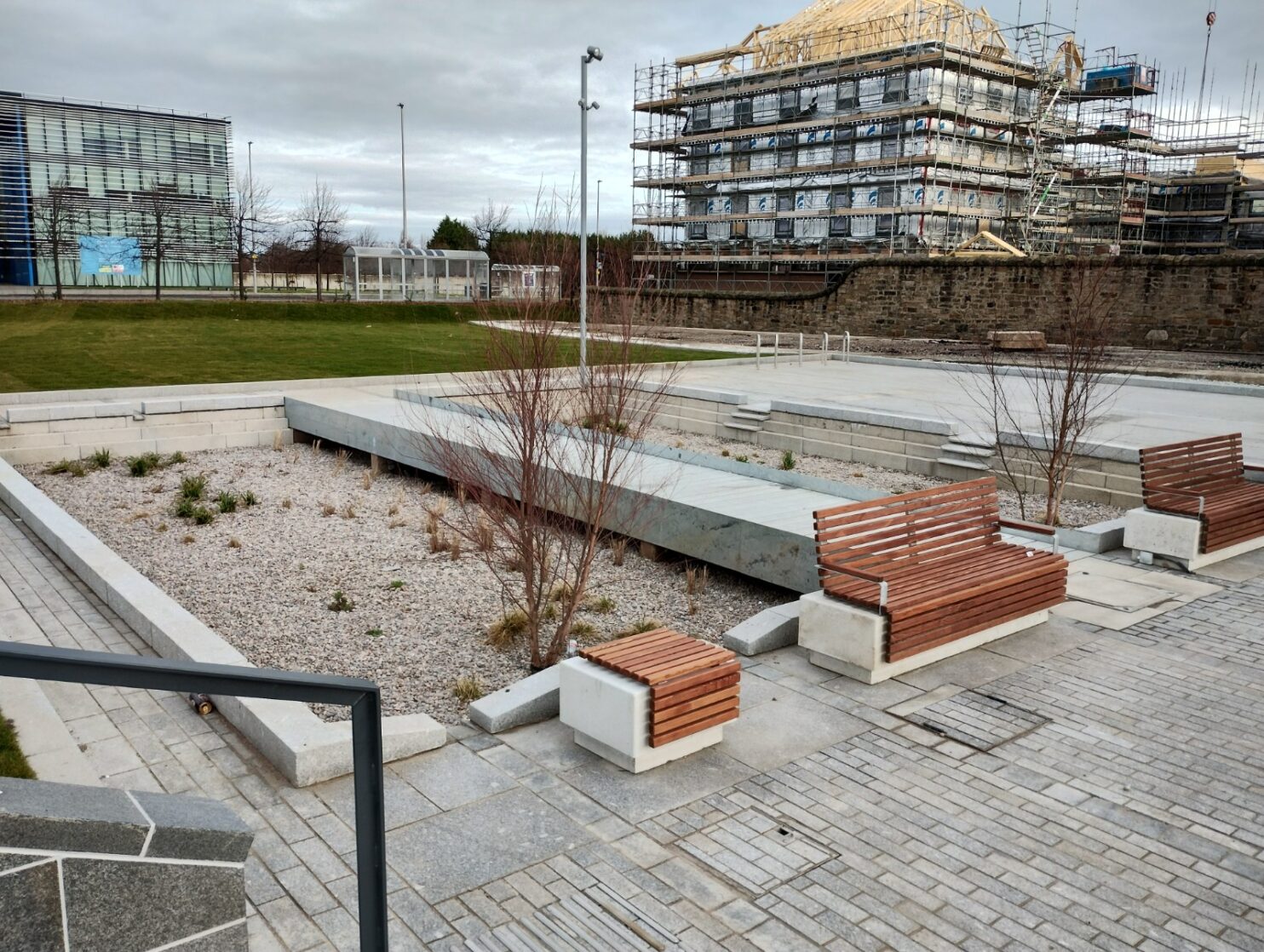
Image: Rain garden at the former Granton Gasworks railway station, Edinburgh. Photograph: McPhail, Wikimedia Commons, CC0.